
21.08.2026
Europe’s newest eye on the health of Earth’s vegetation has taken another crucial step towards orbit – the European Space Agency’s FLEX satellite has been fuelled at Europe’s Spaceport in French Guiana ahead of its planned launch on 15 September at 03:21 CEST (14 September at 22:21 local time).
Once launched and commissioned, this latest ESA Earth Explorer research satellite, equipped with its Fluorescence Imaging Spectrometer, will provide new insights into the health of the world’s plants by measuring the faint glow of fluorescence emitted as they capture light for photosynthesis.
This signal, invisible to the naked eye, varies with environmental conditions and plant health, enabling scientists to detect vegetation stress before it becomes apparent on the ground.
FLEX will deliver the first global maps of vegetation fluorescence at a spatial resolution of 300 m × 300 m, providing a new way to assess photosynthetic activity. These data will improve understanding of how carbon moves between plants and the atmosphere, and how photosynthesis drives the carbon and water cycles.

FLEX brings plant health into focus
The stakes are high. Photosynthesis is one of the planet’s most important natural processes, underpinning food production and absorbing huge quantities of carbon dioxide from the atmosphere. Yet scientists still have significant gaps in their understanding of how vegetation responds to drought, heat, changing rainfall and other environmental stresses.
FLEX is intended to help close that gap.
The FLEX satellite arrived in French Guiana in mid-July, together with the Copernicus Sentinel-3Csatellite, after a two-week voyage by sea from Nice, France. At Europe’s Spaceport, engineers have been carrying out inspections and preparations to ready both satellites for liftoff aboard a Vega-C rocket in the early hours of 15 September.

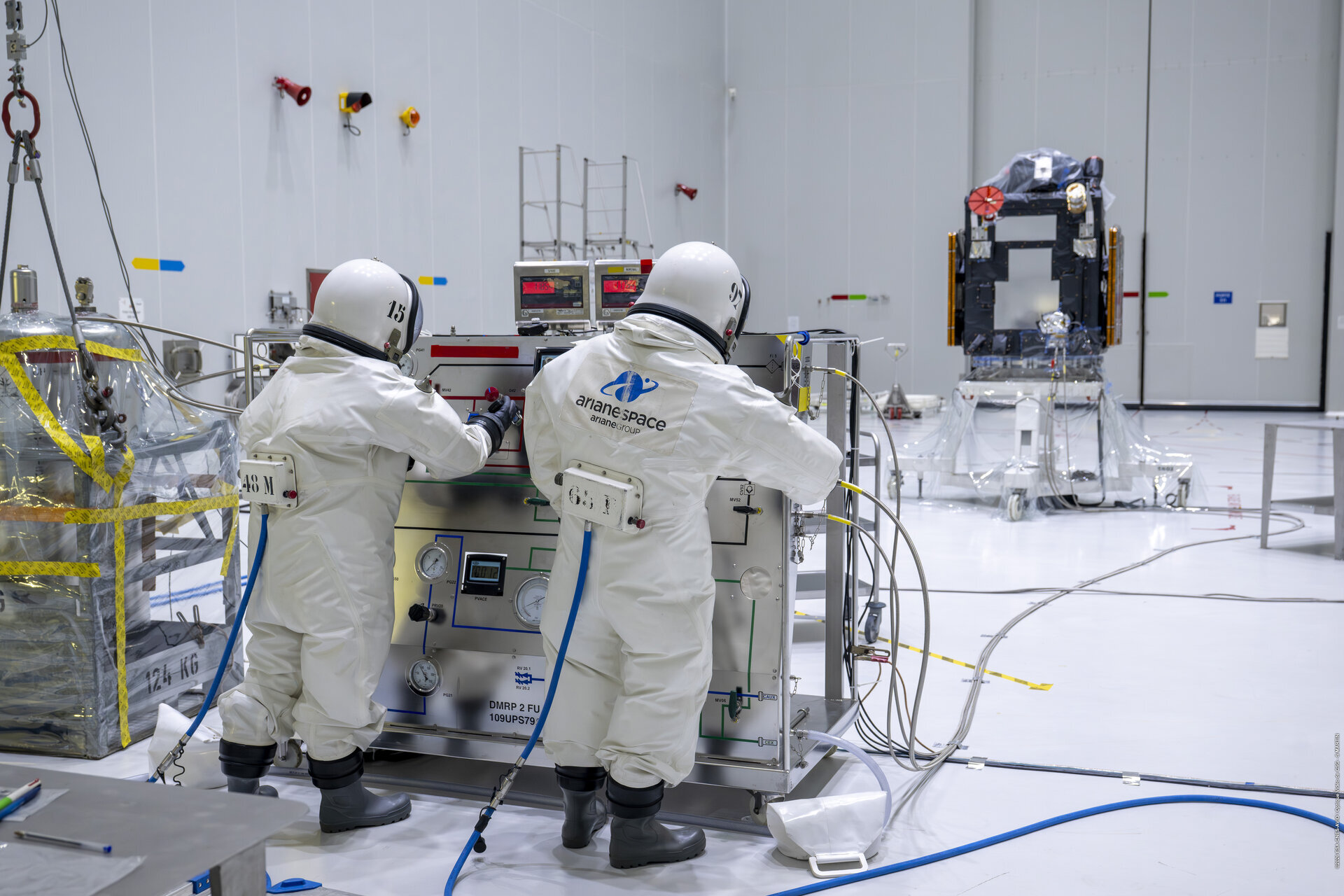
For FLEX, the latest milestone was the hazardous and delicate process of loading the satellite with 30 kg of highly volatile fuel. This propellant will allow FLEX to perform manoeuvres after separation from the rocket and throughout its planned minimum 3.5-year mission, during which it will observe at least three seasonal vegetation cycles in both the northern and southern hemispheres.
Fuelling is an extremely hazardous operation and takes place under strict safety procedures, carried out by a highly specialised team.
Frank de Bruin, ESA’s Launch Campaign Manager for FLEX, said, “Preparations to ready our satellite for launch have been going very well here at Europe’s Spaceport and I thank everyone involved. For fuelling, everyone apart from the fuelling experts left the cleanroom for safety reasons. Everything went according to plan and FLEX is now fully loaded. The next steps involve installing FLEX on its launcher adapter before encapsulating it into lower position of the Vega-C rocket fairing.”

Although FLEX and Sentinel-3C will be launched together, FLEX will initially fly in tandem with the Sentinel-3A satellite. This will provide complementary measurements of clouds, aerosols and water vapour, alongside information about the land surface, including surface temperature, land-cover type and additional vegetation parameters. Together, these near-simultaneous observations will provide an unprecedented view of the function and condition of vegetation across the globe.

Access the video
A team of teams like never before: rehearsing a unique launch at ESA mission control
On 15 September, two spacecraft will leave Earth together aboard the same launcher from Europe’s spaceport in Kourou: FLEX, ESA’s photosynthesis mission, and Sentinel-3C, Copernicus’ newest satellite monitoring Earth’s oceans, land, ice and atmosphere.
At ESA’s European Space Operations Centre (ESOC), two independent mission teams are preparing to operate the spacecraft in parallel in a closely coordinated effort. As launch approaches, they are rehearsing side by side to prepare not only for their own missions, but also for the moments when the two operations intersect.
Preparing a spacecraft for its first days in orbit requires a large team of spacecraft operations engineers, flight dynamics specialists, ground operators, software experts and project teams, which have supported the design, production and testing of the satellite. This team is supported by control rooms, ground stations and communications networks.
For the launch of FLEX and Sentinel-3C, ESA is preparing all of this for two missions at once.

Once in space, FLEX and Sentinel-3C will operate in closely related orbits, creating additional operational considerations during launch and early operations.
“Launching two satellites is not the difficult part. We’ve done similar things before, such as ESA’s Herschel and Planck missions in 2009, but those were managed by a combined team,” says Franco Marchese, ESA’s Flight Operations Director for the Sentinel-3C launch and early orbit phase (LEOP). “What makes this launch different is that we have two teams operating in parallel and that the satellites fly in basically the same orbit. That’s the real challenge.”
“ESOC is one of the few mission control centres in the world that can do that,” he adds.
A team of teams

Every launch campaign relies on a "team of teams" consisting of specialists across many disciplines working as one operational community.
Libe Jauregui, ESA’s Flight Dynamics Manager for Sentinel-3C, captures the feeling: “During a LEOP, everyone is trying to meet a common goal. You really feel it.”
For Sentinel-3C and FLEX, however, two complete mission teams are preparing to operate side by side. Each has its own flight control team, ground stations operations team, flight dynamics team and project teams focused on their respective spacecraft.
While the teams of the two missions prepare and operate independently, their work intersects at key points. Some resources and support teams are shared, while certain activities require close coordination between the two missions.

This means preparing not only for the needs of each individual mission, but also for situations in which both teams may need to act, respond or access shared resources at the same time.
“Although the mission control teams remain separate, some activities are carried out jointly, such as shared processes and documentation,” says Pablo Asenjo Garcia, Ground Operations Manager for Sentinel-3C at ESA. “Each team still has to validate its own procedures, but there are clear synergies that enhance collaboration at ESOC. We can train together, share support teams and learn from each other throughout the preparation process.”
These points of connection are at the heart of the joint simulation exercises.
Simulations: living launch day before the launch

Long before a spacecraft reaches the launch pad, mission teams prepare for LEOP through a simulation campaign: a series of highly realistic rehearsals that allow the team of teams to practise responding to both routine and unexpected situations.
The rehearsals often run for days at a time – just as LEOPs do. Teams practise nominal and contingency scenarios, including spacecraft anomalies, orbit determination issues, ground segment failures and other operational surprises. Behind the scenes, ESA’s specialised simulation officers design and run these exercises, monitoring multiple voice loops, introducing simulated failures and adapting events in real time as teams respond.
But simulations are about more than testing systems and procedures.
“Simulations are not just about the technical side of things,” says Emilie Brannan, a Simulation Officer for Sentinel-3C at ESA. “There’s also a human side to it.”
They give teams the opportunity to practise communicating, making decisions under pressure and coordinating across disciplines before doing so with real spacecraft in orbit.

Twice the spacecraft, twice the challenge

While most simulations are conducted separately, the joint exercises concentrate on something more unusual: situations that could affect both missions at the same time.
“Teams have to remember that whatever happens to their spacecraft may have implications for the other mission,” explains ESA FLEX Simulation Officer Gustavo Baldo Carvalho. “What happens if they suddenly need the same resource at the same time? Those are exactly the kinds of situations we challenge teams to think through during the simulations.”
Simulation planners rehearse the nominal launch sequence, including the two spacecraft separations, a staggered acquisition-of-signal timeline and the collaboration required as both spacecraft enter closely related orbits. This phase requires particularly close coordination between the flight operations directors and flight dynamics teams, who exchange orbit information and refine trajectory predictions as the launch unfolds.
Of course, the teams also rehearse contingency scenarios.
During one dual-mission exercise, an unexpected launcher injection resulted in orbital parameters that differed from pre-launch calculations. While teams worked to determine the satellites' positions and assess potential proximity risks, additional spacecraft anomalies were introduced, pushing both control rooms to full capacity. Later in the simulation, a fire drill added another layer of complexity, requiring the teams to adapt while maintaining operations.
“This ‘big contingency’ simulation put a lot of strain on the teams, but it’s great to push our limits and be ready for whatever comes our way,” says Pere Ramos Bosch, ESA’s Flight Dynamics Manager for FLEX.
A team of teams – times two
The Sentinel-3C and FLEX launch campaign may appear to be simply two spacecraft sharing a ride into space.
Inside ESOC, however, the picture looks different.

The missions remain operationally independent but preparing them side by side creates opportunities to share experience, solve common problems and strengthen the connections between teams.
“Often, individuals from both teams are working together to solve a shared problem,” explains Pere. “The team feeling is enhanced because we are in the same place. The person you need to speak to is often literally down the hall.”
“When everyone is training together, it’s a community feeling,” adds Emilie.
On 15 September, Sentinel-3C and FLEX will leave Earth together before beginning their separate missions in orbit.
At ESOC, the challenge is not simply to prepare two spacecraft for their first days in space. It is to prepare two independent mission teams to operate side by side – coordinating in synergy whenever their paths, resources or decisions intersect.
Access the video
FLEX and Sentinel-3C launched
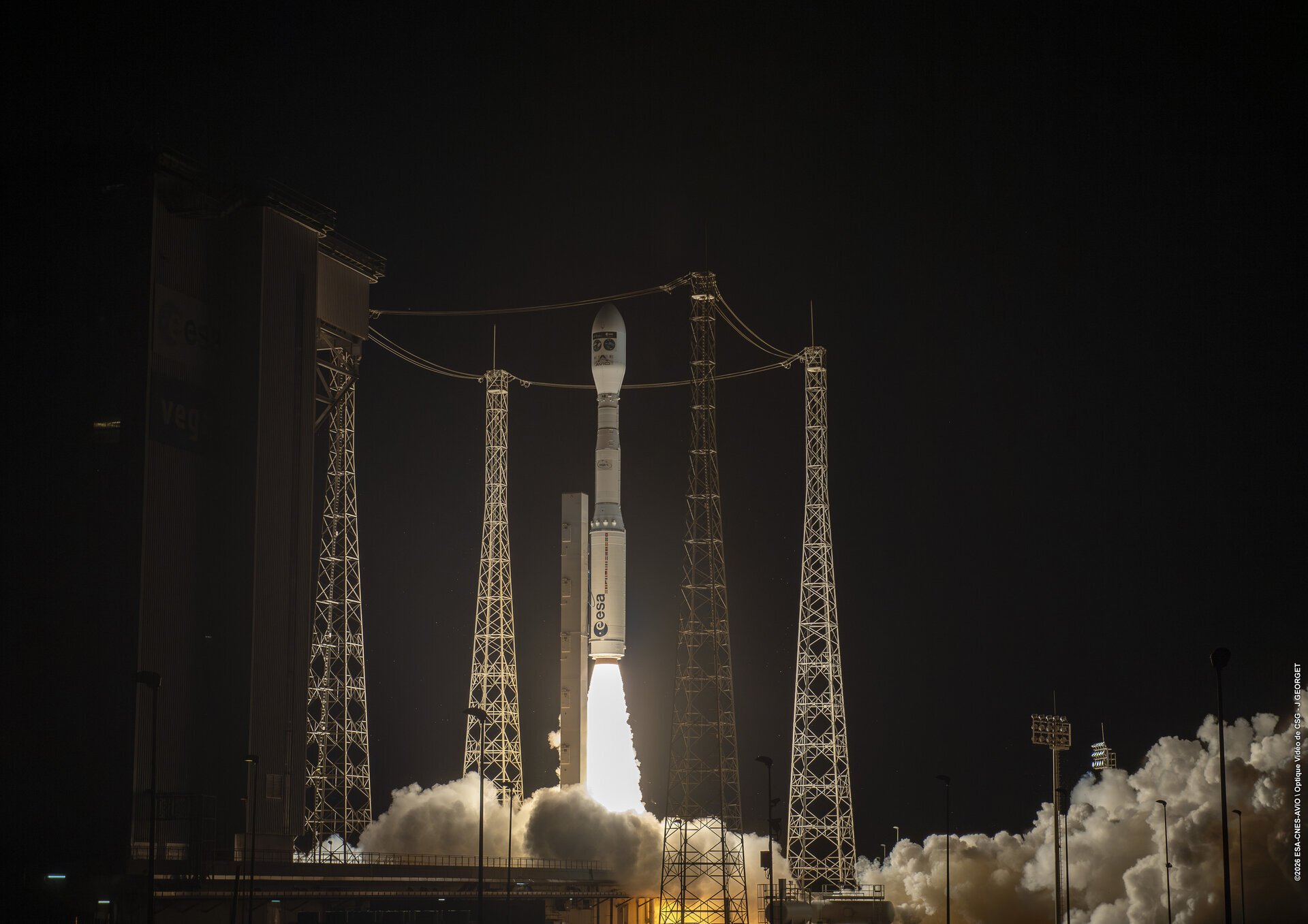
The European Space Agency’s FLEX Earth Explorer satellite and the Copernicus Sentinel-3C satellite have been launched together aboard a Vega-C rocket from Europe’s Spaceport in French Guiana, marking a new milestone in Europe’s Earth Observation Programmes.
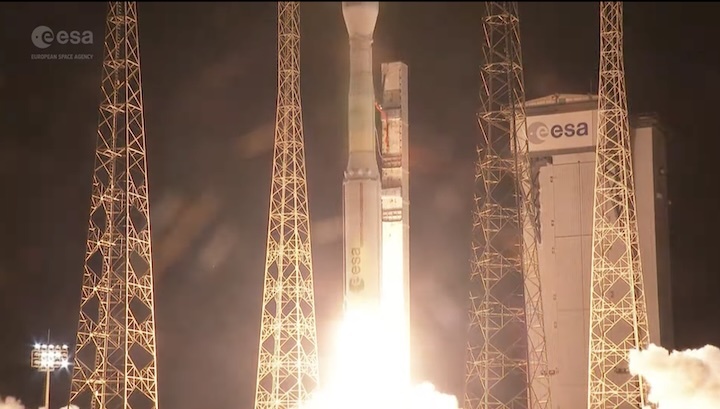
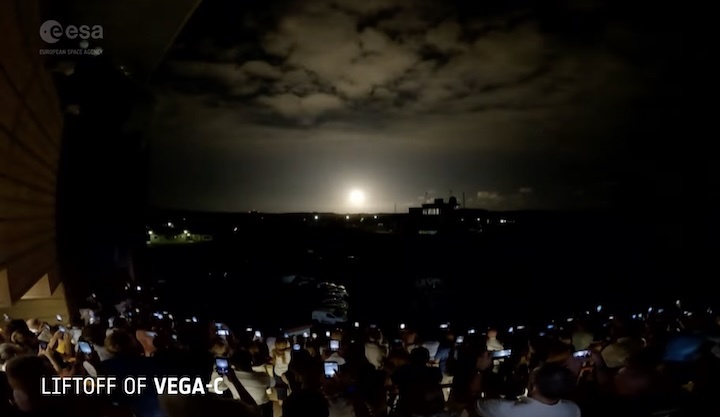
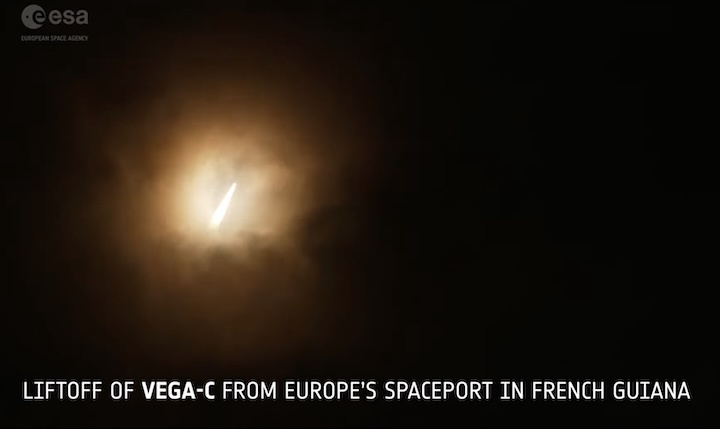
Flight VV30 lifted off on 15 September at 03:21 (14 September at 22:21 local time).
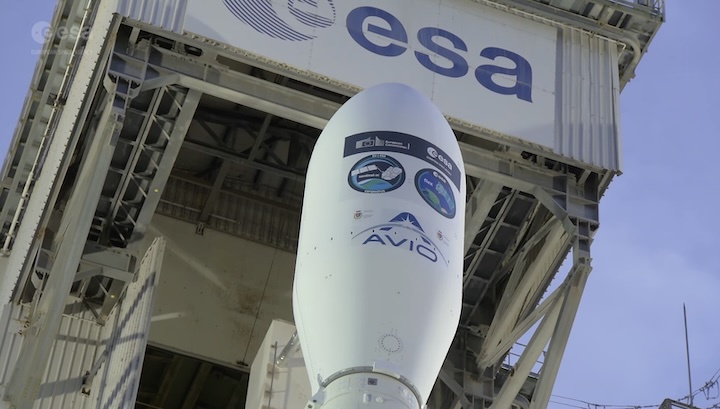
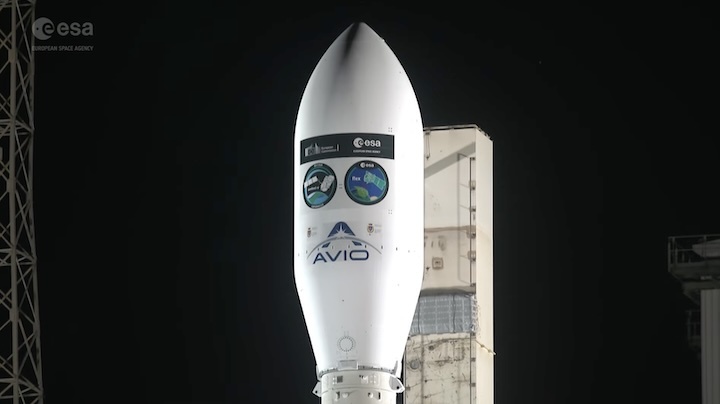
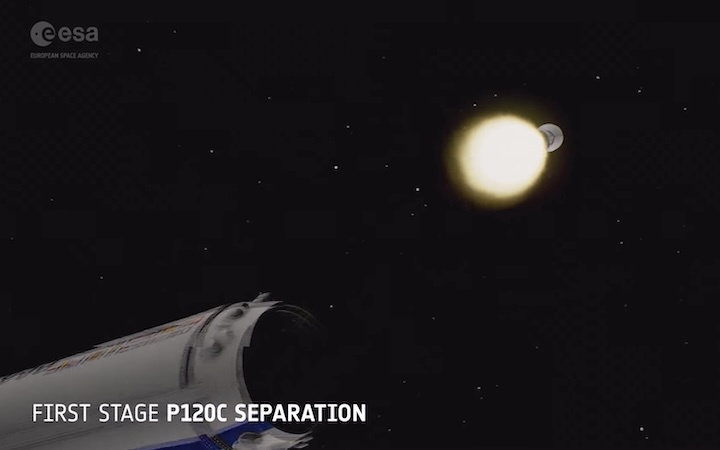
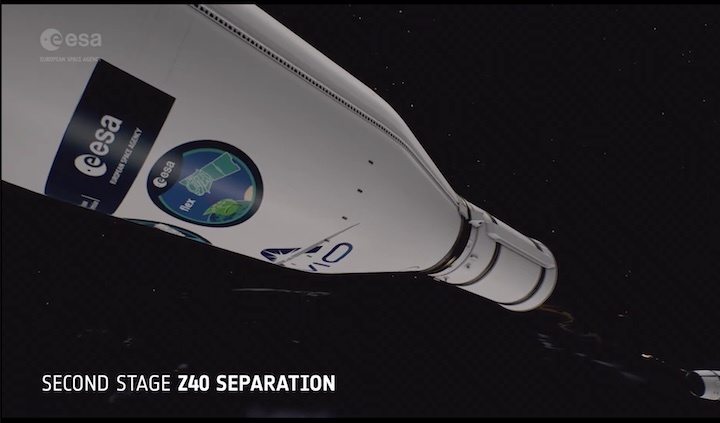
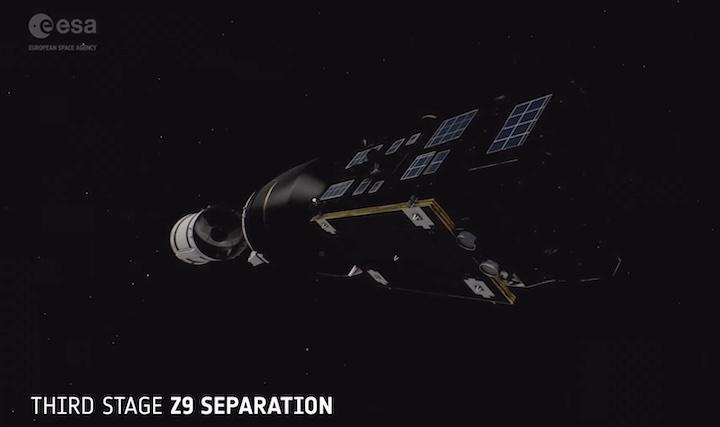
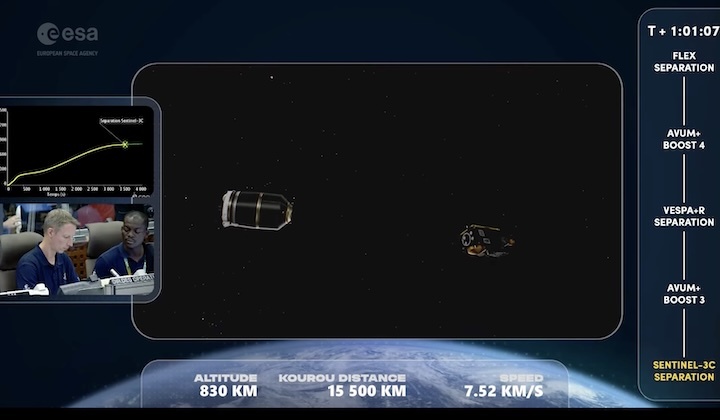
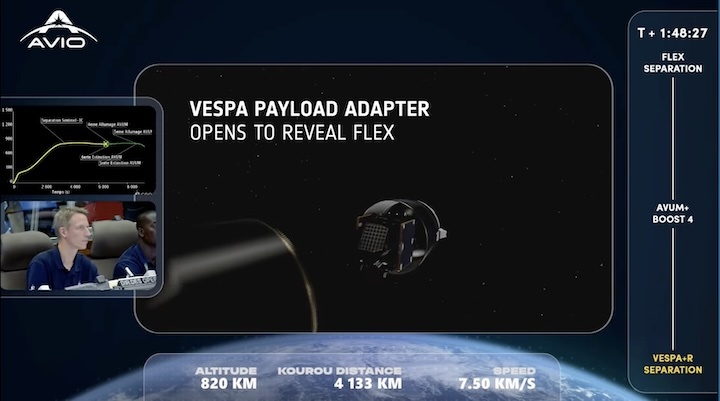
A launch adapter called Vespa allowed both satellites to be stacked inside the Vega-C fairing for launch. Positioned on top of Vespa, Sentinel-3C was injected into orbit first, followed by FLEX approximately one hour later.

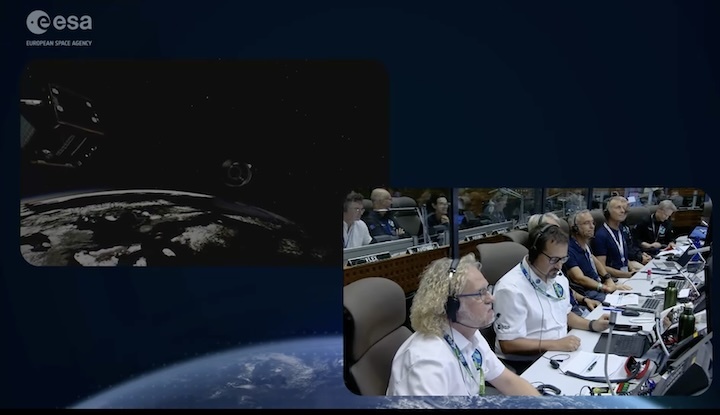
Following the satellites’ separate deployments, ESA’s European Space Operations Centre in Germany received the all-important first signal from each satellite, confirming that both had been safely released from the rocket and had established contact with ground control.
Mission controllers will now spend the coming days conducting the ‘launch and early orbit phase’, meticulously checking and verifying the health and performance of both satellites and confirming that all systems are functioning as expected.

ESA’s Director of Earth Observation Programmes, Simonetta Cheli, said, “Today’s launch is the culmination of years of scientific innovation, engineering excellence and international cooperation.
“Developed within ESA’s FutureEO programme, FLEX is a research mission that will advance our understanding of plant health and the role of photosynthesis in the carbon and water cycles. Sentinel-3C is the third satellite in the Sentinel-3 series, systematically measuring Earth’s oceans, land, ice and atmosphere to support Europe’s Copernicus Services.
“Preparing and launching two satellites together is no easy task. My thanks go to the many experts who have contributed throughout both satellites’ development, testing and preparation for launch, and who have worked tirelessly to ensure that both satellites have reached orbit safely.”
FLEX to reveal the hidden activity of Earth’s vegetation
FLEX, the latest Earth Explorer mission, is ESA’s first satellite designed specifically to measure photosynthetic activity from space. Its Fluorescence Imaging Spectrometer will detect the extremely faint fluorescence emitted by plants as they absorb sunlight during photosynthesis.
This signal, invisible to the human eye, provides a direct indication of how efficiently vegetation is converting sunlight and carbon dioxide into energy. FLEX measurements will help scientists assess plant health, ecosystem productivity and the effects of environmental stress and climate change.
Sentinel-3C strengthens Europe’s environmental monitoring
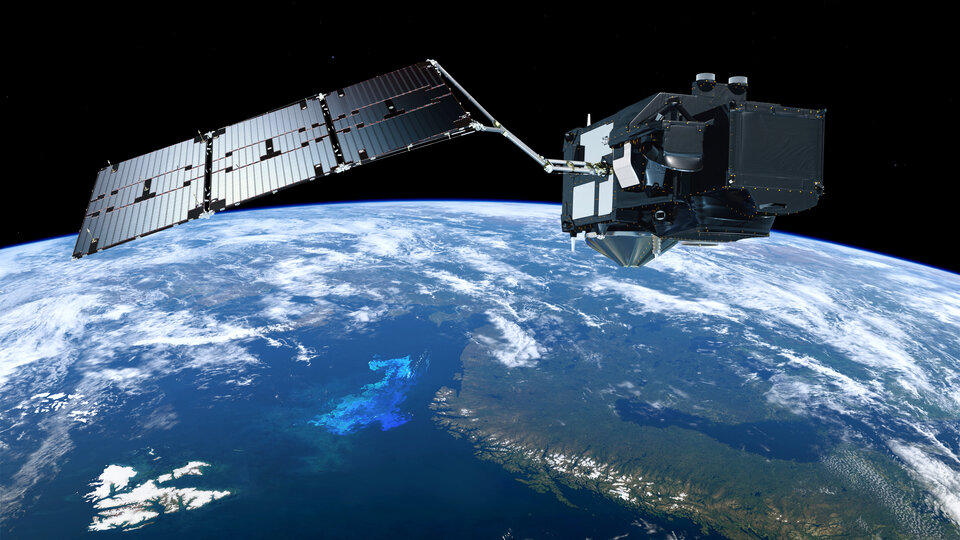
Copernicus Sentinel-3C is the third satellite in the Sentinel-3 series and will continue the long-term collection of essential environmental data.
Its suite of instruments will systematically observe the oceans, land, ice and atmosphere, measuring parameters including ocean and land-surface temperatures, ocean colour, sea and ice conditions, vegetation and inland-water levels. The mission will provide near-realtime information supporting ocean forecasting, climate monitoring, environmental management and scientific research.
Sentinel-3C is part of Copernicus – the Earth observation component of the EU’s Space programme. For the Sentinel-3 satellites, ESA is responsible for the development. After the commissioning phase, the Sentinel-3 mission is jointly managed by ESA and Eumetsat, where Eumetsat is responsible for routine spacecraft operations and the delivery of marine and near-realtime atmospheric data, while ESA delivers land, cryosphere, inland water and offline atmospheric products. Together, the two agencies provide mission data and services to users worldwide.
A shared journey into orbit

FLEX and Sentinel-3C were launched on Vega-C flight VV30, demonstrating the launcher’s ability to place two Earth observation missions into their different required orbits. FLEX was encased within the Vespa secondary launch adapter, with Sentinel-3C on top.
An evolution of Europe’s Vega family of rockets, Vega-C can launch 2300 kg into low-Earth orbit. It weighs 210 tonnes on the launch pad and reaches orbit with three solid-propellant-powered stages before the fourth liquid-propellant stage takes over for precise placement of satellites into their desired orbit around Earth.
ESA leads the Vega-C programme, working with Avio as prime contractor and design authority. For this launch, Avio was also the launch service operator.
Looking ahead

The two satellites have travelled a long road from development and integration through final testing and preparation for liftoff at Europe’s Spaceport.
Their successful deployment into orbit around Earth now begins the next phase – where teams at ESA’s European Space Operations Centre will commission the satellites and their instruments to ready them for their duties in orbit.
Once fully operational, Eumetsat will assume responsibility for operating the Sentinel-3C satellite, while FLEX remains under ESA’s control. However, some orbital gymnastics will be performed as, initially, FLEX will orbit in tandem with Sentinel-3A, and then later Sentinel-3C will be moved to replace Sentinel-3A in this tandem formation.
In tandem

This tandem arrangement benefits FLEX, allowing its measurements of the faint fluorescence emitted by vegetation to be combined with near-simultaneous observations from Sentinel-3.
Sentinel-3 provides complementary information on the atmosphere – including clouds, aerosols and water vapour – as well as the land surface, including surface temperature, land-cover type and additional vegetation parameters. Bringing these measurements together with FLEX’s observations will give scientists an unprecedented view of the health and functioning of vegetation around the world.
Quelle: ESA