
7.10.2026
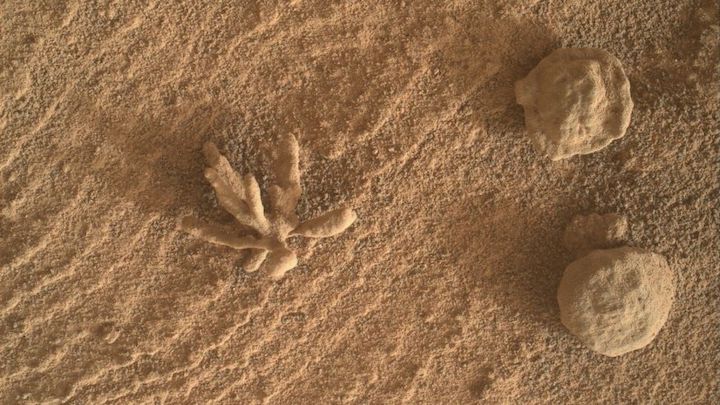
Curiosity NASA
Researchers have developed a new method that could be used to distinguish between amino acids produced by extraterrestrial life, as opposed to non-organic processes.
The electrical technique is detailed in a paper published in Nature Communications.
Amino acids are the building blocks of proteins. The basic chemical formula of amino acids remains unchanged, but each one comes in 2 mirror image forms called L- and D-forms.
In living organisms, amino acids are exclusively found in the L-form (also called left-handed). Sugars have D-form (or right-handed) amino acids).
Chemical and physical processes that have nothing to do with life produce L- and D-form amino acids in equal abundance.
So, this property, called chirality of amino acids, is a potential signature of biology.
The latest research avoids the problems of conventional methods that are sensitive to vibrations of large groups of molecules and also do not require the use of destructive chemical reagents.
Instead, the team from Japan’s University of Osaka harnessed developments in nanotechnology to target single molecules.
They measured the electrical properties of molecules through a gap between 2 gold nanowires which generates an electrical tunnelling current.
“By combining our nanogap tunneling technique with artificial intelligence, we were able to distinguish between the L- and D-forms of amino acids with over 80% accuracy,” says lead author Takahito Oshiro.
“This is the first discrimination of amino-acid chirality at the single-molecule level and constitutes a fundamental advance in chemical sensing.”
The team tested whether the method could be used to identify the chirality of amino acids in complex mixtures.
“We analysed natural samples from the Murchison meteorite in Australia and soil samples from the Atacama Desert in Chile,” says senior author Masateru Taniguchi.
“Our method was comparable to traditional methods, as both were capable of capturing the major features of amino acid composition.”
The team hopes their technique can be developed into a compact instrument to be carried on board future science missions searching for extraterrestrial life.
Quelle: CONNECTSCI