
5.07.2026
The oldest known image of the cosmos is a Bronze Age disc of bronze and gold, dug from a German hilltop by looters and recovered three years later in a Swiss police sting
The oldest known image of the cosmos is not painted or carved. It is cast in metal.
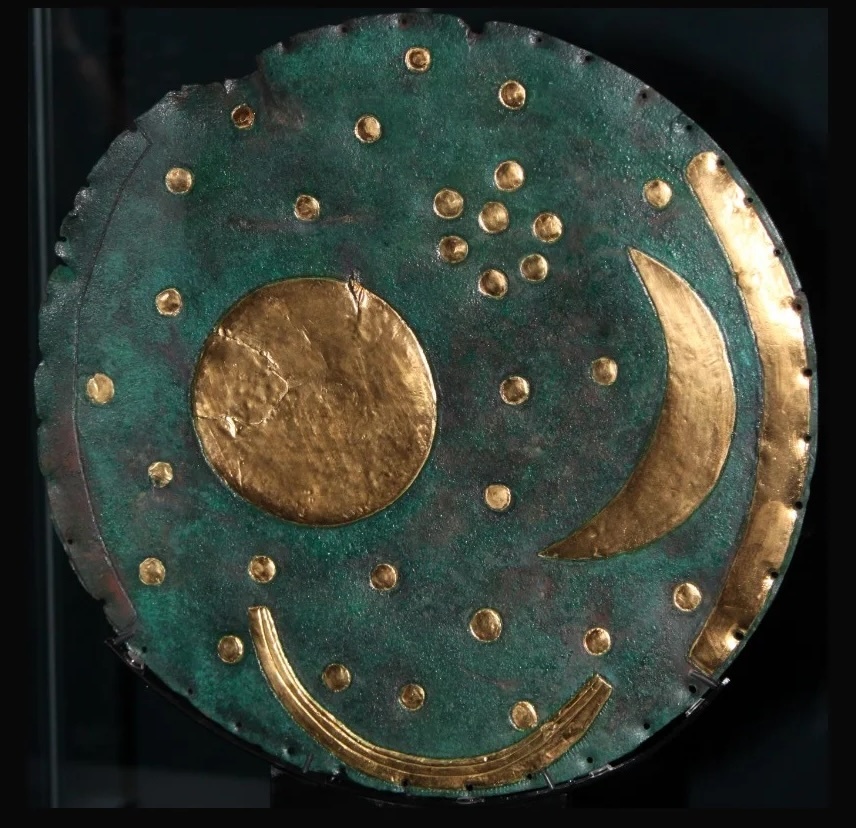
The oldest known image of the cosmos is not painted or carved. It is cast in metal. It is a disc about the size of a large dinner plate, roughly 32 centimetres across, its dark green face inlaid with gold: a full circle, a crescent, and a scatter of small gold dots. A team of researchers led by the archaeometallurgist Ernst Pernicka describes it as the world’s earliest known concrete representation of astronomical phenomena.
The object is called the Nebra sky disc, after the town in central Germany near where it was found. If the mainstream reading is right, someone hammered and inlaid it around 1600 BC, in the Early Bronze Age, more than a thousand years before Greek astronomers began mapping the heavens on paper. That would make it the oldest surviving picture in the world that sets out to show the actual sky rather than gods or symbols. It is that claim, and the strange path the disc took to reach a museum case, that keep it in the news.
What the bronze actually shows
The disc reads, at a glance, like a night scene. A large gold circle sits near the centre, taken to be either the full moon or the sun. Beside it curves a clear crescent moon. Around them are thirty-two gold dots standing in for stars, and one detail draws the most attention: a tight little cluster of seven, which many researchers read as the Pleiades, the small knot of stars in Taurus that rises and sets with the farming year across the northern hemisphere.
Two more features were added later, because the disc was reworked more than once. Along the rim sit two arcs, and in the accepted interpretation each spans the angle between the points where the sun rises and sets over the course of a year, as seen from that latitude in central Germany. A third addition runs along the bottom edge, a curved shape usually described as a boat or a sun ship. The reworking matters. It suggests the disc was not a single sketch of the sky but an object in use over time, adjusted as its owners’ understanding or purpose changed.
Read this way, the disc is less a star map than a working almanac. The arcs would mark the swing of the sun between the solstices. The cluster of seven would flag the season. The combination hints at a Bronze Age community tracking the year closely enough to reconcile the solar and lunar calendars, the kind of bookkeeping that decides when to plant and when to hold a festival.
How it came out of the ground
The disc did not surface through careful excavation. In the summer of 1999 two treasure hunters working with a metal detector dug it out of the Mittelberg, a wooded hill in Saxony-Anhalt, together with two bronze swords, two axes, two arm spirals and a chisel. None of it went to a museum. The finders sold the hoard, and over the next two years the disc passed through several hands on the black market, its price climbing as its fame spread underground.
It was recovered in a police operation. In 2002 investigators arranged to meet sellers offering the disc in Basel, Switzerland, and seized it in the sting. The looters and a dealer were later prosecuted, and their courtroom account of where and how the hoard came out of the ground became part of the evidence archaeologists would lean on. The disc now sits in the State Museum of Prehistory in Halle, and in 2013 it was added to UNESCO’s Memory of the World register.
That history is also the disc’s central weakness. Because it was torn from its resting place by looters rather than lifted by archaeologists, no one recorded the soil layers around it, the single most reliable way to date a buried object. Everything about its age has had to be reconstructed after the fact.
How the date is pieced together
There is no method that dates a lump of bronze directly. So the case for 1600 BC is built sideways, from the things buried with the disc and the ground it lay in. Organic remains on one of the swords gave a radiocarbon date of around 1600 BC. The copper in the disc and in the accompanying metalwork traces, through its trace elements and lead isotopes, to a single ore source in the eastern Alps, in the Salzburg region of Austria, worked in the Early Bronze Age. The gold of the inlays traces to Cornwall.
Pernicka’s team argues that these threads tie the disc to its companions and to a Bronze Age date, and that soil clinging to the disc matches sediment from the Mittelberg. On this reading the hoard is a genuine closed find, buried as a set, and the disc belongs with the swords that can be dated. It is painstaking, indirect work, and its authors present it as the best available reconstruction rather than a reading taken straight off the object.
A contested age, and a contested picture
Two of the disc’s headline claims are actively disputed, and both bear on whether it is really the oldest image of the sky.
The larger challenge came in 2020, when the archaeologists Rupert Gebhard and Rüdiger Krause published a critical reassessment arguing that the disc need not be Bronze Age at all. Their case rests on the same looted provenance that troubles everyone. The finders’ story of where the disc lay, they note, did not stay consistent, and the depth they described does not sit easily with the Bronze Age layers at the site. If the disc was not truly part of the buried hoard, then it cannot borrow the swords’ date, and on stylistic grounds Gebhard and Krause argue it belongs to the first millennium BC, in the Iron Age rather than the Bronze Age. That would make it roughly a thousand years younger. If they are right, the disc is still a remarkable object, but not the oldest depiction of the cosmos.
Pernicka’s team rejected the argument in detail, holding that the court testimony, the sediment matches and the metal analyses together fix the disc to the hoard and the hoard to the Bronze Age. Most specialists have sided with the earlier date. But the disagreement is real, it turns on evidence that looting destroyed, and no test yet settles it outright.
The second dispute is about meaning. Even granting the early date, calling the disc a map of the sky is an interpretation, not a reading printed on the metal. Gebhard has questioned whether the arrangement of dots depicts real stars at all, or whether it is a freer, symbolic image of the heavens. The Pleiades identification is a strong inference, not a caption. The arcs, the sun ship, the calendar function: each is a careful argument built on the object, and each could be wrong without making the disc any less old.
Even the disc’s critics grant that it is a deliberate image of celestial things, a sun or moon, a crescent and points of gold, made by a European culture that had no writing. What they contest is narrower: its exact age, and whether it maps the real sky or renders it more freely.
The disc itself gives none of this away. In its case in Halle it reads as calmly as it must have three and a half thousand years ago, or however long it has been: a dark circle of metal, a gold moon, a handful of gold stars, holding its argument in place and letting everyone else supply the words.
Quelle: SD