
29.06.2026
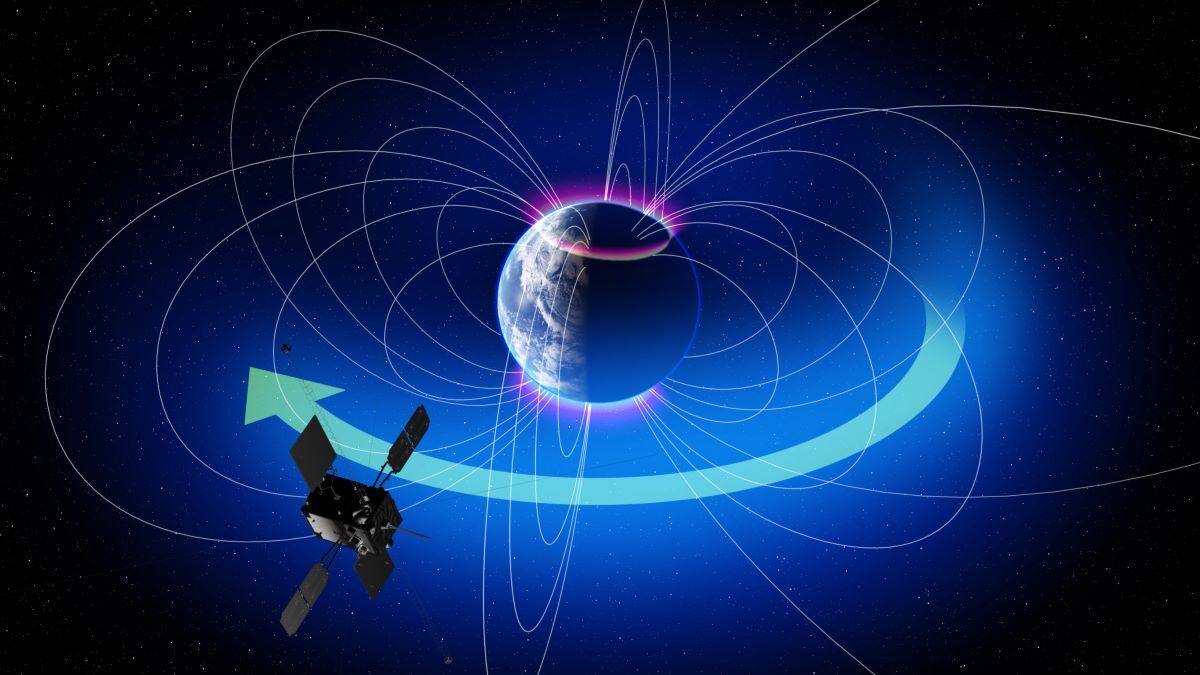
An illustration showing the Arase satellite observing ring current ions during the super geomagnetic storm. Credit: ERG Science Team
Scientists studying the magnetosphere which surrounds the Earth believe they have uncovered the processes behind the largest geomagnetic storm in more than 20 years.
In May 2024, auroras were seen at unusually low latitudes.
Over the Mother’s Day weekend of May 10–11, aurora borealis was visible as far south as Caribbean islands, Mexico’s Yucatán Peninsula and Hawai‘i (latitude of about 20°N). Aurora australis was seen across Australia as far north as Queensland’s Mackay region sitting on 21°S.
The so-called “Mother’s Day Storm” was caused by an historic geomagnetic storm which ranks as a G5 strength, or “Extreme” – the highest on the G-scale used by the US-based National Oceanic and Atmospheric Administration (NOAA) to measure geomagnetic events.
Powerful geomagnetic storms can disrupt power grids, satellite communications and navigation.
It is the second-strongest geomagnetic storm recorded since 1981. The last comparable geomagnetic storm was the November 2004 superstorm.
The 2024 storm, however, is the largest ever recorded in the Earth’s ring current region – a belt of charged particles around our planet.
There are 2 sources of charged ions in the ring current: solar wind and the electrically-charged upper layer of the atmosphere called the ionosphere. Scientists have debated how much each contribute.
During most storms, both sources contribute. During storms driven by intense solar wind, however, the Earth-based ions dominate. The level of this dominance has never been directly observed until now.
The May 2024 G5 storm was driven by solar ejections from the massive sunspot AR3664.
Powerful solar eruptions from the sunspot impacted Earth’s magnetosphere, the region of space around the planet dominated by its magnetic field.
Results published in Science Advances based on observations from the 2024 storm suggest that understanding the ionosphere contributions to the rung current could help predict the severity of future super geomagnetic storms.
The team used data from Japan’s Arase satellite which was launched in 2016.
“This is the first simultaneous observation of ring current ions and solar wind during a storm this large, and the data was clear – approximately 85% of ions were oxygen from Earth's own ionosphere,” explains lead authorNaritoshi Kitamura from Japan’s Nagoya University.
“Near the peak of the storm, Arase detected a 40% decrease in magnetic field intensity at roughly 16,000km above Earth and much closer to Earth than similar large decreases previously documented.”
The same region also showed a drop in high-energy electrons that normally orbit Earth. When a magnetic field weakens this much, electrons drift out from their normal paths.
The team say the possible effect of magnetic field deformation on the electron loss also warrants further investigation.
Quelle: CONNECTSCI