
16.09.2020
Japan's Hayabusa2 space explorer will aim to probe the asteroid "1998KY26" located between the orbits of Earth and Mars in 2031 after completing its current mission of collecting samples from another asteroid, the country's science minister said Tuesday.
It is hoped Hayabusa2 will approach the ball-shaped asteroid, which has a diameter of around 30 meters and rotates about every 10 minutes, in July 2031, Education, Culture, Sports, Science and Technology Minister Koichi Hagiuda said.
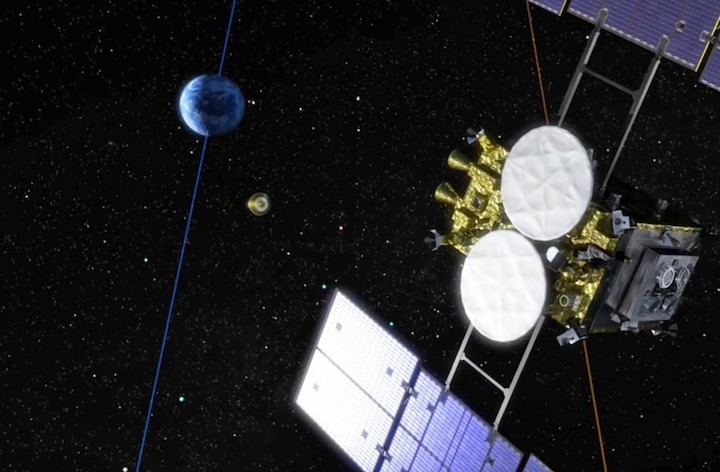
The probe is expected to observe the spinning asteroid by camera without landing on it, according to the Japan Aerospace Exploration Agency.
Since "1998KY26" is assumed to be a carbon-rich asteroid similar to Ryugu, which Hayabusa2 probed on its current mission, comparing observed data between the two may lead to a new discovery.
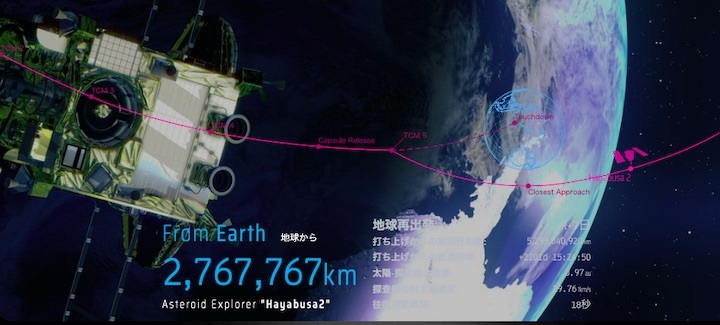
Hayabusa2, which was launched on a rocket in December 2014, is scheduled to return to the vicinity of Earth in early December and drop a capsule containing the samples of Ryugu before embarking on the new mission. The capsule is expected to land in southern Australia.
JAXA had also studied the asteroid "2001AV43," which is orbiting the sun in between Earth and Mars, as a potential target for Hayabusa2's next mission.
Quelle: Kyodo News
----
Update: 12.12.2020
.
Quelle: JAXA
----
Update: 20.09.2025
.
Can Hayabusa2 touchdown? New study reveals space mission’s target asteroid is tinier and faster than thought
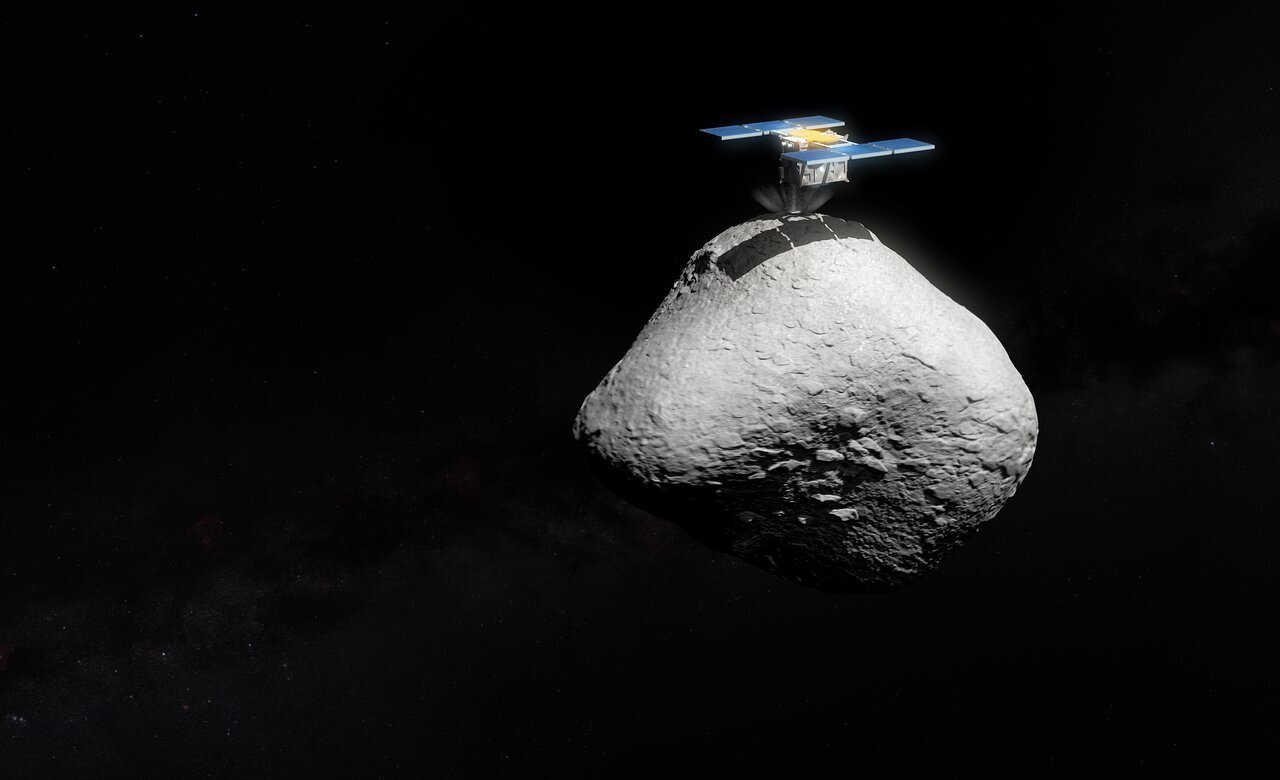
Astronomers have used observatories around the world, including the European Southern Observatory's Very Large Telescope (ESO’s VLT), to study the asteroid 1998 KY26, revealing it to be almost three times smaller and spinning much faster than previously thought. The asteroid is the 2031 target for Japan’s Hayabusa2 extended mission. The new observations offer key information for the mission’s operations at the asteroid, just six years out from the spacecraft’s encounter with 1998 KY26.
“We found that the reality of the object is completely different from what it was previously described as,” says astronomer Toni Santana-Ros, a researcher from the University of Alicante, Spain, who led a study on 1998 KY26 published today in Nature Communications. The new observations, combined with previous radar data, have revealed that the asteroid is just 11 metres wide, meaning it could easily fit inside the dome of the VLT unit telescope used to observe it. It is also spinning about twice as fast as previously thought: “One day on this asteroid lasts only five minutes!" he says. Previous data indicated that the asteroid was around 30 metres in diameter and completed a rotation in 10 minutes or so.
"The smaller size and faster rotation now measured will make Hayabusa2’s visit even more interesting, but also even more challenging,” says co-author Olivier Hainaut, an astronomer at ESO in Germany. This is because a touchdown manoeuvre, where the spacecraft ‘kisses’ the asteroid, will be more difficult to perform than anticipated.
1998 KY26 is set to be the final target asteroid for the Japanese Aerospace eXploration Agency (JAXA)'s Hayabusa2 spacecraft. In its original mission, Hayabusa2 explored the 900-metre-diameter asteroid 162173 Ryugu in 2018, returning asteroid samples to Earth in 2020. With fuel remaining, the spacecraft was sent on an extended mission until 2031, when it’s set to encounter 1998 KY26, aiming to learn more about the smallest asteroids. This will be the first time a space mission encounters a tiny asteroid — all previous missions visited asteroids with diameters in the hundreds or even thousands of metres.
Santana-Ros and his team observed 1998 KY26 from the ground to support the preparation of the mission. Because the asteroid is very small and, hence, very faint, studying it required waiting for a close encounter with Earth and using large telescopes, like ESO’s VLT in Chile’s Atacama Desert [1].
The observations revealed that the asteroid has a bright surface and likely consists of a solid chunk of rock, which may have originated from a piece of a planet or another asteroid. However, the team could not completely rule out the possibility that the asteroid is made up of rubble piles loosely sticking together. “We have never seen a ten-metre-size asteroid in situ, so we don't really know what to expect and how it will look,” says Santana-Ros, who is also affiliated with the University of Barcelona.
“The amazing story here is that we found that the size of the asteroid is comparable to the size of the spacecraft that is going to visit it! And we were able to characterise such a small object using our telescopes, which means that we can do it for other objects in the future,” says Santana-Ros. “Our methods could have an impact on the plans for future near-Earth asteroid exploration or even asteroid mining.”
“Moreover, we now know we can characterise even the smallest hazardous asteroids that could impact Earth, such as the one that hit near Chelyabinsk, in Russia in 2013, which was barely larger than KY26,” concludes Hainaut.
Notes
[1] Aside from the VLT, the telescopes used include the Gemini South Telescope, the Southern Astrophysical Research Telescope, the Víctor M. Blanco Telescope and the Gran Telescopio Canarias. The first three facilities are operated by the US National Science Foundation's NOIRLab.
Quelle: ESO
----
Update: 30.06.2026
.
Japanese probe set for super-close flyby on July 5: 'We're going to discover another beast to put in the zoo of asteroids'
"This is one of the closest asteroid encounters ever attempted by a mission of this class."
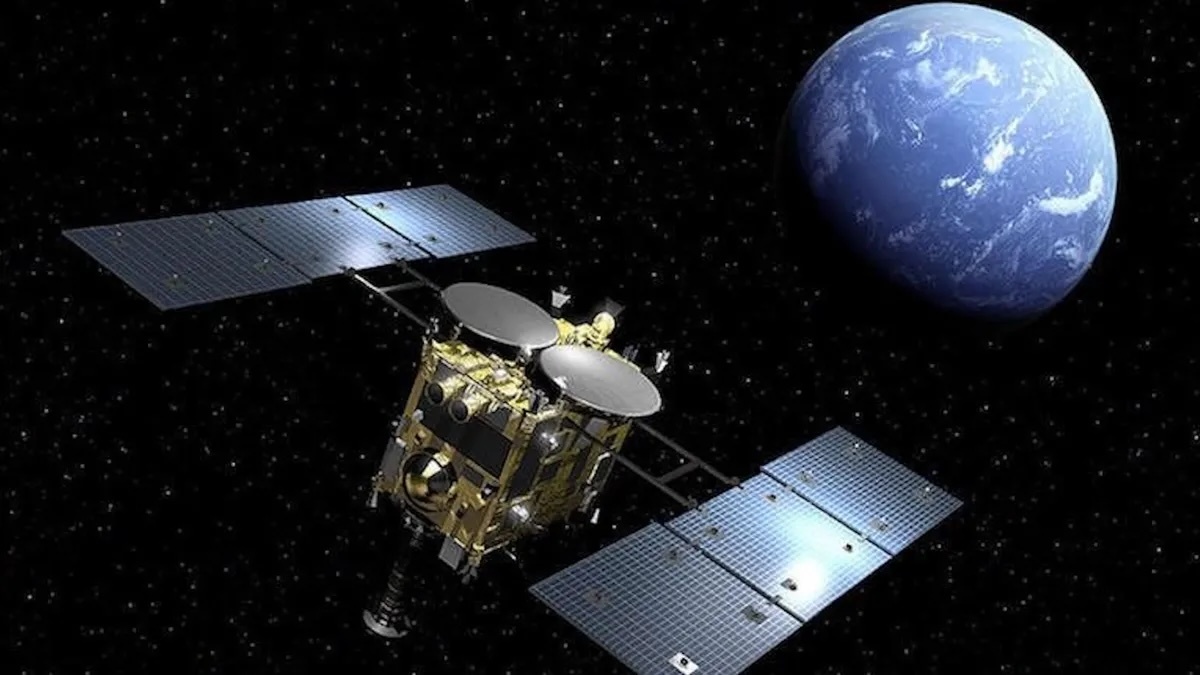
An artist's depiction of Japan's Hayabusa2 spacecraft passing near Earth. (Image credit: JAXA)
Japan's Hayabusa2 sample-return spacecraft is on target to make one of the closest ever flybys of a near-Earth asteroid in early July, as part of its extended mission campaign.
Hayabusa2 launched in December 2014 and rendezvoused with the asteroid Ryugu four years later. The spacecraft collected samples and delivered them to Earth in 2020, completing its primary objectives. But the hardy spacecraft still has bold plans to deliver new and exciting science data.
The spacecraft has been operating well, despite needing to briefly enter a protective safe mode last year, and now is set to make a flyby of the asteroid Torifune on July 5, Satoshi Tanaka of the Japanese Aerospace Exploration Agency (JAXA) said in a presentation on Hayabusa2 during the 35th Meeting of the NASA Small Bodies Assessment Group (SBAG) on June 11.
The flyby will see Hayabusa2 get within 1 to 10 kilometers (0.62 to 6.2 miles) of Torifune, using its instrument suite to study the roughly 450-meter-wide (1,476 feet) asteroid as it whizzes past at 5.3 kilometers per second (3.3 miles per second).
"This is one of the closest asteroid encounters ever attempted by a mission of this class," Tanaka said. "By combining advanced navigation techniques and the engineering capabilities of Hayabusa2, we have made it possible to achieve a flyby at a distance of only about 1 kilometer."
Torifune was first given the designation 2001 CC21 before being named for a deity from Japanese mythology. Tanaka says the asteroid is somewhat similar to Itokawa — the target of Japan's first Hayabusa mission — but little is known for sure about Torifune, adding a level of uncertainty to this extended mission objective.
"It's still a risky operation, because they had not planned for this," Patrick Michel, the principal investigator for the European Space Agency's Hera asteroid mission and part of the Hayabusa2 science team, told Space.com. "The second thing is that we have a high uncertainty on the size of the object," he added, with the dimensions of the asteroid unknown.
The asteroid could, for example, be a contact binary, according to Michel, in which two separate bodies came together at low velocities. Known contact binary small bodies include the Kuiper belt object Arrokoth, imaged by NASA's New Horizons, and comet 67P/Churyumov-Gerasimenko, described as a "rubber duck" when visited by ESA's Rosetta spacecraft.
"We're going to discover what it looks like. And each time we have seen a new asteroid, we've been surprised," Michel said. "We're going to discover another beast to put in the zoo of asteroids."
The very high velocity of the flyby means there will be limited time to collect images and other data on the asteroid, but the rapid encounter will also provide a useful test for planetary defense, as well as adding to planetary science.
The flyby, using advanced navigation techniques to guide and control the spacecraft, will be a useful test of a rapid reconnaissance concept that could be used to determine the physical properties of an asteroid. Such reconnaissance could provide vital information before intercepting a threatening asteroid with a kinetic impact, as demonstrated by NASA's DART mission in 2022.
Tanaka said that Hayabusa2 has been busy during its deep space cruise phase, including making observations of the zodiacal light and exoplanets, and the Torifune flyby will, hopefully, not be its final act. The ultimate goal of the Hayabusa2 extended mission is to visit the tiny asteroid 1998 KY26 in 2031, which would be the smallest asteroid ever visited. The spacecraft could even attempt to land on the miniscule world, which is just 11 meters (36 feet) wide.
Quelle: SC
----
Update: 6.07.2026
.
Japan's Hayabusa2 Successfully Observes Asteroid Torifune

Yuya Mimasu, head of the Hayabusa2 extended mission team, celebrates after the successful flyby observation of the asteroid Torifune by Hayabusa2 unmanned probe on Sunday. (from JAXA's official YouTube)
Tokyo, July 5 (Jiji Press)--Japan's Hayabusa2 unmanned probe successfully flew past the asteroid Torifune at close range on Sunday, the Japan Aerospace Exploration Agency said.
The probe is in normal condition, JAXA said.
According to the plan, Hayabusa2 passed about 800 meters from the center of Torifune at around 6:30 p.m. Japan time to take pictures of its surface and observe it with an infrared camera and a spectrometer. Torifune is located about 100 million kilometers from Earth.
JAXA will hold a press conference on Monday afternoon after confirming the actual distance and whether the observation was successful.
At JAXA's control room in Sagamihara in Kanagawa Prefecture, south of Tokyo, members of the operations team closely monitored the data transmitted from Hayabusa2 with a delay of about five minutes. After confirming the mission's success, they celebrated by clapping and hugging one another.
Quelle: jiji.com
+++
Japan’s Hayabusa2 Probe Flies by Torifune Asteroid, in Step Forward for Planetary Defense Technology
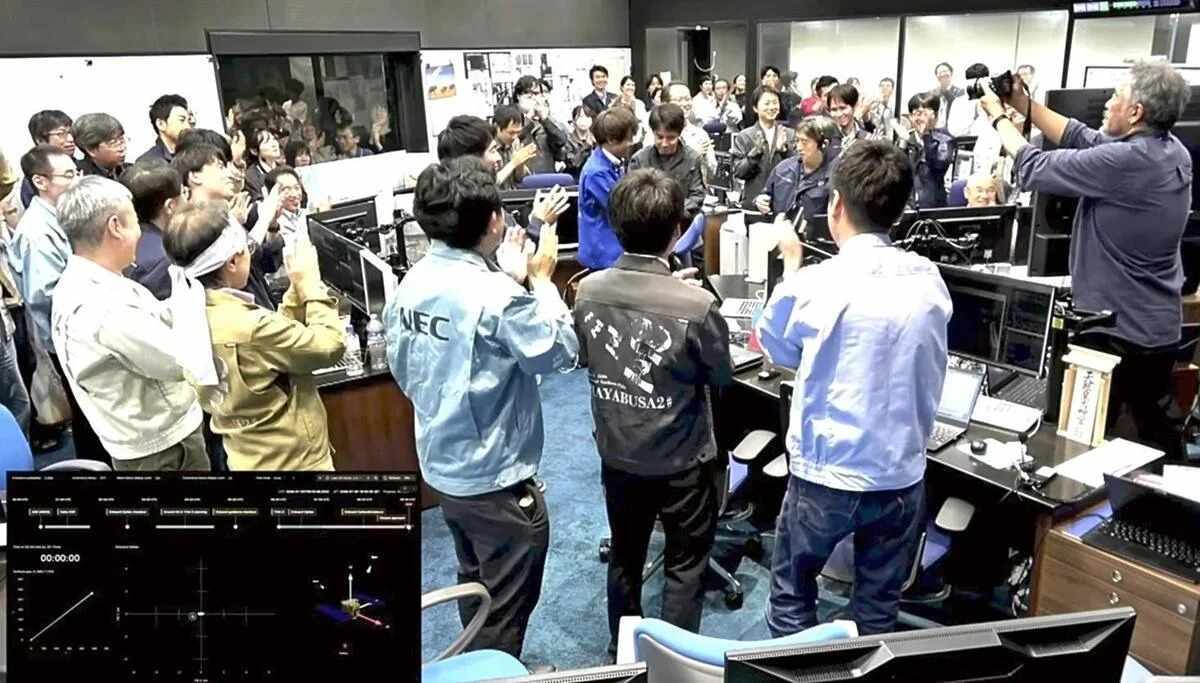
From JAXA’s YouTube channel
People celebrate after watching the Hayabusa2 flyby.
Japan’s Hayabusa2 probe has pulled off a high-speed flyby of the Torifune asteroid, located about 100 million kilometers from Earth, the Japan Aerospace Exploration Agency said on Sunday.
According to JAXA, no abnormalities have been detected on the spacecraft, and the flyby is believed to have been successful.
According to the plan for the latest mission, the Hayabusa2 was to approach Torifune, which is about 500 meters in diameter, at around 6:30 p.m. on Sunday at a blistering speed of about five kilometers per second, or about 15 times the speed of sound, observing the asteroid’s surface as it passed about 800 meters from its center.
Since most flybys are typically performed several hundred to several thousand kilometers away from their target, a flyby at a distance of less than 1 kilometer would be a world-class achievement.
Successful use of the probe’s high-precision guidance technology will spur the development of planetary defense technology, which involves crashing an unmanned probe into an asteroid on a collision course with Earth to alter its orbit and prevent an impact.
Quelle: The Japan News
+++
Hayabusa2 flies past asteroid as Japan aims to acquire data for planetary defense
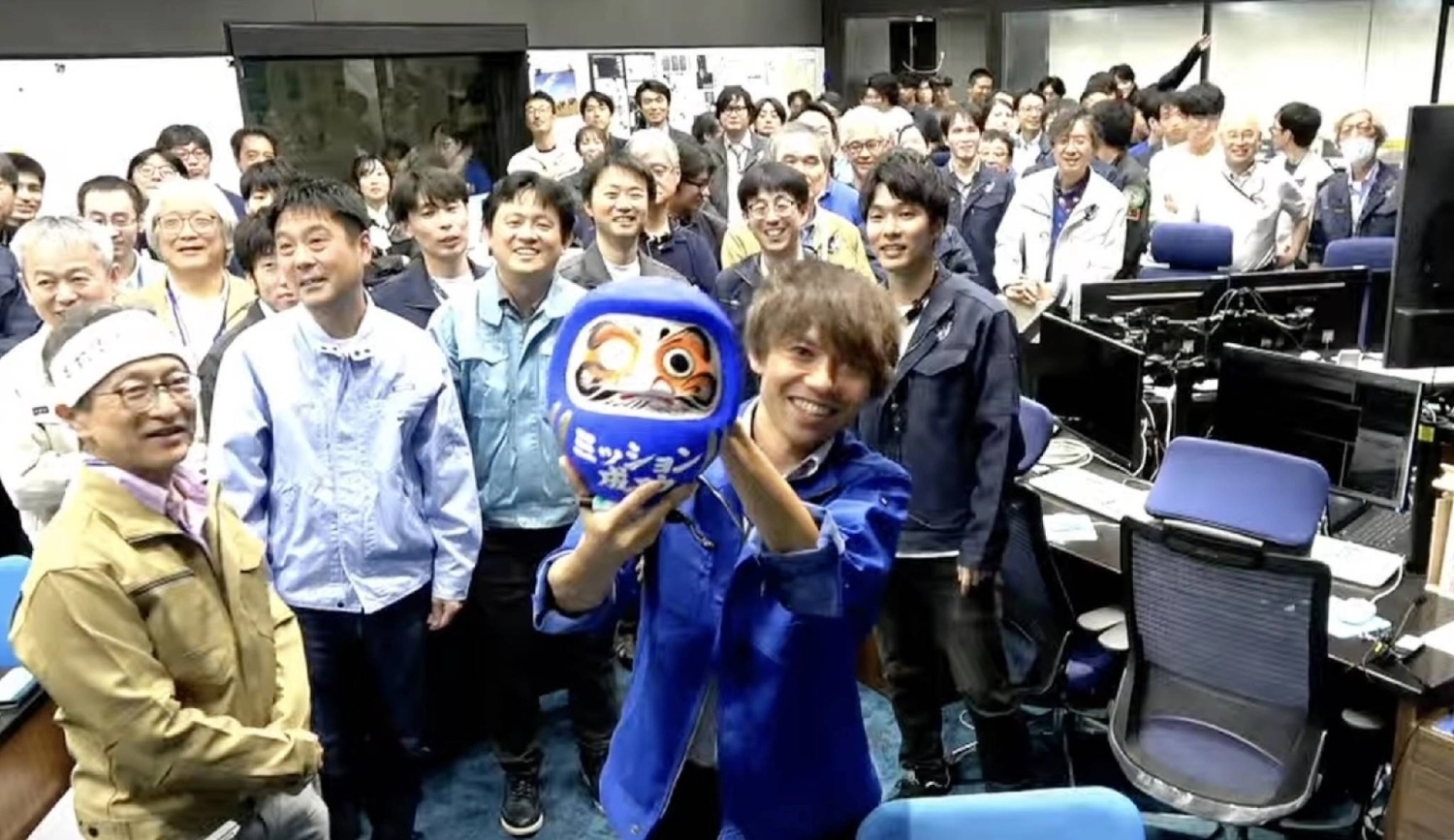
JAXA officials celebrate after the Hayabusa2 probe's successful flyby of the asteroid Torifune on Sunday in a screenshot taken from YouTube. | JAXA / VIA JIJI
Japan’s Hayabusa2 probe flew past the asteroid Torifune on Sunday — one of the closest encounters ever attempted by a spacecraft of its kind — on a mission that could provide data on how to defend Earth from collisions.
The Japan Aerospace Exploration Agency (JAXA) spacecraft passed within close range of the 450-meter-wide asteroid’s center at around 6:30 p.m. Japan Standard Time while traveling at approximately 5 kilometers per second — or 18,000 kilometers per hour — relative to Torifune.
The encounter marks a new phase for Hayabusa2, which completed its primary mission in 2020 after returning samples from the asteroid Ryugu to Earth. Since then, the probe has been operating on an extended mission, with Torifune serving as a key test before its planned rendezvous with the far smaller asteroid, 1998 KY26, in 2031.
According to JAXA, the purpose of the Torifune flyby was to demonstrate high-precision orbital guidance and gather data that could support planetary defense efforts. The latter goal is focused on the ability to identify and monitor asteroids and other near-Earth objects at an early stage, and to develop measures to prevent damage if one is found to pose a collision risk.
There are many asteroids of similar size to Torifune in outer space. An asteroid of that size — which is large enough to cause significant damage — is projected to collide with Earth once every 100 to 1,000 years. Currently, ground-based observations are unable to reveal the details of these asteroids.
Hayabusa2’s extended mission could contribute to the field in two ways: By testing high-speed flyby observation techniques and by exploring small asteroids that may be difficult to detect but could still survive passage through Earth’s atmosphere. The probe was not originally designed for a high-speed flyby of this kind, making the maneuver technically challenging.
The goal for the flyby was to acquire basic data for technology needed to accurately guide a probe toward a small celestial body. That capability would be important for missions that aim to deliberately alter an asteroid’s trajectory, such as by striking it with a spacecraft or otherwise changing its orbit.
To acquire meaningful data, the spacecraft must approach as close as possible to the asteroid without crashing into it. While optical navigation is essential due to the uncertainty in the asteroid’s orbit, asteroids are much smaller and darker than planets and can only be seen a few days before a flyby.
“The unique difficulties presented by the last-minute navigation guidance for an asteroid mean that the flyby operation is similar to orbit-inducing technologies used to collide a spacecraft with an asteroid,” JAXA said in a press release prior to the flyby.
The encounter was also a rehearsal for future rapid reconnaissance missions. In a real planetary defense scenario, scientists need to quickly assess an asteroid’s size, shape, surface and internal structure before determining whether and how to deflect it.
Hayabusa2’s final extended-mission target, 1998 KY26, is estimated to be only about 30 meters in diameter, according to JAXA, although some estimates say it is even smaller. If the probe reaches it as planned in 2031, it would be the first spacecraft to explore an asteroid of that scale at close range.
Quelle: The Japan Times
----
Update: 7.07.2026
.
JAXA Releases Photo of Asteroid Torifune
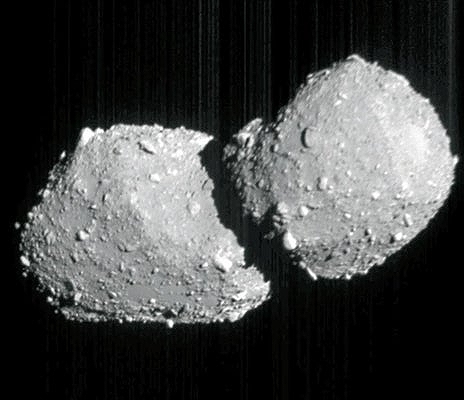
Courtesy of JAXA, the University of Tokyo, the Chiba Institute of Technology, the Institute of Science Tokyo, the National Institute of Advanced Industrial Science and Technology / the Observatoire de Paris and the Instituto de Astrofisica de Canarias
The asteroid Torifune
Japan Aerospace Exploration Agency (JAXA) on Monday released a photo of the asteroid Torifune taken when its Hayabusa 2 asteroid explorer conducted a flyby of the asteroid on Sunday. The Torifune is at about 100 million kilometers away from the Earth.
Quelle: The Japan News
+++
JAXA’s Hayabusa 2 Space Probe Successfully Conducts Close-Range Flyby of Asteroid Torifune
The Japan Aerospace Exploration Agency’s (JAXA) Hayabusa 2 asteroid explorer space probe successfully conducted a flyby of the asteroid Torifune on Sunday. Hayabusa 2 was able to approach Torifune, which was at about 100 million kilometers away from the Earth, and observe it while passing by it at close range without any trouble.
This highly difficult mission, which served as a test of the probe’s high-precision guidance technology, was just the latest achievement for Hayabusa 2.
Launched in 2014 from the Tanegashima Space Center in Kagoshima Prefecture, Hayabusa 2 succeeded in sending back to Earth a capsule that contained samples taken from the asteroid Ryugu in December 2020. The probe has since been using its remaining fuel to continue traveling through space, and this was its first full-fledged mission in five and a half years.
For this mission, Hayabusa 2 was to approach Torifune in the early evening on Sunday at a high speed of 5 kilometers per second [from the asteroid’s perspective] and observe its surface while passing as close as about 800 meters from the core of the asteroid, which is approximately 500 meters in diameter. This was made possible by technology which allows the probe to autonomously control its own course while accurately measuring the distance between itself and the asteroid.
In most flyby missions, the craft observes its subject from a distance of hundreds or thousands of kilometers, so a successful flyby at a distance shorter than 1 kilometer is an extraordinary achievement. It offers a demonstration of cutting-edge guidance technology which could contribute to the development of planetary defense technology that aims to prevent potentially dangerous asteroids from crashing into the Earth by striking them with unmanned probes to change their trajectory.
Yuya Mimasu, JAXA’s team leader for this mission, said “I want to check what kind of data Hayabusa 2 was able to produce.”
The continued advancement of observation technology has led to the discovery of an increasing number of asteroids whose orbital paths bring them close to Earth. Countries such as European nations and the U.S. are also aiming to acquire planetary defense technology.
Professor Seiji Sugita of the University of Tokyo, an expert on planetary science, said “The success of this flyby mission is a significant achievement in the field of space disaster prevention.”
Hayabusa 2 will continue flying, aiming as a final goal to reach the asteroid 1998KY26, between the orbits of the Earth and Mars.
Quelle: The Japan News
----
Update: 20.07.2026
.
Scientists told them, 'No, it's too dangerous,' but they did it anyway: Inside Japan's super-close asteroid flyby
A last-minute proposal saw Hayabusa2 whizz within just 800 meters of a near-Earth asteroid.
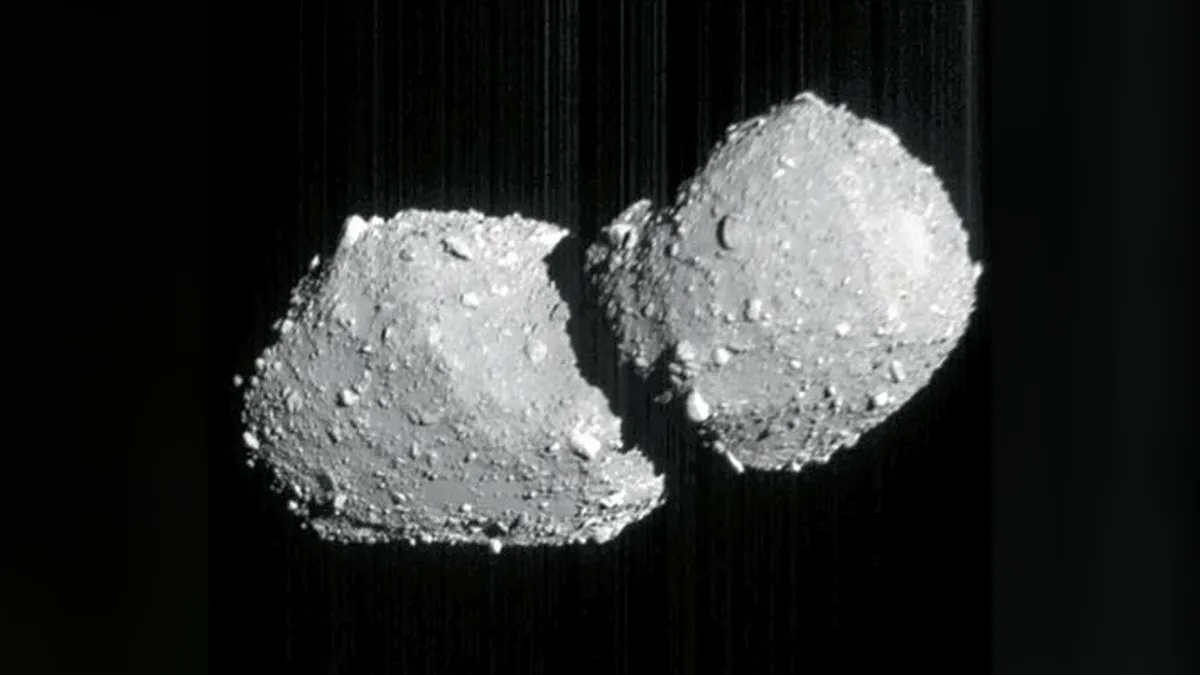
The Asteroid Torifune, as seen by the Hayabusa2 probe's Optical navigation camera (telephoto) during a close flyby on July 5, 2026. (Image credit: Japan Aerospace Exploration Agency (JAXA)
Japan's Hayabusa2 spacecraft returned spectacular images of a near-Earth asteroid following a super-close flyby on July 5, but heated debate was needed before teams signed off on the daring attempt.
When images of the asteroid Torifune arrived on the morning of July 6 Japan time, Makoto Yoshikawa and his team at the Japan Aerospace Exploration Agency (JAXA) got two surprises at once. Torifune turned out to be a contact binary, in which two chunks of rock have come together under gravity, and the returned images were also larger than hoped.
"We did not imagine such a contact binary," Yoshikawa, former mission manager of Hayabusa2, told scientists gathered at the Asteroids, Comets and Meteors conference in Poznan, Poland, on July 10. "Originally, we didn't think we could have such a very big image. Maybe we will take a very small one, but the image was much larger than we expected."
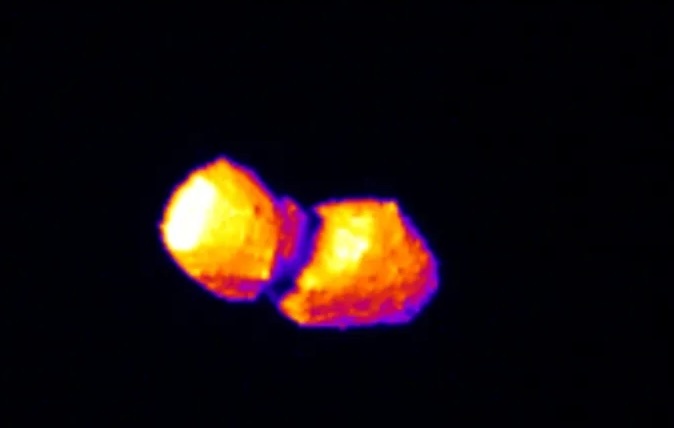
The asteroid Torifune as seen by Hayabusa2's Mid-Infrared Camera during the July 5 flyby. (Image credit: JAXA)
The double surprise was the payoff of months of debate between science and engineering teams, and a last-minute proposal that alarmed some of the scientists it was meant to serve. In the end, the flyby was so close as to be at the very edge of what the aging spacecraft was designed to conduct.
Hayabusa2 launched in December 2014 and rendezvoused with the asteroid Ryugu four years later. The spacecraft collected samples and delivered them to Earth in 2020, completing its primary objectives. JAXA then made plans for an asteroid flyby and a rendezvous with the tiny asteroid 1998 KY26 in 2031.
Usually for flybys, the closest distance is 100 kilometers (62 miles), Yoshikawa said, but in Hayabusa2's case this would not be close enough to gather good images. Hayabusa2 was designed for rendezvous and proximity operations, including hovering, correcting and landing — not for a high-speed pass at 5.3 kilometers per second (3.3 miles per second). Its cameras were also not designed for high-speed slewing.
According to Yoshikawa, science team members pushed back. At a distance of 100 kilometers, Hayabusa2's cameras would barely resolve the asteroid's global shape. Engineering responded with a proposal of 10 kilometers (6.2 miles). Science said that was acceptable, but the team kept pushing. Eventually, engineers confirmed they could get to within 1 kilometer (0.6 miles) of the asteroid's center. "Science people were very happy, because they could have a nice photo," Yoshikawa said.
Then, just one month before the flyby, extended mission team leader Yuya Mimasu proposed going even closer. "Yuya Mimasu said the closest distance should be 800 meters," Yoshikawa recounted. "Some science people said 'No, it's too dangerous,' and a very heated discussion started."
One major issue was the unknown size and dimensions of Torifune and the safety of the spacecraft. The team had assumed a worst-case asteroid size of 1,400 meters by 400 meters (4,600 by 1,300 feet) based on ground-based observations. A pass 800 meters (2,625 feet) from the center of the target would sit just outside that exclusion zone. The spacecraft's optics had also been affected by dust from sampling Ryugu. The final navigation analysis put the targeting error ellipse at around 200 meters (656 feet). "The distance fixed is 800 meters," Yoshikawa said, "but this is quite a big challenge for us."
Hayabusa2 detected Torifune on June 19. The spacecraft used ground-based guidance up to three hours before the flyby, before switching to onboard guidance. "This is quite new," Yoshikawa said. "We developed software for this, and we sent it to the spacecraft."
The result was the stunning, up-close imagery of the dual-lobed Torifune, captured by the probe's Optical Navigation Camera Telescope (ONC-T). But all four of Hayabusa2's science instruments returned data. The Thermal Infrared Imager (TIR) captured nine seconds of thermal imaging between 09:29:50 and 09:29:59 GMT on July 5, just a second before closest approach, independently confirming the contact binary structure in heat emission.
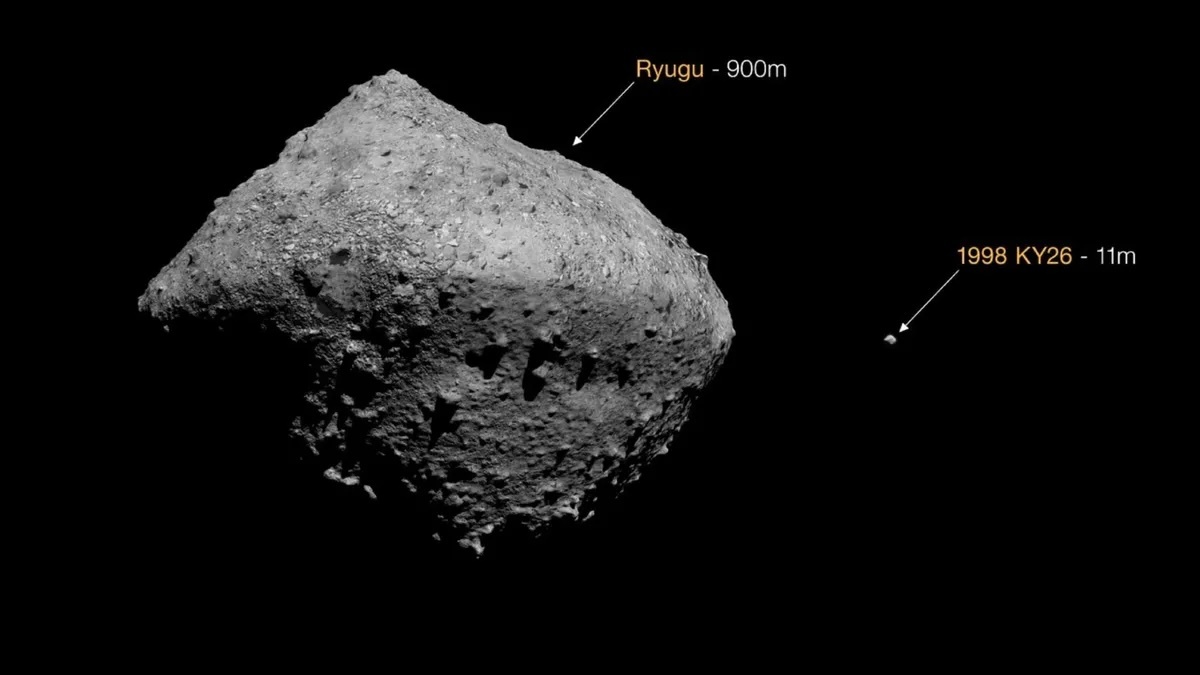
A size comparison between asteroid Ryugu, which was visited by Hayabusa2 in 2020, and its next target, 1998 KY26. (Image credit: ESO/M. Kornmesser. Asteroid models: T. Santana-Ros, JAXA/University of Aizu/Kobe University)
The Near Infrared Spectrometer (NIRS3) and laser altimeter (LIDAR) also got data, with the latter delivering what Yoshikawa described as possibly the first successful LIDAR ranging measurement during an asteroid flyby. But while the most urgent 25 MB of data was downlinked, teams will need to wait months for the rest of the 300 MB of total science data. Hayabusa2's ion engine system restarted on July 9 to begin the cruise toward two Earth flybys in 2027 and 2028 and will fire for around four months. Only after this can the rest of the data be sent to Earth.
Yoshikawa explained that the Torifune flyby was more than just a bonus milestone and photo and science op. The successful super-close flyby means that "JAXA has acquired the technology to collide spacecraft with a small celestial body," he said in his closing remarks at ACM, drawing a parallel to NASA's DART mission. "This flyby mission can be said to serve as a demonstration of the fast reconnaissance concept in planetary defense," verifying the ability to characterize an unknown asteroid rapidly — a capability that could provide crucial information ahead of an impactor mission.
This is not the end for Hayabusa2. The ultimate destination for the spacecraft's extended mission is the tiny asteroid 1998 KY26, a roughly 36-foot-wide (11 m), rapidly rotating rock with which it is scheduled to rendezvous in 2031.
Quelle: SC