
5.06.2026
NASA has announced that, after six months of trying to recover the MAVEN mission at Mars, they are saying goodbye.
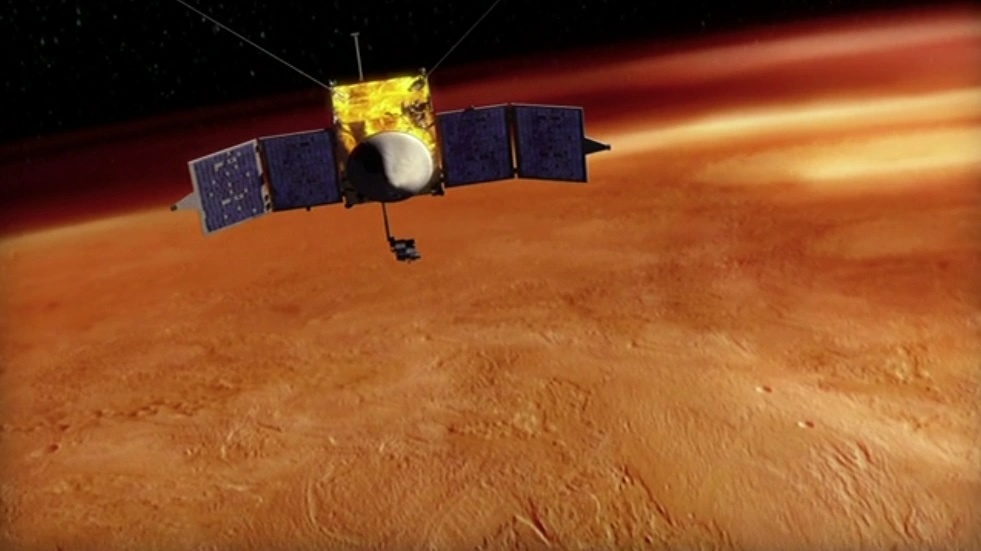
Update (June 3, 2026): The first mission devoted to observing the Martian atmosphere and its evolution, NASA’s MAVEN (Mars Atmosphere and Volatile Evolution), has ended after more than 11 years in orbit at Mars and a decade beyond its primary, one-year mission. The spacecraft was heard last on Dec. 6, when it experienced an unexpected loss of signal after it passed behind the Red Planet.
In-depth analysis confirmed that, after MAVEN emerged from behind Mars relative to Earth in early December 2025, the spacecraft was spinning at an unexpectedly high rate, which drained its batteries. The mission is unrecoverable. NASA will host a telecon on June 3rd to discuss the farewell.
One of NASA’s key science assets in orbit around Mars has failed to phone home, and controllers are currently working to understand why.
The loss occurred after December 6th, when ground stations in NASA’s Deep Space Network last heardfrom the Mars Atmosphere and Volatile Evolution (MAVEN) spacecraft. MAVEN is on an elliptical, 3.6-hour orbit, which takes it from a closest approach of 180 km (110 miles) out to a distance of 4,500 kilometers. The spacecraft periodically falls out of communications range when it passes behind Mars as seen from Earth; however, this time around, it failed to reconnect when it came back in range.
Operators stated December 15th that, although no telemetry was received from the spacecraft since December 4th, a small segment of partial tracking data from December 6th was obtained. Analysis suggests that the spacecraft was spinning at an unexpected rate as it reemerged from behind Mars, and its trajectory may have changed.
"The spacecraft and operations teams continue to investigate the anomaly to address the situation," says Alana Johnson, Senior Communications Specialist in NASA's Planetary Science Division). "More information will be shared once it becomes available."
Teams are currently working to address the issue, but their work will be hindered as Mars is currently passing behind the Sun as seen from Earth. The Red Planet passes solar conjunction on January 9, 2026. This is typically a time when teams plan for an extended communication blackout with missions on and around the Red Planet.
Launched in November 2013 from Cape Canaveral Air Force Station, MAVEN was built by Lockheed Martin and operated by the Laboratory for Atmospheric and Space Physics at the University of Colorado in Boulder and the NASA Goddard Spaceflight Center. The mission goal was to study the interaction between the solar wind and Mars’s tenuous atmosphere, addressing the mystery of how the planet lost most of its atmosphere to space.
MAVEN had a nominal two-year mission but has operated at the Red Planet for more than 12 years. The mission was being considered for termination under the tight FY2026 NASA budget.
MAVEN was on hand to watch those interactions for a complete 11-year cycle of solar activity. It also followed changes that occurred during dust storms. MAVEN has shown that the atmospheric escape rate is 10 times higher when the planet is at perihelion (nearest the Sun in its orbit) versus aphelion (farthest from the Sun). Observing the evolution of this loss allowed researchers to understand the loss of surface water on Mars that occurred about 4 billion years ago, shortly after the formation of the solar system.
Although comets are not part of MAVEN's mission, the orbiter observed Comet 3I/ATLAS on October 9th, catching the interstellar comet when it came nearest Mars. The comet passed 0.19 astronomical unit (29 million kilometers) from the Red Planet on October 3rd. All Mars-based assets were tasked with catching the comet's passage, including MAVEN, the Mars Reconnaissance Orbiter and the Perseverance rover. The maneuver to follow 3I/ATLAS was unrelated to loss of contact, as the mission was in good health through October and November.
It’ll be a shame if MAVEN is indeed a loss. The mission would’ve have provided tandem observations with the ESCAPADE Blue and Gold orbiters set to arrive around the Red Planet in 2027. ESCAPADE just launched on a Blue Origin New Glenn rocket last month.
MAVEN may be down, but not out. We’ll update this post as new information warrants.
Quelle: Sky&Telescope