
7.11.2026
The Andromeda galaxy is one of the most distant things you can see with the naked eye. The difficult part isn't finding it. It's believing that faint smudge really is another galaxy.
The first time I showed someone the Andromeda galaxy (M31), our conversation did not go quite as planned.
I'd carefully worked my way across the sky, starting from the Great Square of Pegasus and hopping from star to star until I was confident I had the right patch. I pointed the telescope, got M31 in its crosshairs and proudly announced to my wife that I had found the closest giant galaxy to the Milky Way. Would she like to see it?
She then stayed quiet for a little too long as she looked through the eyepiece. Then came an unexpected question. "Is it near that little smudge?" Hmmm. "Err, no. It is that little smudge," I replied.
There was a pause. Of course, I knew exactly what had happened. We'd both seen photographs of M31 — a vast spiral galaxy with a brilliant center, sweeping dust lanes and hundreds of billions of stars. What we were actually looking at was a grayish blur that could easily have been mistaken for a mark on the eyepiece.
That apparent disappointment is now my favorite part of finding Andromeda because the unimpressive smudge is real. The light entering your eyes has been traveling across space for about 2.5 million years. No screen, photograph or telescope is necessary. You are intercepting ancient light in your backyard. Technically, the Triangulum Galaxy (M33), about 2.7 million light-years away, can be seen with the naked eye, so it is therefore the most distant object the naked eye can see. But not mine — I've never seen it. M31 is a much more realistic naked-eye target.
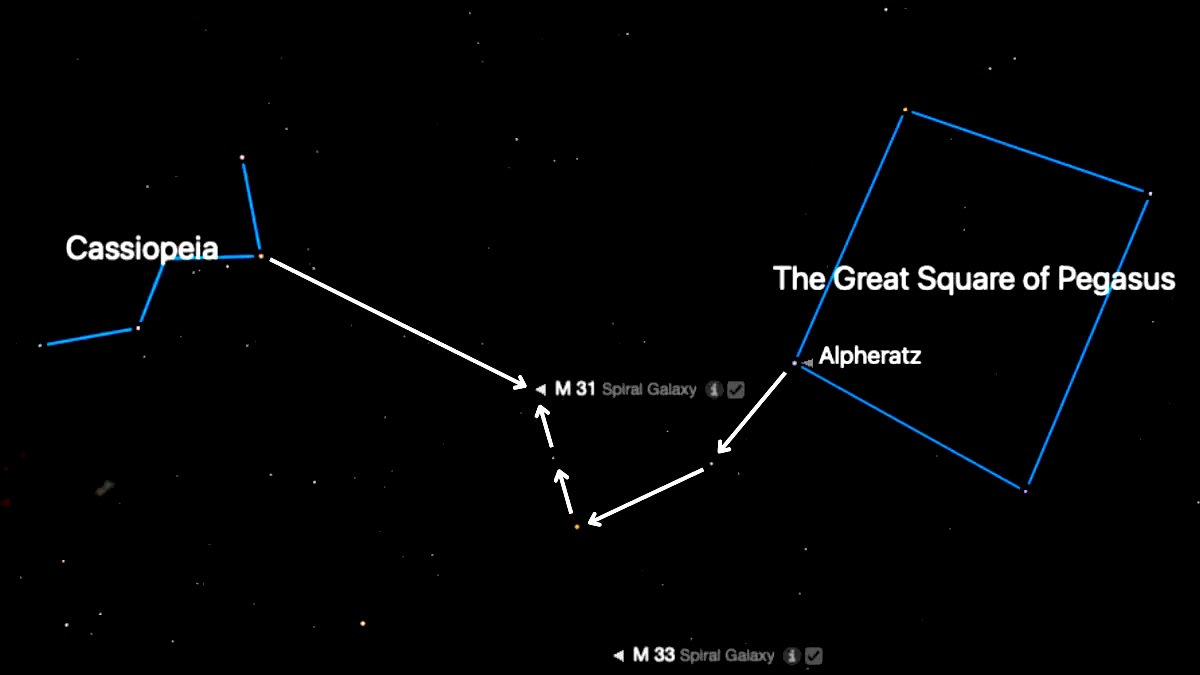
The Andromeda galaxy is at its most dramatic in photographs, not an eyepiece. (Image credit: Created using Canva and a base image from Starry Night)
Quelle: SC