
3.11.2026
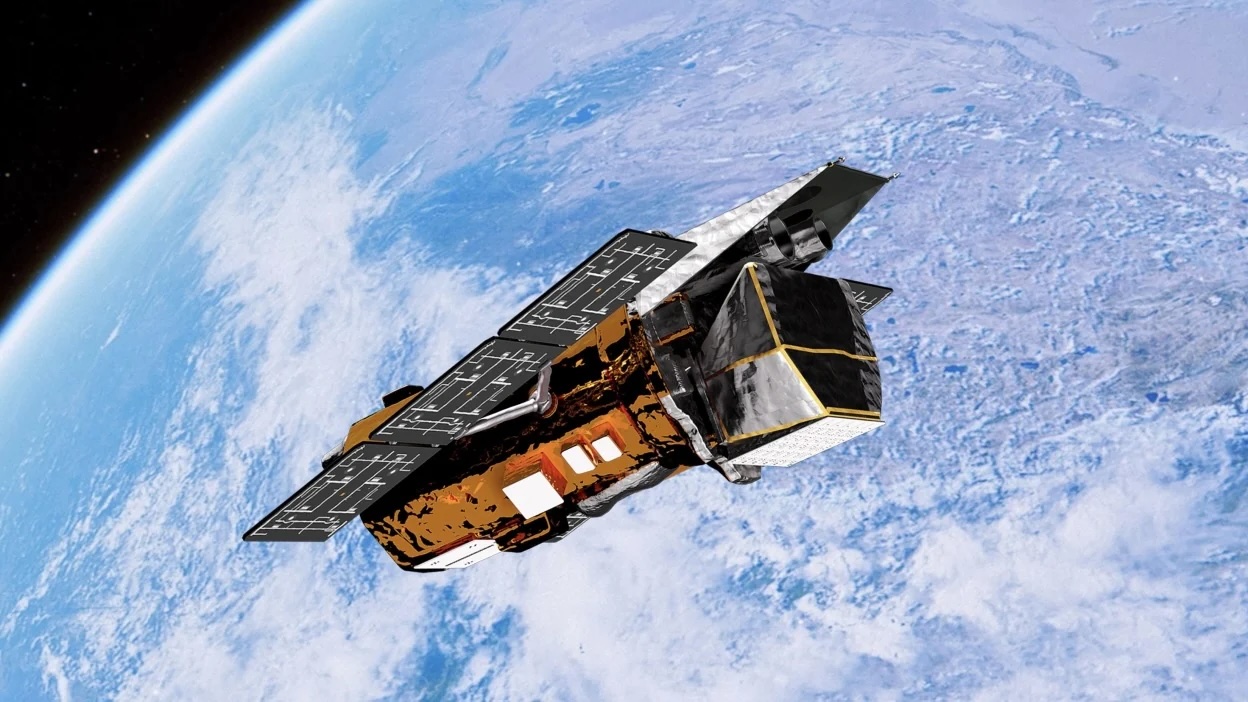
NASA and the U.S. Space Force estimate that the Neil Gehrels Swift Observatory will plunge to Earth on Nov. 4, 2026. Credit: NASA’s Goddard Space Flight Center Conceptual Image Lab illustration
NASA expects its Swift space telescope to re-enter Earth's atmosphere early Wednesday, ending over two decades of Swift's monitoring of sudden, powerful events in space.
The U.S. Space Force's prediction puts the re-entry at about 3:30 a.m. ET on Wednesday, Nov. 4. Most of the spacecraft should burn up as it falls through the atmosphere, though some pieces may reach the ground, according to NASA.
Though the agency doesn't offer a live orbital tracker of the spacecraft, you can monitor Swift's final days — or hours — through the agency's blog, as well as some third-party websites and apps.
Swift, whose official name is the Neil Gehrels Swift Observatory, will meet its demise after NASA and commercial contractor Katalyst Space tried to save it with a robotic spacecraft designed to boost it into a higher orbit. That $30 million rescue attempt failed, which means scientists have lost a quick-response telescope to study brief cosmic events. NASA says other missions will help fill some of the gap, but its absence will leave researchers with fewer ways to follow up on new discoveries.
"While deeply disappointed at the outcome, I'm nonetheless incredibly appreciative of the heroic efforts undertaken by the collective Katalyst and Swift teams," Brad Cenko, the mission's principal investigator, told Mashable in August. "I sincerely do view this effort as a success, even if we were not able to reach our ultimate goal."
To follow Swift's descent, you can read NASA's posts at https://science.nasa.gov/blogs/swift. NASA and the Space Force will continue updating the re-entry predictions, as the timing and location could shift.
But if you want a live look at its whereabouts, several websites provide global mapping and visualization tools for satellites like Swift, using its unique catalog designation, NORAD ID 28485. The data directly comes from the Space Force, which tracks satellites.
Visual trackers, such as Orbital Radar, N2YO, and KeepTrack, take this mathematical information from Space-Track.org, the public portal operated by the U.S. military, and plug it into their own map engines.
NASA launched Swift in 2004 to study gamma-ray bursts: flashes of high-energy light produced by some of the universe's most powerful explosions. Swift could spot a burstand quickly turn toward it to observe the fading light. It also helped scientists study objects like black holes and stars that flare in X-rays.
Earth's upper atmosphere creates drag on satellites in low orbit, slowing them and pulling them down. Recent solar activity increased that effect on Swift. NASA hired Katalyst to build a spacecraft that could approach the observatory, grab it, and raise its orbit. But ongoing control problems with the servicing spacecraft, LINK, ended the plan before it could attempt the capture and boost maneuvers.
Swift briefly returned to science observations after the unsuccessful rescue mission. It homed in on hundreds of targets, including the remains of stellar explosions, active black holes in distant galaxies, and comets in our solar system. On Oct. 20, Swift reached an altitude of 171 miles and could no longer counter the drag. The spacecraft entered a protective mode, and its operations team sent a command to end the mission.
NASA says surviving fragments could fall anywhere between 20.6 degrees south and 20.6 degrees north latitude. That band stretches around the world near the equator. The chance of someone on Earth being harmed by debris is "unlikely," with a chance of about 1 in 2,100, according to the agency.
Quelle: Mashable