
29.08.2026
Magnetohydrodynamic aerobraking testing platform gets stronger magnetic fields
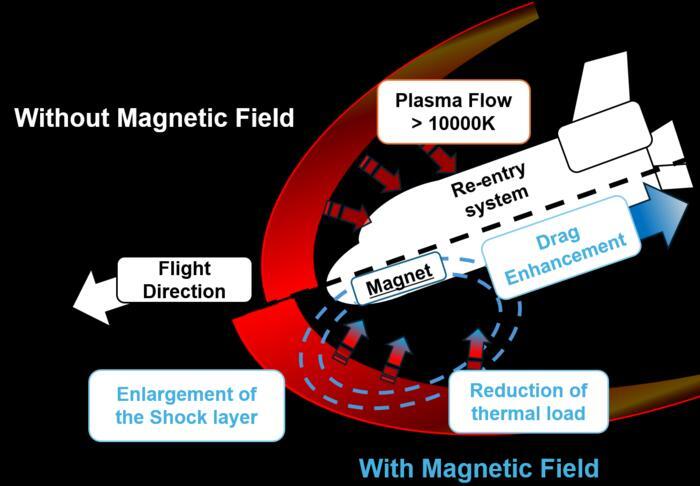
Magnetohydrodynamic (MHD) aerobraking for spacecraft on reentry. By generating a magnetic field, the superheated plasma at the surface of a vessel can be pushed further away while generating an increased aerodynamic drag.
CREDIT
Tokyo Metropolitan University
Tokyo, Japan – Researchers from Tokyo Metropolitan University have created a new system to test magnetohydrodynamic aerobraking for spacecraft reentering the atmosphere. Their platform generates intense magnetic fields with a powerful electromagnet as a miniature vessel is hit with a shockwave traveling at over seven kilometers per second. Their magnets reached far higher fields than previous work with permanent magnets and are a crucial stepping stone toward tests with real vessels in the atmosphere.
When spacecraft reenter the atmosphere, they are hit by shockwaves exceeding several kilometers per second which heat up the air at the vessel surface to several thousand degrees. To counter this intense heating, current technologies use heat-resistant tiles and sacrificial material which help dissipate heat and protect the craft. While reliable, this kind of approach has serious limitations, increasing weight, surface wear, cost, and repair times. This is especially limiting when there is an increasing demand for vessels to be reusable.
A promising technology for overcoming these challenges is magnetohydrodynamic aerobraking (MHD). By applying a magnetic field to the weakly-ionized plasma at the shockwave, the ultra-hot shock layer can be expanded and pushed away from the craft surface. Not only does this reduce the flow of heat into the vessel, but it can increase the aerodynamic drag, slowing the craft down. While previous works resoundingly support this method, testing such systems is itself a big challenge. Experiments usually involve putting a permanent magnet inside a small test model and hitting it with a shockwave, but their design makes it difficult to systematically trial different field strengths and shapes.
To enable engineers to trial a wider range of magnetic fields, a team led by Associate Professor Kohei Shimamura of Tokyo Metropolitan University have engineered a new system using a powerful electromagnet mounted inside a small model; the electromagnet is formed by a customizable set of coils and powered by a pulse-forming network (PFN) which hits it with an intense pulse of current, generating a strong field for a short period of time. In a test, the model is hit by a shockwave traveling at over seven kilometers per second for a period of tens of microseconds in a hypersonic expansion tube, a ground-based facility for testing aircraft and spacecraft in extreme environments. The team designed the system to track the arrival of the shockwave and precisely sync the magnetic field to its duration, reaching field strengths significantly exceeding what is possible with a permanent neodymium magnet. A high-speed camera was also synced to the shockwave to record the light given off by the heated shockwave layer (or “self-emission” layer).
To see it at work, the team designed two different models, each with coil configurations specifically tailored for their different shapes. They confirmed that fields of 1.24 and 1.58 Tesla were created, the latter more than double the field strength of conventional neodymium magnets. The self-emission layer was also observed to be more than 15% thicker with the field on.
The team’s work is a vital step towards planned tests of real reentry experiments, and the development of a core technology for any future space mission which involves reentry into any atmosphere.
Quelle: AAAS