
10.07.2026
Training while flying: Inside BepiColombo's arrival simulations
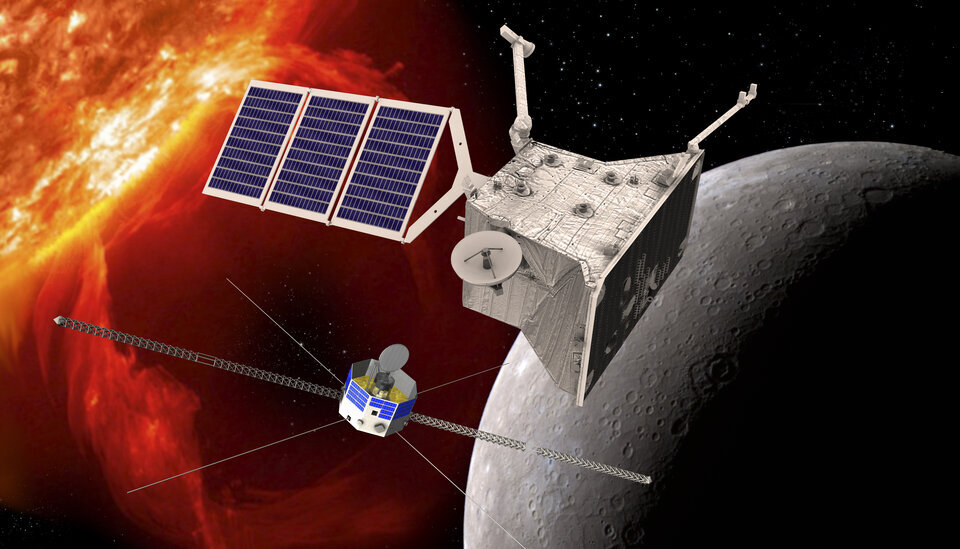
Since its launch in October 2018, the joint ESA/JAXA BepiColombo mission has been on an eight-year journey through space to reach Mercury. This September, the mission will finally enter its long-awaited Mercury Arrival Phase – a series of critical manoeuvres and key module separations spanning several months that will deliver two spacecraft into their science orbits around the Solar System's innermost planet.
To prepare, mission teams are already rehearsing for this important phase by simulating every step of the complex arrival sequence.

Space missions do not arrive at their destinations by chance. The planning, training and coordination required to place a spacecraft into orbit around another world can be just as demanding as those needed before launch – perhaps even more so.
Last month, BepiColombo teams from ESA, JAXA and industry partners gathered at ESA's European Space Operations Centre (ESOC) in Darmstadt, Germany, to begin a simulations campaign that will run through to the end of October.
For ESA Simulations Officer Petr Shlyaev, the gathering was particularly meaningful.
"Exactly eight years and two days ago we were in this room doing the same thing in preparation for Bepi's launch. The fact that we are now here means that everything has worked out well."
Petr has been coordinating preparations since mid-November last year, developing scenarios that test not only procedures, but people.
"People working together is what makes this mission work, especially when facing challenges – and Bepi is a challenge," says ESA BepiColombo Flight Director Ignacio Tanco. "If you see something that you don't understand during the simulation, you have to drill into it and treat it as you would in reality."
Training while flying

What makes the simulations campaign particularly demanding is that the mission itself never stops.
Unlike a launch and early orbit phase (LEOP), where teams can focus entirely on upcoming operations, BepiColombo's mission control team must continue flying the spacecraft while preparing for Mercury arrival.
"Contrary to a LEOP, we need to work on the preparations at the same time that we take care of the cruise operations, so it feels like rehearsing the final act while the show is still running," says ESA BepiColombo Operations Manager Nacho Clerigo.
The mission's long duration adds another challenge. While many experts who supported BepiColombo during launch remain closely involved, others have joined the mission more recently. The simulations campaign therefore serves not only to rehearse critical operations, but also to bring together years of experience and strengthen team coordination ahead of Mercury arrival.
A complex spacecraft, a complex arrival

The scale of the preparation reflects the complexity of the spacecraft itself.
Unlike most planetary missions, BepiColombo is not a single spacecraft. The mission consists of the Mercury Transfer Module (MTM), ESA's Mercury Planetary Orbiter (MPO), JAXA's Mercury Magnetospheric Orbiter (Mio), and the Mio Sunshield and Interface Structure (MOSIF).
This design allows the mission to deliver two scientific orbiters (MPO and Mio) to Mercury, where they will conduct complementary investigations of the planet and its environment.
But before the science can begin, an intricate sequence of operations must take place.
"The arrival phase is not a single event, but six months full of one-of-a-kind activities and critical operations," explains Nacho.

The first major milestone comes on 3 September, when the MPO-Mio-MOSIF composite separates from MTM. Next, Mercury orbit insertion will begin on 21 November with a sequence of 16 burn manoeuvres that will continue through to March 2027. Along the way, MPO and Mio will separate on 9 December, allowing Mio to enter its science orbit. The MOSIF sunshield, which will remain attached to MPO, will be released on 16 December. MPO will subsequently continue to adjust its orbit around Mercury, reaching its science orbit in March 2027 before beginning science operations in April.
Each of these milestones brings unique challenges, and each one is being repeatedly rehearsed during the simulations campaign.
Two agencies, one mission

The complexity of Mercury arrival is not limited to the spacecraft itself. It also depends on close coordination between teams spread across Europe and Japan.
This collaboration becomes particularly important during the separation of JAXA's Mio orbiter from ESA's MPO, when activities on both spacecraft must be executed in an exact sequence.
"Mio is going to be released into space and MPO is the launcher. Many steps need to happen on both sides in a specific order and we need to be synchronised," explains Nacho.
Teams must align timelines, verify readiness criteria and maintain a common understanding of what constitutes a ‘go’ or ‘no-go’ decision.
During one recent simulation, controllers were confronted with an anomaly that forced them to abort and re-schedule a planned separation scenario.
"It generates continuous discussions and iterations between the different teams," Nacho adds.
The exercise highlighted an essential aspect of Mercury arrival: success depends not only on operating the spacecraft, but on ESA and JAXA working together as one team.
Almost there


Access the video
Eight years after launch and with simulations now underway, Mercury is finally within reach.
"I feel like the thing we have been preparing for such a long time – arrival - is finally becoming real. We are almost there, which means we are finally going to do all the things we have been discussing. It's really great!" says an excited Nacho.
As the BepiColombo team continues with intensive preparations, engineers, scientists and space enthusiasts alike eagerly wait for what will be ESA’s first arrival at a planet in a decade.
Quelle: ESA
----
Update: 29.08.2026
.
Watch live: BepiColombo begins its arrival at Mercury
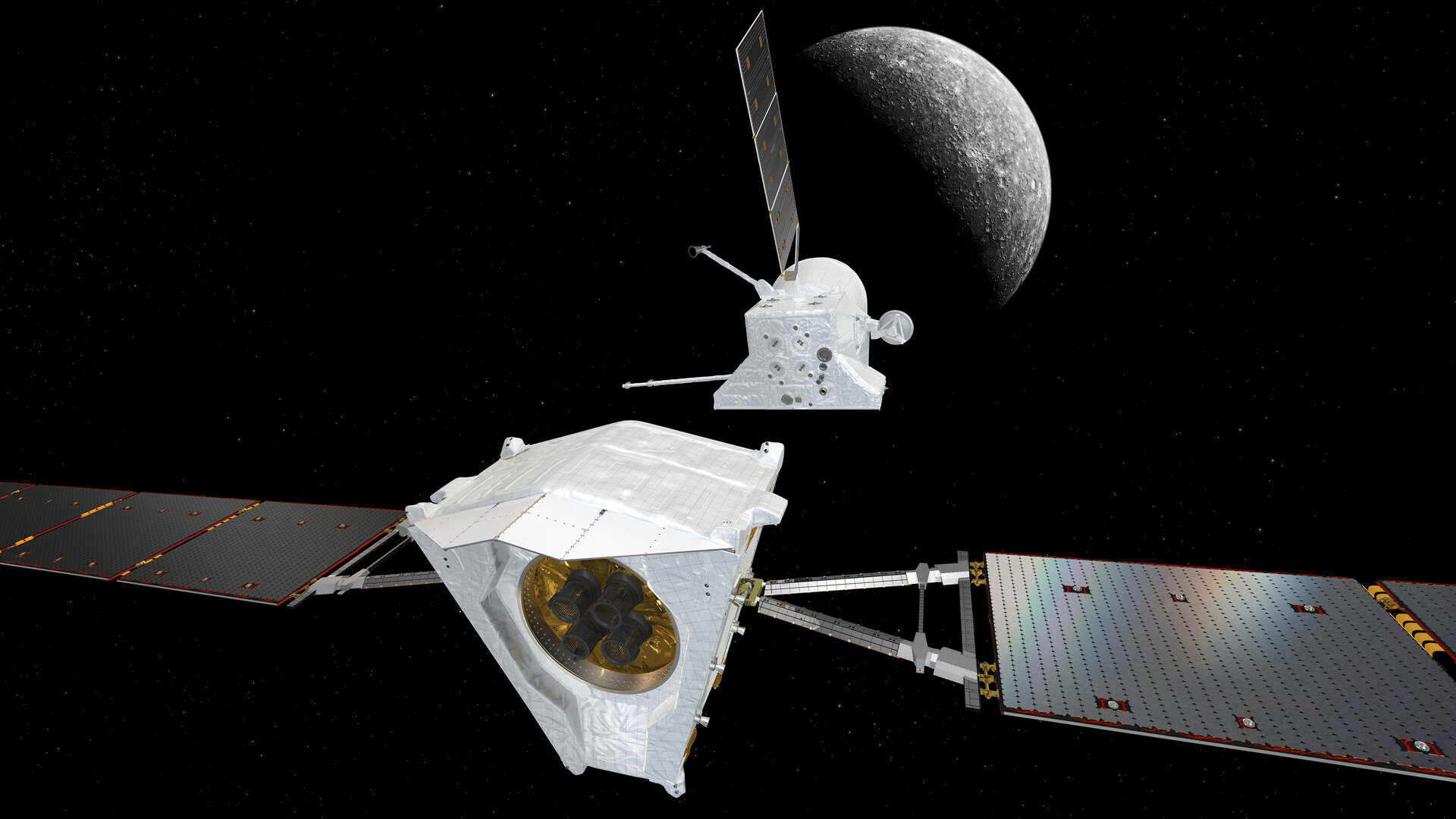
After eight years, the ESA/JAXA BepiColombo mission is about to enter its Mercury Arrival Phase. On 3 September 2026, ESA’s Mercury Transfer Module (MTM) will separate from BepiColombo’s two science orbiters – the first major step in one of the most operationally challenging planetary arrival sequences ever attempted by ESA.
The European Space Agency (ESA) will livestream the critical milestone from 13:45 CEST. Tune in and witness the first step of one of the most complex phases of the mission, live from ESA mission control.
The ESA/JAXA BepiColombo mission is ready for the first critical step towards arriving at its final destination, the mysterious planet Mercury. After eight years of travelling together as one stacked spacecraft, ESA’s Mercury Transfer Module (MTM), which has powered BepiColombo’s interplanetary journey, will separate from BepiColombo’s two science orbiters on 3 September 2026.
But separation is only the beginning.
Getting to Mercury is hard. Arriving there is even harder. BepiColombo's arrival is one of the most demanding operational sequences ever carried out by ESA. MTM's separation on 3 September is just the first step. After MTM has separated, in November ESA's Mercury Planetary Orbiter (MPO) and JAXA's Mercury Magnetospheric Orbiter (Mio) will enter orbit around Mercury together, before separating from each other in December 2026. Science operations will begin in April 2027.
The programme will be broadcast live from ESA's European Space Operations Centre (ESOC) in Darmstadt, Germany, and will feature live views from the iconic Main Control Room as the Mission Control Team carries out the separation operations. Our co-hosts will share special mission moments. ESA and JAXA experts will provide behind-the-scenes insights and expert analysis.
Then comes the wait. Following separation, teams on Earth will listen for BepiColombo’s post separation acquisition of signal and carry out the first checks to confirm the spacecraft is healthy and that the operation has gone to plan.
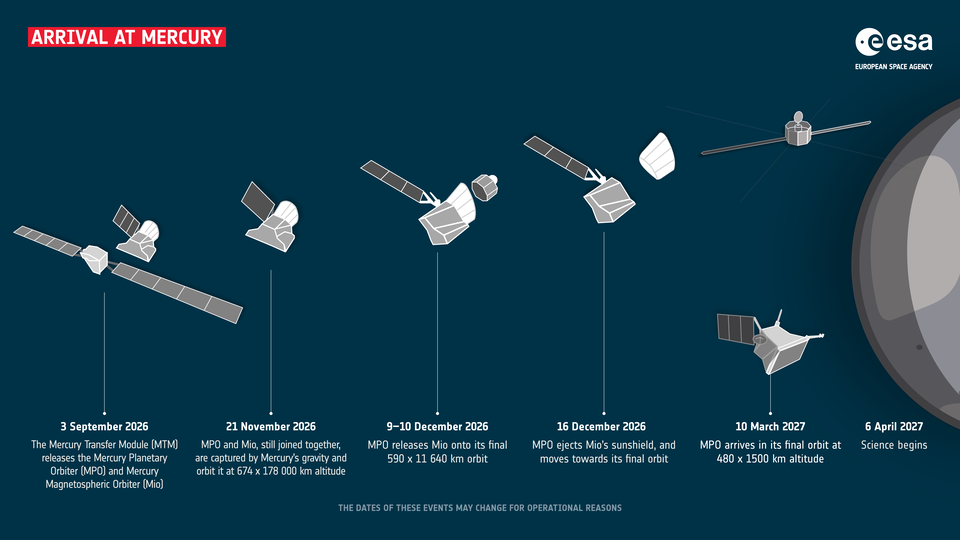
BepiColombo arrival at Mercury timeline
Watch live from 13:45 CEST on 3 September
All times in CEST and subject to change at short notice. Tune in to follow live: ESA on YouTube; ESA on LinkedIn.
13:45 – Start of ESA livestream programme, streaming from ESA’s European Space Operations Centre (ESOC) in Darmstadt, Germany
14:00 – MTM separation
14:30 – One-hour break in livestream
15:30 – Livestream resumes
15:53 – Earliest expected acquisition of signal after separation, followed by a spacecraft status check
16:15-16:45 – End of ESA livestream
Join ESA's livestream on YouTube here!
Quelle: ESA