
30.08.2026
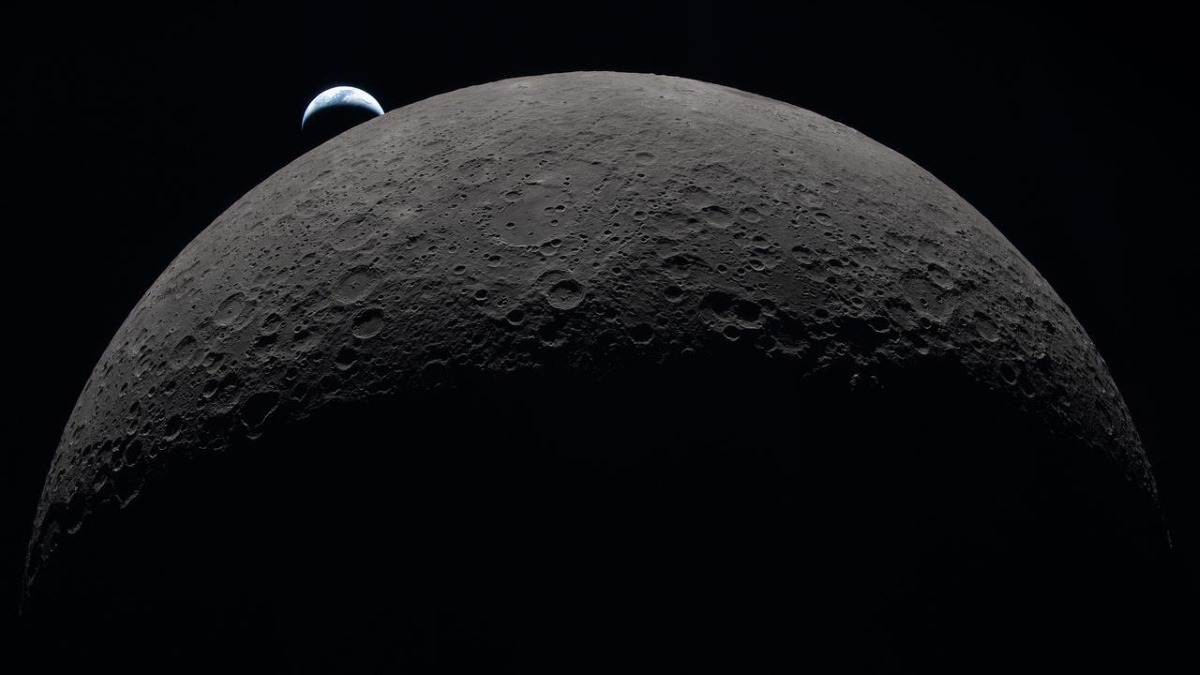
Earth sets over the Moon in photo captured by the Artemis II crew during their journey around the far side of the Moon. Credit: NASA
Sorry, Pink Floyd fans. The title of arguably one of the greatest albums of all time is based on a misnomer. There is no “dark side” of the Moon.
Let me explain with some help from astrometallurgist and space resource extraction expert Matt Shaw who is based at Melbourne’s Swinburne University and Australia’s national science agency CSIRO.
Firstly, Shaw explains, there is no “dark side” side of the Moon “because it’s no darker than the side we see”.
Case closed.
But let’s get into the details of it. What’s going on with the 2 faces of the Moon?
The faces of the Moon
The Moon and Earth are unusual when it comes to the planet-satellite systems in our solar system.
Our Moon is quite large for a natural satellite compared to our planet and its orbit around the Earth takes exactly the same time as an Earth day.
“If you imagine walking around a pole and turning your body slowly as you walk around so that you are looking at the pole the whole time, what you’ve done is walk in a circle, and rotated around your own axis in the same time period,” Shaw explains.
“Now, why the Moon has that exact orbital period gets a bit more complicated. This is a phenomenon called ‘tidal locking’ and can happen over time with any moon.
“This essentially happens because the Moon isn’t perfectly spherical, it has its own lumps and bumps and the gravity of Earth actually distorts it a bit, kind of like how the Moon itself creates tides here on Earth. Over time, gravity acting on these lumps and bumps starts to slow down or speed up the rotation of the Moon until it’s locked at that perfect rotational speed to match its orbit.”
The result of this tidal locking is that the same side of the Moon faces the Earth at all times. We never see the other side from Earth. To us, it is “dark” or mysterious.
But on the Moon, the situation is very different, Shaw explains.
“A day on the Moon lasts for about a month in Earth time, think of the lunar cycle,” he says. “This equates to 2 weeks of daylight during the ‘day’ and 2 weeks of nighttime during the ‘night’. So, when we’re seeing a new Moon from here on Earth, the FAR side of the Moon is in full daylight.
“Perhaps there’s an argument to be made for ‘dark’ referring metaphorically to our inability to see it, but from a physics perspective, it’s just as bright there as the near side.”
What’s it like?
So, it’s not the “dark side”. Physicists and astronomers prefer the term lunar “far side”. What’s it like on the far side, then?
“The lunar far side is pretty similar to the side we can see, although it has a lot less of the Mare, which are the dark bits we see on the Moon when we look up at it,” Shaw says.
“The Mare are old basalt flows that came up from inside the Moon and they’re rich in iron and in some places titanium. The lunar far side is mostly the lighter ‘highlands’ rocks. This material is older and originates from the formation of the Moon itself, this lighter material has more aluminium and silicon in it. Besides the colour, the far side is still pockmarked with impact craters from meteorites hitting it just like the near side.”
“The other aspect of the lunar far side is that if you were on it you wouldn’t see Earth. So if you were on the Far side of the Moon you’d never get any ‘Earthlight’ during the night (think ‘Moonlight’ but the other way around).”
Shedding light on the “dark side”
“Luckily, because we have satellites like the ‘Lunar Reconnaissance Orbiter’ mapping the Moon, we actually have great photos and maps of the far side of the Moon, even though only a handful of humans have ever actually seen it in person,” Shaw says.
“Our understanding of the lunar far side stems mostly from satellites mapping from orbit, there’s quite a list of satellites and not all of them have just taken pictures.
“For example, my favourite mission was called GRAIL, which was mapping the gravity of the Moon. The only missions that have ever landed on the far side of the Moon are the Chang’e missions from China’s National Space Agency (CNSA).
“Specifically, the Change’e 4 mission which deployed a little rover (Yutu-2), and the Chang’e 6 mission which was the first and only mission to date to ever return physical samples from the far side of the Moon.
“The reason we haven’t landed there as much is that it’s a little more difficult. If you’re landing on the near side of the Moon, it’s easy to communicate with Earth, just point your antenna ‘up’. But on the far side, because of the tidal locking, the only way to talk to Earth is via a communications relay satellite that bounces your signal back to Earth from orbit. This means that you need much more complicated communications and control setups.
“China is the only country to date that has landed on the far side of the Moon. But they’re also one of the only countries that has even tried.”
Turning to the “dark side” to understand the universe
Shaw also notes that the lunar far side “is protected from the ‘noise’ of Earth by the rest of the Moon itself”.
“You don’t get any of the radio waves or communication bands that emit from Earth, so the sky is very, very quiet from a radio perspective.”
He says this has led astronomers to consider using the far side of the Moon as a kind of staging post for planned missions to listen out for radio signals from the early universe to get clues about what was happening in the cosmos soon after the Big Bang.
“Radio waves especially are one of the best ways for us to observe the universe, so with such a ‘quiet’ place on the far side of the Moon, there is a lot of interest in setting up some large telescopes there that will allow us to gaze into the universe without the ‘light pollution’ we normally get here on Earth,” Shaw says. “In fact, one of the more concrete plans involves converting an entire crater on the Moon into a radio dish to use as a telescope!”
Quelle: CONNECTSCI