
19.10.2026

Moon Rovers in the Fast Lane
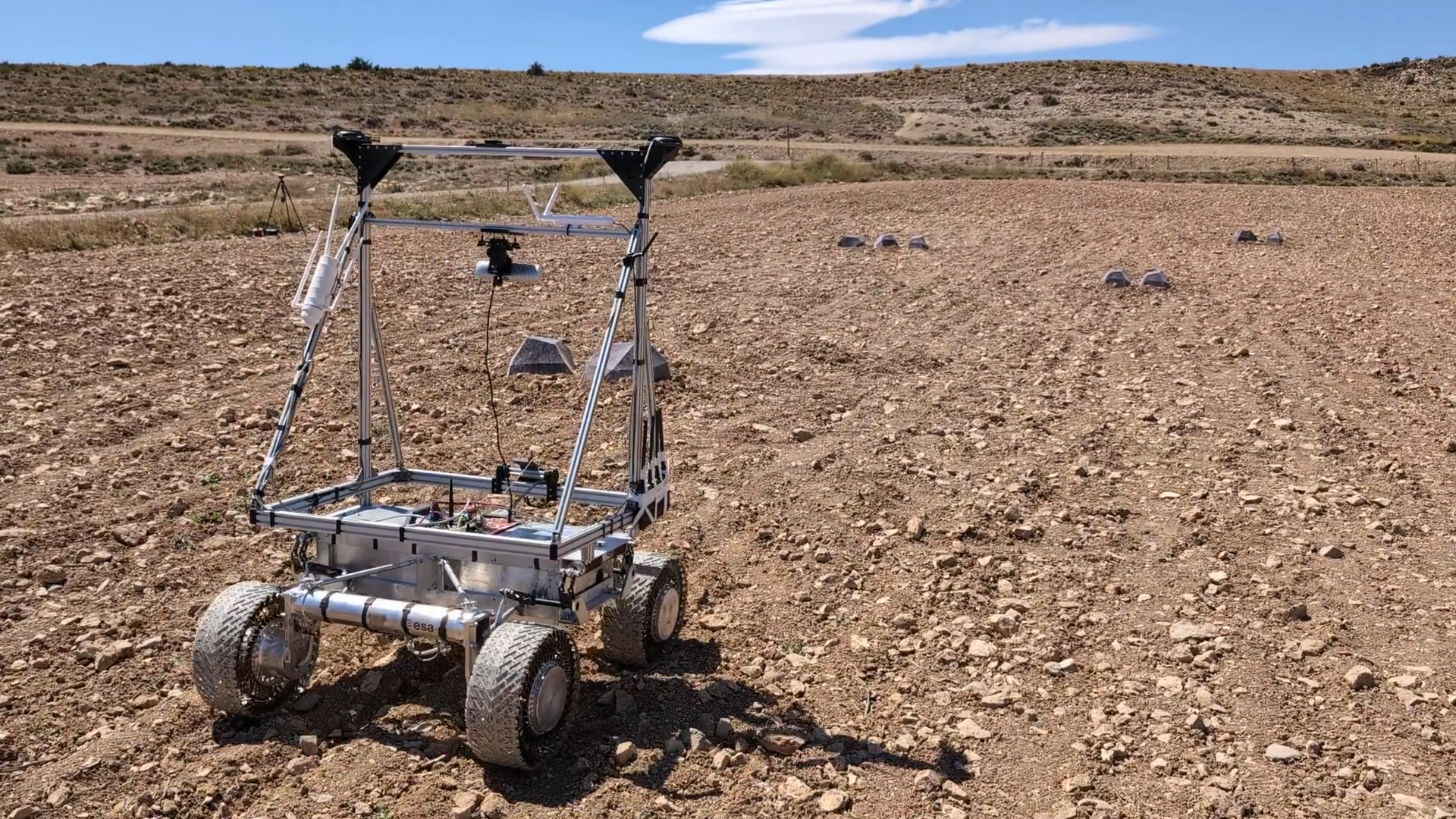
Today, a field test in Fuerteventura, Spain, concluded for a new lunar rover Guidance, Navigation and Control (GNC) system, FASTNAV, that will makes lunar rovers faster, allowing them to cover ten times more ground.
Over eleven days, engineers tested whether the GNC system could autonomously move a rover quickly across a volcanic desert, traversing over lava boulders and dunes. The system aims to get rovers travelling across the lunar landscape at 1 metre per second – roughly 3.6km/h. Previously most rovers have only been able to crawl along at 0.2km/h so this marks a dramatic increase in exploration efficiency.
"The idea behind FastNav is exactly what the name suggests, fast navigation for lunar rovers" explains Lennart Puck, Technical Officer for the activity. "We are targeting rover speeds of around one metre per second. Compared with previous planetary rovers, it’s a leap forward."
Traversing the lunar surface between points of scientific interest takes time, so moving ten times faster and more autonomously will allow more of the lunar surface to be explored. This is important when it comes to exploring the Moon's polar regions, which are of particular interest due to the possible presence of water and mineral resources. Here, future missions may need to move through areas of shadow and low temperature quickly to reach the next interesting science location.
"If we can drive fast enough, we can remain within thermally viable regions, so not lunar day and not lunar night, for longer," adds Lennart. "That gives future missions more options and ultimately more possibilities for science."
The field testing, which concluded today, is progressively increasing the complexity and duration of the rover’s missions. The campaign includes short validation runs, longer missions and testing under different lighting conditions to assess the performance of the navigation algorithms – including overnight trials.
"Rovers are vehicles for scientists," says Lennart. "So faster traverses means we can safely get their instruments to interesting locations quicker, which means the more science we can perform. Instead of spending valuable mission time travelling between sites, we can spend more time exploring and making discoveries."
The activity is being co-funded through ESA’s General Support Technology Programme (GSTP) De-Risk Framework with GMV UK. After beginning as an ESA Technology Development Element (TDE) activity, called RAPID, the software has been incrementally matured through GSTP, progressing from an early innovation to a validated field-tested autonomous navigation system that will enable faster, more meaningful lunar exploration missions.
FASTNAV is one module of a larger connected navigation system, called NOMAD, developed by GMV UK, with support from GMV Spain. The field test for the ongoing activity focused on maturing RAPID, improving its robustness and integrating new capabilities, including AI-assisted terrain and hazard awareness from the latest module, called HAWKEYE. These modules sit alongside ANIME/ LUPIN, (a positioning, navigation and timing (PNT) module) developed through ESA’s Navigation Innovation and Support Programme (NAVISP). While the software is not flight-ready yet, it has reached a new phase of maturation, with a more space-ready framework, more AI terrain awareness and more safety assessments. Eventually, NOMAD will mean rovers no longer need to stop to assess obstacles and decide how to avoid them. Instead, they will be able to react to obstacles and adjust routes without stopping, even in low-visibility environments.
By supporting developments such as FASTNAV, GSTP is helping European industry mature advanced robotics, AI and autonomy technologies and developing technologies to support future rovers and landers (and ultimately a human presence on the lunar surface).
Quelle: ESA