
21.08.2026
INNOSPACE announced today that it conducted SEBIT’s first test flight at the Alcântara Space Center in Brazil at 16:30 on August 19 (BRT, UTC-3), ending the flight early.
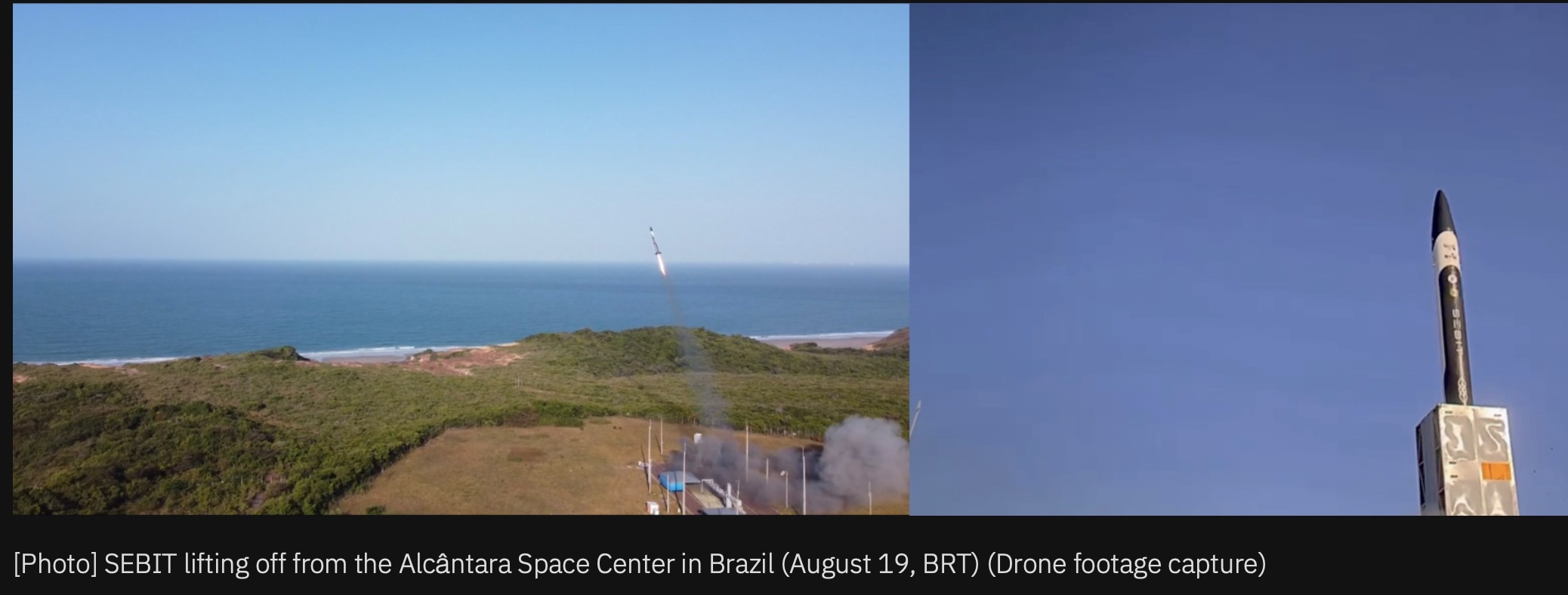
● Conducted its first test flight in Brazil; after a normal liftoff, a trajectory anomaly was detected during flight
● The Brazilian Air Force (FAB) activated the Flight Termination System (FTS) to terminate the rocket’s flight trajectory, in accordance with the Launch Center’s safety regulations
● Flight data secured, including guidance, navigation and control (GNC) and tracking; flight altitude, distance, and time and the exact cause currently under analysis
INNOSPACE announced today that it conducted the first test flight of its multipurpose suborbital rocket ‘SEBIT’ at the Alcântara Space Center in Brazil at 16:30 on August 19 (BRT, UTC-3), and terminated the flight early.
The test flight was carried out to comprehensively verify SEBIT’s flight performance and operational stability and to accumulate the flight data and operational experience needed for future suborbital test and verification services built on reliability and stability.
SEBIT, a single-stage rocket equipped with a three-ton-class hybrid rocket engine, ignited on INNOSPACE’s own launch pad and lifted off normally. During the subsequent flight, movement deviating from the planned trajectory was detected, and in accordance with the launch center’s safety regulations, the Brazilian Air Force (FAB) activated the Flight Termination System (FTS) to terminate the flight. The rocket came down within a designated maritime safety zone off Brazil, and no injuries or property damage occurred.
During this first test flight, INNOSPACE secured flight data on key systems, including the launch pad, propulsion system, guidance, navigation and control (GNC), and tracking. Based on the collected data, the company is currently analyzing detailed flight results including the precise flight altitude, distance, and time along with the cause of the early termination. Once the exact cause and detailed flight results are confirmed, INNOSPACE plans to incorporate the necessary improvements and conduct follow-up test flights to continuously verify SEBIT’s flight performance and operational stability.
“The data and operational experience secured through this first test flight will be an important asset for advancing SEBIT’s suborbital test and verification services,” said Soojong Kim, Founder and CEO of INNOSPACE. “Through repeated flights, we will continuously raise service reliability and grow SEBIT into a mission-focused suborbital space transportation platform that customers can rely on.”
Unlike launch vehicles that place satellites into Earth orbit, SEBIT’ is a multipurpose suborbital rocket developed to carry customer payloads to altitudes of up to 100 km or below and to perform technology testing and verification and scientific research missions in high-altitude and microgravity environments. Building on the data secured through this first test flight, INNOSPACE plans to further advance its technology, define its service operations framework and continuously strengthen reliability and operational stability through repeated launches.
The responsibility for the facility lies with the Brazilian Air Force (FAB). For the first time, the commercial agreement for the use of Alcântara Space Center was facilitated by ALADA – Brazilian Aerospace Projects Company, which was established in 2025 to drive and expand commercial activities involving Brazil's state-owned aerospace infrastructure.
Quelle: INNOSPACE