
21.11.2026
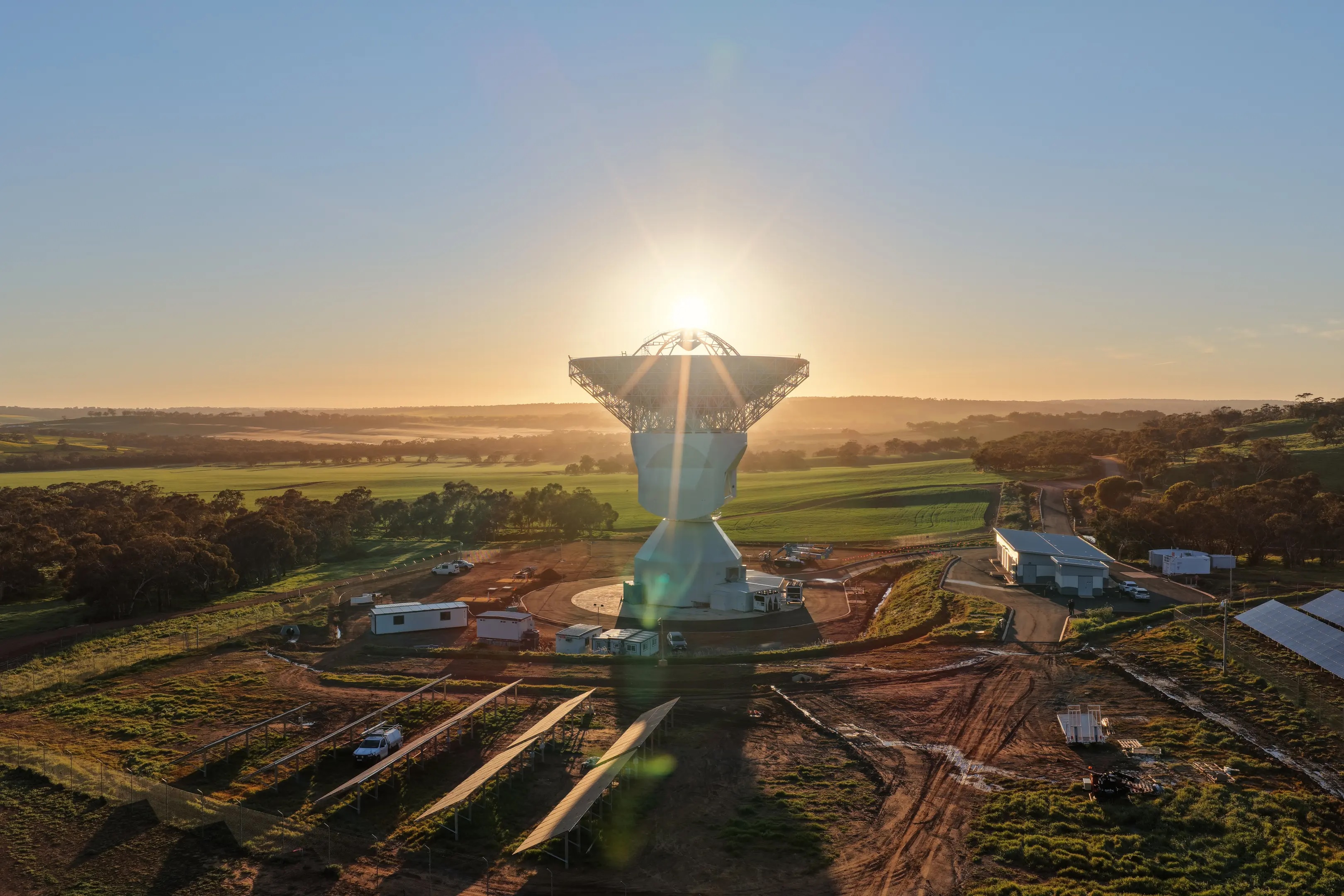
At New Norcia, ESA’s newest deep space antenna, DSA 4, can now send commands to two spacecraft simultaneously using different X-band frequencies, a unique and technically complex capability. Successfully demonstrated with Mars Express and ExoMars Trace Gas Orbiter, this breakthrough boosts efficiency across ESA’s Estrack ground network. This innovation opens new possibilities for supporting an expanding fleet of deep space missions.
Point one deep space antenna at Mars – and talk to two orbiters at the same time.
That is now a reality at ESA’s New Norcia deep space ground station in Western Australia. The agency’s newest 35‑metre antenna – Deep Space Antenna 4 (DSA 4), also known as New Norcia 3 – has demonstrated a unique new communications capability: sending commands to two spacecraft orbiting another planet using two different X-band frequencies simultaneously.
ESA engineers have established this first dual two‑way X‑band link between DSA 4 and ESA’s two Mars orbiters: Mars Express and ExoMars Trace Gas Orbiter (TGO). The antenna now routinely supports both spacecraft during the same pass.
“The capability was introduced early in the design of New Norcia 3, in view of its strategic value for future deep-space missions, most notably at Mars” says Peter Droll, Head of the Ground-based Communication and Tracking Assets Section at ESA.
ESA engineers believe this dual X‑band uplink capability is unique. “We are not aware of any other deep space station on the planet that offers a similar capability,” says Daniel Firre, Ground Operations Engineer at ESA.
Behind this milestone is Estrack, ESA’s global network of ground stations, designed, operated and continuously evolved by ESA’s European Space Operations Centre (ESOC) in Darmstadt, Germany, to meet the growing demands of deep space missions. The achievement reflects ESOC’s role in developing innovative ground segment solutions that enable ESA missions to operate more efficiently and sustainably.
AN X-BAND FIRST FOR DEEP SPACE
Listening to more than one spacecraft at the same time is not new. Many deep space networks, including ESA’s Estrack and NASA’s Deep Space Network, routinely receive simultaneous downlinks from multiple spacecraft using a single antenna – a technique known as multiple spacecraft per aperture. It works because each spacecraft is transmitting on a slightly different frequency.
Sending commands, however, is a different story. Generating two simultaneous uplinks from a single antenna – known as multiple uplink per aperture – is technically demanding.
When both command signals use X-band, they can interfere with one another, like two people talking in a busy room. DSA 4 overcomes this with a hybrid coupler built by the space technologies company Thales Alenia Space that allows a single antenna feed to be shared safely between two command signals and routed independently.
Deep Space Antenna 5 (DSA 5), ESA’s next 35 m deep space antenna that is currently in preparation following the project’s approval at the November 2025 Ministerial Council, will also feature a hybrid coupler and dual X-band uplink capabilities.
UNLOCKING CAPACITY ACROSS ESTRACK
DSA 4’s dual uplink capability is helping ease capacity pressure across the Estrack network.
“Estrack is now facing a capacity challenge as more missions book time with our ground stations,” says Donato Lospalluto, Estrack Maintenance and Operations Architect at ESA. “By expanding our ability to uplink to two spacecraft at once, we can free capacity and support more missions overall.”
“DSA 4’s dual uplink capability is like adding a virtual station to Estrack,” adds Martin Unal, ESA Ground Operations Engineer.
PAVING THE WAY WITH DEEP SPACE ANTENNA 1
Simultaneous uplinking is not entirely new at ESA. Before DSA 4, engineers used Deep Space Antenna 1 (DSA 1) at New Norcia to support Mars Express and TGO at the same time.
DSA 1 is ESA’s only deep space antenna with S‑band uplink capability, allowing it to transmit simultaneously in S‑band and X‑band. This made dual uplinking possible by commanding Mars Express in S‑band and TGO in X‑band.
But it worked only because Mars Express, launched in 2003, carries both S‑band and X‑band systems. Although S‑band was intended mainly for safe‑mode use, engineers adapted it for routine commanding. The workaround reduced overall network load by around 16% but required additional pre‑configuration and was unsuitable during challenging periods such as solar conjunction, when the weaker S‑band signal is more affected by the Sun.
With DSA 4, these limitations are removed. Both deep space antennas at New Norcia now support dual two‑way uplink.
MARS: THE PERFECT PLAYGROUND
Dual X‑band uplink is powerful, but only practical in rare cases.
“Now we have the technical capacity with DSA 4,” says Martin. “The limiting factor for use, however, is having two spacecraft close enough together to receive signals from the same antenna.”
This geometry is rare in deep space but ideal at Mars. With both Mars Express and TGO orbiting the Red Planet, DSA 4 must only be pointed once to command both spacecraft.
For Mars Express and TGO, DSA 4’s dual X-band uplink means more reliable commanding, simpler operations, and reduced competition for ground station time.
More broadly, dual X-band uplink capabilities also provide increased opportunities for cooperation with missions from other space agencies flying close to ESA spacecraft near Mars or Mercury, demonstrating how ESOC is shaping the next generation of deep space ground support through innovative ground segment design. By unlocking new efficiencies across Estrack, these developments help ensure that Europe’s deep space infrastructure can support an increasingly ambitious portfolio of exploration and science missions.
Quelle: ESA