
22.09.2026
BELA ready to explore Mercury’s surface
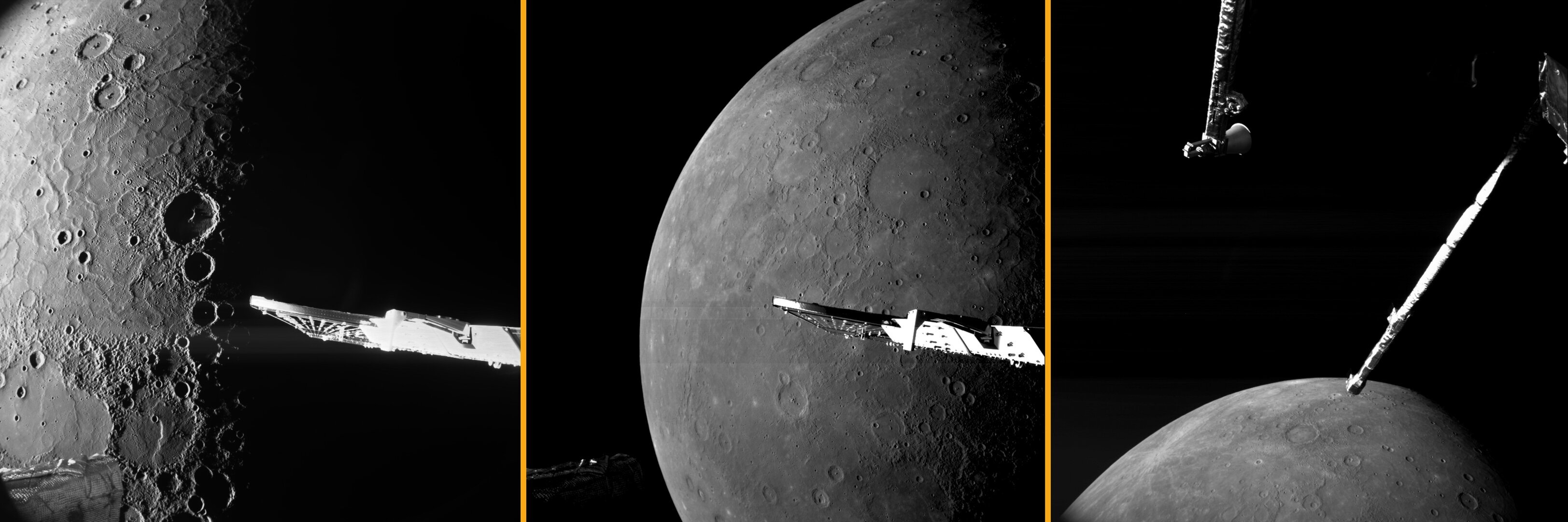
The joint BepiColombo mission to Mercury of the European Space Agency (ESA) and the Japan Aerospace Exploration Agency (JAXA) has entered its final phase after almost eight years in space. Following the successful separation of the Mercury Transfer Module (MTM) from the two orbiters on 3 September 2026, the mission reached another important milestone on 14 September 2026: the laser of the BELA altimeter was successfully activated for the first time in space. The instrument was built under the leadership of the University of Bern.
Launched on 20 October 2018, the joint ESA/JAXA BepiColombo mission has travelled for almost eight years, using a carefully planned but eventful sequence of planetary flybys and solar-electric propulsion to gradually approach its destination, Mercury. The mission is now entering the final stage of its journey to the smallest and innermost planet of our Solar System.
The BepiColombo spacecraft consists of the Mercury Transfer Module (MTM) and two orbiters: ESA’s Mercury Planetary Orbiter (MPO) and JAXA’s Mercury Magnetospheric Orbiter (Mio). The spacecrafts are flying to Mercury together as a coupled system, but once there, they will be placed into separate orbits. Following the first separation maneuvers of the MTM from Mio and MPO, preparations are underway for the spacecraft’s arrival at Mercury and the start of its scientific mission in 2027. On board the space probe is an instrument which was designed and built at the Physics Institute of the University of Bern: the laser altimeter BELA – the heaviest instrument on the MPO probe. On 14 September 2026, the instrument team successfully activated BELA’s laser for the first time in space and for the first time since 2017.
BELA ready to map Mercury’s surface
On 14 September 2016, the laser altimeter BELA had left Bern for ESA’s European Space Research and Technology Centre ESTEC to be integrated onto the MPO spacecraft. Ten years later to the day, the instrument team from the University of Bern and the German Aerospace Center (DLR) Berlin fully activated the BELA laser altimeter for the first time since the spacecraft began its journey – a crucial step towards the start of BepiColombo’s scientific mission.
BELA was developed by an international consortium under the leadership of the University of Bern and the German Aerospace Center (DLR), in cooperation with the Max Planck Institute for Solar System Research and the Institute of Astrophysics of Andalusia (IAA-CSIC). The aim is to measure the shape, topography and morphology of the surface of Mercury.
“With BELA, we will be able to create a three-dimensional representation of Mercury with unprecedented accuracy”, explains Antoine Pommerol from the Space Research and Planetary Sciences Division at the Physics Institute of the University of Bern, Co-Principal Investigator for BELA.
A cautious step-by-step activation
The activation of BELA followed a carefully controlled sequence. First, the team commanded the laser to emit a ten-second burst. During this initial test, more than a hundred ultrashort pulses of infrared light were sent out toward open space from the spacecraft, which is roughly 200 million kilometers away from Earth. Pommerol explains: “The laser pulses were only sent toward open space this time, not yet toward Mercury. But they could still be characterized by the instrument, providing crucial data on the health of the laser system after 8 years in space and 9 years since its last firing. When the first data packet reached the ground station about ten minutes after the test, it confirmed that the instrument had performed as expected.”
BELA was then given the first “go” for the next step. The team repeated the ten-second sequence and, after receiving a second confirmation, extended the laser operation to ten minutes. Only after this test had also been successfully completed did they run the laser for more than an hour.
This step-by-step procedure allowed the team to check the instrument’s performance at each stage while keeping the risk as low as possible. “In particular, the test confirmed that the laser was operating reliably and that its thermal behavior remained within the expected limits”, says Pommerol.
“Commissioning is meant to be undramatic”, says Dr. Liliane Burkhard, Instrument Scientist for BELA at the University of Bern’s Physics Institute. “Each step is carefully designed to reveal any potential problems while the laser is operating for only ten seconds, rather than for an hour. Seeing the first data packet arrive exactly as predicted was incredibly rewarding, especially after the instrument had spent so many years traveling in space just waiting to be switched on”.
The final steps towards Mercury science
“It was very exciting to fully activate BELA again,” says Pommerol. The last time the team fully tested the functionality of the instrument was in 2016, in a dedicated laboratory in Bern. “Although we were cautiously optimistic that BELA would perform as intended, it was a great relief – and a source of satisfaction – to confirm that all subsystems are working nominally. We are now eager to begin the science phase and investigate some of Mercury’s enduring mysteries.”
The next major milestone is scheduled for 9 December 2026, when JAXA’s Mio will be deployed into its operational orbit around Mercury. Further maneuvers will then prepare ESA’s Mercury Planetary Orbiter (MPO) for its own science orbit, which it is scheduled to reach in March 2027.
On 6 April 2027, the long wait will finally be over: BepiColombo’s science phase will begin. After more than eight years in space, the mission will start its detailed investigation of Mercury, offering scientists an unprecedented opportunity to study the planet closest to the Sun.
Quelle: University of Bern