
22.09.2026
Alpha Cubesat
ITHACA, NY – Students in Cornell’s Space Systems Design Studio (SSDS) have just published mission results for two unique light sail experiments. These sails are slightly larger than a pizza box, and harness momentum from photons to accelerate to high velocities. With ChipSats onboard – gram-scale spacecraft that fit in the palm of your hand, the sails can become free-flyers. They origami-fold into CubeSats for launch, and completely separate when deployed, allowing them to be far smaller and lighter than traditional solar sails. The ChipSats provide all ground communications and steering capabilities, for a fraction of the mass and cost.
The two experiments – Alpha CubeSat and Sailing to the Stars – launched to the ISS in late 2025 on NG-23 and Crew-11, respectively.
Alpha is 1U CubeSat, funded by NASA’s CubeSat Launch Initiative, that deployed the light sail in low Earth orbit. Through the TinyGS network, amateur radio operators around the world managed to establish contact with the small ChipSat spacecraft onboard prior to the sail’s quick demise due to atmospheric drag.
“This is the first time a spacecraft this small has transmitted complete data packets from orbit to ground,” said Joshua Umansky-Castro, mission lead and recent graduate of the Aerospace Engineering Ph.D. program at Cornell University. “This is a huge milestone that advances the state-of-the-art for the ChipSat platform.”
In the months that followed (until deorbit in May 2026) The CubeSat confirmed a successful deployment, and carried out several secondary tech demos including a magnetorquer-only spin-stabilization algorithm, all COTS avionics, including the first-ever flight of a RockBLOCK Iridium modem, a fully 3D-printed chassis, and even the first holographic-image message plaques sent to space.
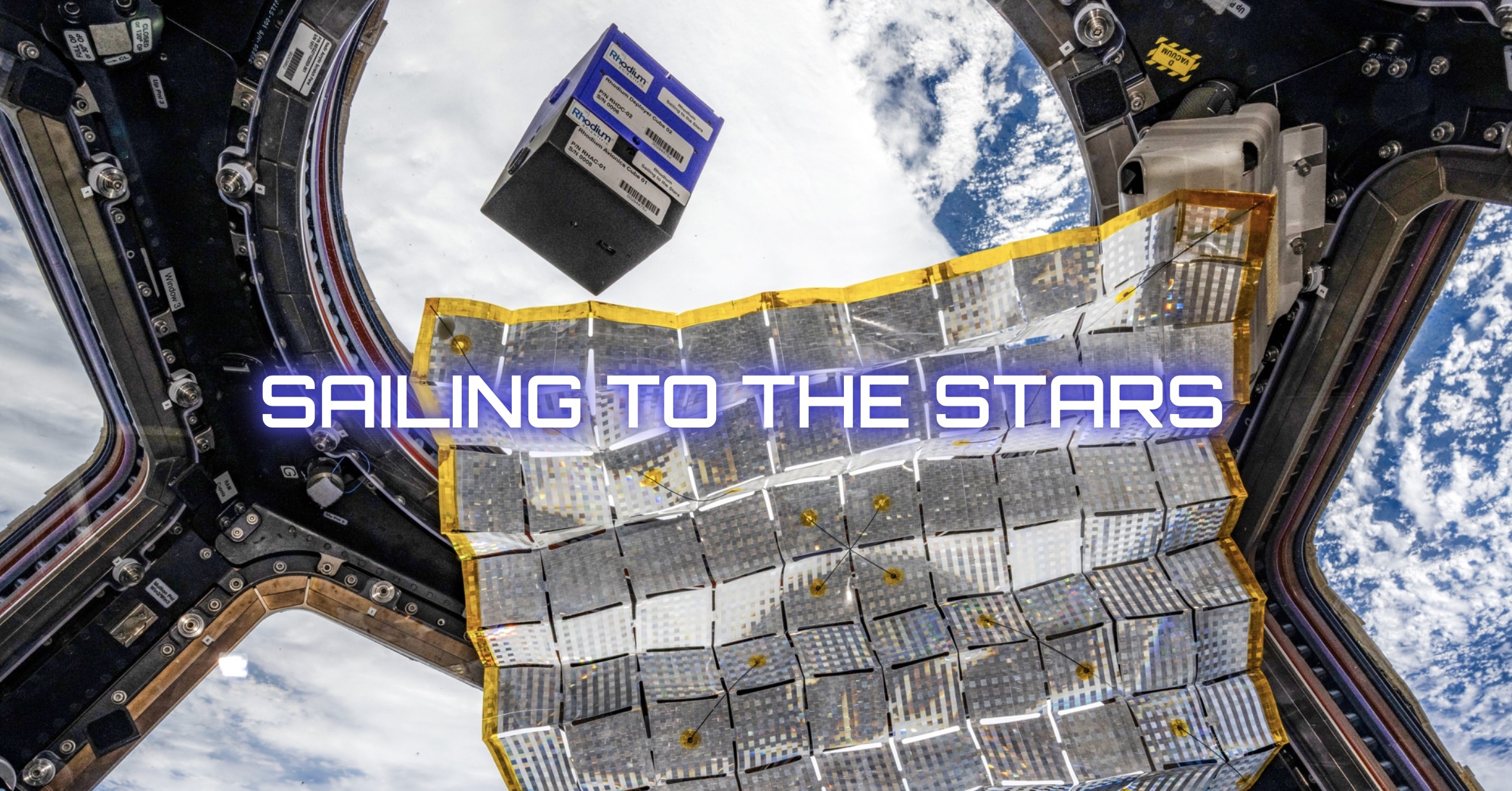
Sailing to the Stars is a companion ISS experiment that tested the deployment of six of these light sails in the microgravity environment of the space station. Funded by ISS National Laboratory in collaboration with Rhodium Scientific, it obtained critical video footage and IMU data that helps the students better understand the sail-deployment dynamics. Two different CubeSat-scale deployer designs were tested – both entirely 3D-printed with modular “CubeSat-LEGO” components, spin-stabilized with laptop hard disk drive reaction wheels, and commanded via TV remotes – to assess which release mechanism displayed more stable kinematics. The insights gained from this experiment inform the design of future missions.
Student-Led Space Exploration
These light sail missions were designed, assembled, and tested by students, with the original concept for Alpha proposed by a high school student as part of the Museum of Science Fiction’s International CubeSat Design Competition. Since 2016, over 150 students contributed to the spacecraft projects, with over 50% interning or working in the aerospace industry after graduation.
“Going into college, it was my dream to work on something that would fly in space,” said Verena Padres ’26, manager of the Sailing to the Stars project. “I’m so grateful for the opportunity to not only gain hands-on spacecraft engineering experience, but to also lead the team from mission concept through launch!”
What’s Next?
Both light sail experiments completed all major mission objectives. Their success paves the way for future ChipSat-sail launches to demonstrate steering, orbit-raising, laser-propulsion, and even solar system exploration missions to the moon, Mars, and beyond. The ultimate goal? Interstellar travel. As highlighted by initiatives such as Breakthrough Starshot, sails riding on laser beams could one day send tiny spacecraft to nearby star systems in the search for life beyond our own.
About SSDS
The Space Systems Design Studio is a lab within the Sibley School of Mechanical and Aerospace Engineering at Cornell University. It is run by Professor Mason Peck and seeks ways to take advantage of spacecraft physics to improve space capabilities.
Quelle: AAAS