
18.08.2026
Firefly Aerospace is advancing on two fronts this month, pushing development of its next-generation medium-lift rocket while refining the design of its operational smallsat launcher. The dual path is part of the company’s strategy to expand its role in both commercial and government markets.
Central to the updates is Eclipse, Firefly’s upcoming medium-lift vehicle.
Designed to deliver more than 16 metric tonnes to low-Earth orbit, Eclipse represents a significant step up in capability from the company’s current Alpha rocket.
The first stage is being engineered for reusability, with a particular focus on return-to-launch-site landings that would allow the booster to fly back to its original pad after staging.
Company officials confirm the vehicle remains on track for its first launch next year. However, they have indicated that the initial flights may prioritize reaching orbit successfully, meaning the first actual booster landings could be deferred until later missions once the system has proven itself in flight.
The first stage of Eclipse will be powered by seven kerosene-fueled engines named Miranda.
Firefly announced a major test milestone on that front, with one Miranda engine fired at full power for 226 seconds, nearly four minutes. That duration exceeds what is required for a normal ascent, giving engineers extra confidence in the engine’s endurance.
During the long burn, the team conducted sweeps that varied both the power level and the mixture ratio between RP-1 kerosene fuel and liquid oxygen. These tests help map the engine’s performance across a range of operating conditions it might encounter in flight.
With more than 150 hot-fire tests now completed on the Miranda, Firefly believes the engine’s performance is where it needs to be for flight. The next phase will move the engine into formal qualification testing, a critical step before it can be certified for use on the first Eclipse vehicle.
While Eclipse development continues, Firefly has also been refining its existing Alpha rocket.
Alpha has previously flown with a distinctive black carbon-fiber finish. Block II will instead feature a white exterior.
The change is not merely cosmetic, with the white coating forming part of an upgraded thermal protection system intended to better manage heat loads during ascent and atmospheric flight.
The timing of the thermal upgrade appears connected to lessons learned from Alpha’s sixth mission, known as “Message In A Booster.”
That flight ended in failure after one side of the first stage experienced significantly higher temperatures than expected. The excess heating reduced structural margins and ultimately contributed to an explosion at the moment of stage separation.
The company believes adding robust thermal protection is a logical response aimed at preventing a similar issue on future flights.
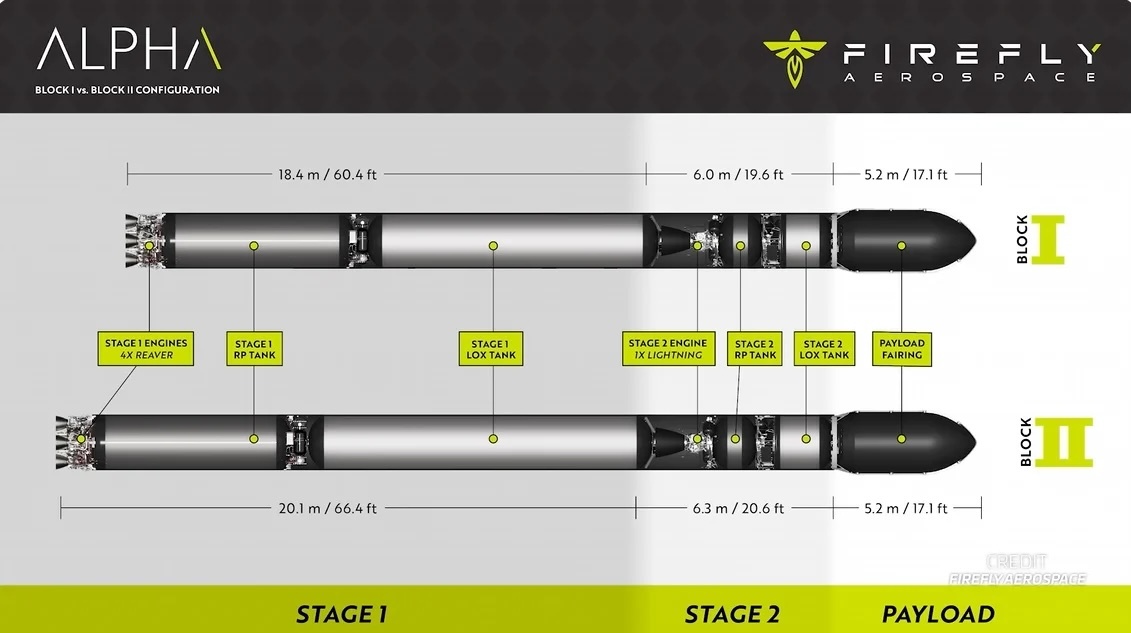
Beyond the new paint and thermal improvements, Block II introduces physical changes as well.
Stretched propellant tanks will increase the rocket’s overall height by more than two meters, or roughly seven feet.
The additional propellant volume is expected to provide a meaningful performance boost, allowing Alpha to carry heavier payloads or reach more demanding orbits.
These and other upgrades will make their first appearance on the next Alpha flight, the debut of the Block II configuration, currently targeted for the fourth quarter of this year.
A second Alpha mission is also planned for the same quarter, allowing Firefly to demonstrate the improved vehicle in relatively quick succession.
Looking further ahead, the flight rate for Alpha is set to increase substantially. Lockheed Martin has secured access to as many as 25 launches on the vehicle.
The original agreement, signed in 2024, committed the company to 15 Alpha missions through 2029, with an option for 10 additional flights.
This month, Firefly announced a two-year extension of that contract, stretching the arrangement through 2031. The longer timeline provides both companies with greater planning certainty and signals sustained demand for dedicated smallsat launches.
If timelines hold, Eclipse’s first flight next year will mark Firefly’s entry into the medium-lift market with a partially reusable vehicle, while the upcoming Block II Alpha missions later this year will validate the practical benefits of the latest design changes.
Quelle: NSF