
11.04.2025
SpaceX to launch new Intuitive Machines moon lander, lunar satellites in 2027
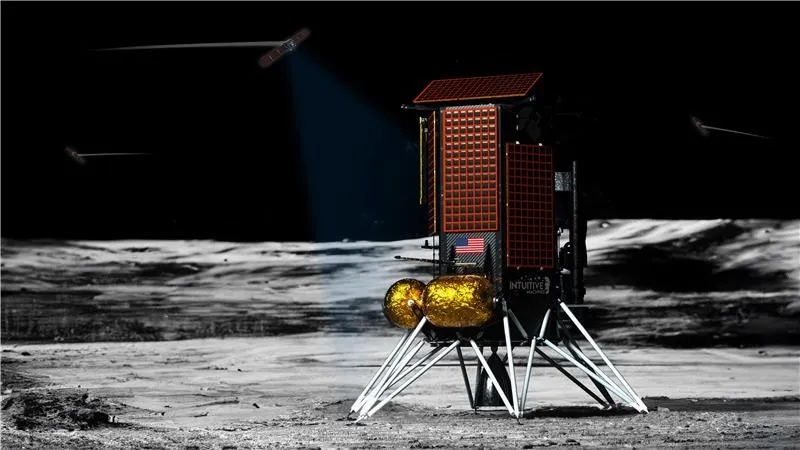
Intuitive Machines will use a SpaceX Falcon 9 rocket launch its IM-4 moon lander, shown in an artist's view above, along with two lunar communications relay satellites in 2027. (Image credit: Intuitive Machines)
Intuitive Machines may have crashed its latest moon lander on the lunar surface, but that's not keeping the company down for long.
The Houston-based company has picked SpaceX to launch IM-4, its fourth moon lander, on a Falcon 9 rocket in 2027 alongside two relay satellites for a NASA lunar communications network. The news comes just weeks after the company's IM-2 moon lander crashed near the moon's south pole, and as the firm continues work on its third moon lander (yes, it's called IM-3), which is expected to launch in 2026.
“Lunar surface delivery and data relay satellites are central to our strategy to commercialize the Moon," Intuitive Machines CEO Steve Altemus said in a statement Tuesday (April 8). "We plan to deploy the first of five lunar data relay satellites on our third mission, which will introduce our pay-by-the-minute service. The two additional satellites on our fourth mission are intended to scale that service, followed by two additional deployments to complete the constellation and fully support NASA and commercial lunar operations." The relay satellites will support NASA’s Near Space Network Services contract, Intuitive Machines wrote.
Intuitive Machines' IM-4 moon lander will carry six NASA payloads under a contract with the agency's Commercial Lunar Payload Services program. A new drill experiment built by the European Space Agency to hunt for water near the moon's south pole, will be aboard.
Intuitive Machines' first moon lander, called IM-1 Odysseus, tipped over after breaking a landing leg while attempting to land in 2024. The second lander, the IM-2 Athena, fell on its side during a lunar south pole landing attempt on March 6.
The IM-3 moon lander is under construction now.
Quelle: SC
----
Update: 18.08.2026
.
South Korea sends lunar radiation detector on NASA commercial lander
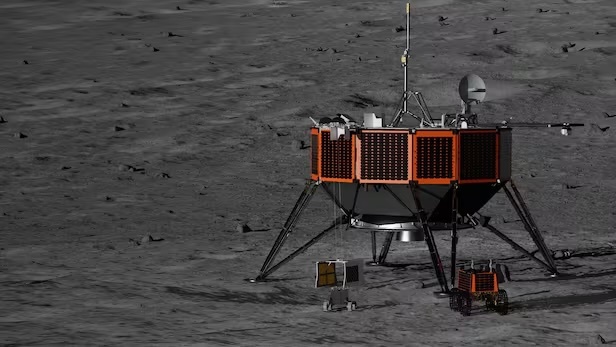
A rendering of Intuitive Machines' private lunar lander that will carry the Korean-made Lunar surface space radiation detector (LVRAD) /Courtesy of NASA
The lunar surface space radiation detector (LVRAD), developed with domestic technology, will head to the lunar south pole aboard a National Aeronautics and Space Administration (NASA) commercial lunar lander.
Korea AeroSpace Administration said on the 17th that it signed an implementation agreement with NASA on the 14th for cooperation on LVRAD's payload integration and operation. Korea AeroSpace Administration plans to complete development of a flight model that will perform an actual mission in space by 2027 and then ship the equipment to the United States according to NASA's launch schedule. NASA will launch the detector aboard a commercial lander and support instrument operations and transmission of observational data after arrival on the lunar surface.
The mission is part of NASA's Commercial Lunar Payload Services (CLPS) program, under which NASA purchases lunar landing and payload delivery services from U.S. private companies. In March, NASA signed a $180.4 million contract with Intuitive Machines, with a landing target of 2030. The total mass of the seven payloads is about 75 kg, of which five are NASA instruments. LVRAD development is led by Korea Astronomy and Space Science Institute (KASI).
LVRAD is an instrument that identifies the characteristics of space radiation reaching the lunar south pole. It consists of a space radiation dosimeter/spectrometer that measures radiation transmission and energy distribution, and a neutron spectrometer that analyzes the neutron environment. The observational data will be used to determine how radiation affects the lander, exploration equipment, and astronauts, and to enhance the safety of future crewed and uncrewed lunar exploration.
The lunar lander that will carry the detector is being developed by the U.S. space company Intuitive Machines. The company has previously delivered payloads to the moon twice, and this contract is Intuitive Machines' fifth CLPS mission award.
Oh Tae-seok, head of Korea AeroSpace Administration, said, "This agreement will serve as an opportunity to further strengthen cooperation between Korea AeroSpace Administration and NASA on future lunar base efforts."
Quelle: ChosunBiz