
14.05.2025

This picture of Mars is a composite of several images captured by Europa Clipper’s thermal imager on March 1. Bright regions are relatively warm, with temperatures of about 32 degrees Fahrenheit (0 degrees Celsius). Darker areas are colder. The darkest region at the top is the northern polar cap and is about minus 190 F (minus 125 C).
Credit: NASA/JPL-Caltech/ASU
Headed for Jupiter’s moon Europa, the spacecraft did some sightseeing, using a flyby of Mars to calibrate its infrared imaging instrument.
On its recent swing by Mars, NASA’s Europa Clipper took the opportunity to capture infrared images of the Red Planet. The data will help mission scientists calibrate the spacecraft’s thermal imaging instrument so they can be sure it’s operating correctly when Europa Clipper arrives at the Jupiter system in 2030.
The mission’s sights are set on Jupiter’s moon Europa and the global ocean hidden under its icy surface. A year after slipping into orbit around Jupiter, Europa Clipper will begin a series of 49 close flybys of the moon to investigate whether it holds conditions suitable for life.
A key element of that investigation will be thermal imaging — global scans of Europa that map temperatures to shed light on how active the surface is. Infrared imaging will reveal how much heat is being emitted from the moon; warmer areas of the ice give off more energy and indicate recent activity.
The imaging also will tell scientists where the ocean is closest to the surface. Europa is crisscrossed by dramatic ridges and fractures, which scientists believe are caused by ocean convection pulling apart the icy crust and water rising up to fill the gaps.
“We want to measure the temperature of those features,” said Arizona State University’s Phil Christensen, principal investigator of Europa Clipper’s infraredcamera, called the Europa Thermal Imaging System (E-THEMIS). “If Europa is a really active place, those fractures will be warmer than the surrounding ice where the ocean comes close to the surface. Or if water erupted onto the surface hundreds to thousands of years ago, then those surfaces could still be relatively warm.”

This picture of Mars is a colorized composite of several images captured by Europa Clipper’s thermal imager. Warm colors represent relatively warm temperatures; red areas are about 32 degrees Fahrenheit (0 degrees Celsius), and purple regions are about minus 190 F (minus 125 C).
Credit: NASA/JPL-Caltech/ASU
Why Mars
On March 1, Europa Clipper flew just 550 miles (884 kilometers) above the surface of Mars in order to use the planet’s gravitational pull to reshape the spacecraft’s trajectory. Ultimately, the assist will get the mission to Jupiter faster than if it made a beeline for the gas giant, but the flyby also offered a critical opportunity for Europa Clipper to test E-THEMIS.
For about 18 minutes on March 1, the instrument captured one image per second, yielding more than a thousand grayscale pictures that were transmitted to Earth starting on May 5. After compiling these images into a global snapshot of Mars, scientists applied color, using hues with familiar associations: Warm areas are depicted in red, while colder areas are shown as blue.
By comparing E-THEMIS images with those made from established Mars data, scientists can judge how well the instrument is working.
“We wanted no surprises in these new images,” Christensen said. “The goal was to capture imagery of a planetary body we know extraordinarily well and make sure the dataset looks exactly the way it should, based on 20 years of instruments documenting Mars.”
NASA’s Mars Odyssey orbiter, launched in 2001, carries a sister instrument named THEMIS that has been capturing its own thermal images of the Red Planet for decades. To be extra thorough, the Odyssey team collected thermal images of Mars before, during, and after Europa Clipper’s flyby so that Europa scientists can compare the visuals as an additional gauge of how well E-THEMIS is calibrated.
Europa Clipper also took advantage of the close proximity to Mars to test all the components of its radar instrument in unison for the first time. The radar antennas and the wavelengths they produce are so long that it wasn’t possible for engineers to can do that in a clean room before launch. The radar data will be returned and analyzed in the coming weeks and months, but preliminary assessments of the real-time telemetry indicate that the test went well.
To leverage the flyby even further, the science team took the opportunity to ensure that the spacecraft’s telecommunication equipment will be able to conduct gravity experiments at Europa. By transmitting signals to Earth while passing through Mars’ gravity field, they were able to confirm that a similar operation is expected to work at Europa.
Europa Clipper launched from NASA’s Kennedy Space Center in Florida on Oct. 14, 2024, via a SpaceX Falcon Heavy, embarking on a 1.8 billion-mile (2.9 billion-kilometer) journey to Jupiter, which is five times farther from the Sun than Earth is. Now that the probe has harnessed the gravity of Mars, its next gravity assist will be from Earth in 2026.
More About Europa Clipper
Europa Clipper’s three main science objectives are to determine the thickness of the moon’s icy shell and its interactions with the ocean below, to investigate its composition, and to characterize its geology. The mission’s detailed exploration of Europa will help scientists better understand the astrobiological potential for habitable worlds beyond our planet.
Managed by Caltech in Pasadena, California, NASA’s Jet Propulsion Laboratory in Southern California leads the development of the Europa Clipper mission in partnership with the Johns Hopkins Applied Physics Laboratory in Laurel, Maryland, for NASA’s Science Mission Directorate in Washington. APL designed the main spacecraft body in collaboration with JPL and NASA’s Goddard Space Flight Center in Greenbelt, Maryland, NASA’s Marshall Space Flight Center in Huntsville, Alabama, and Langley Research Center in Hampton, Virginia. The Planetary Missions Program Office at NASA Marshall executes program management of the Europa Clipper mission. NASA’s Launch Services Program, based at NASA Kennedy, managed the launch service for the Europa Clipper spacecraft.
Quelle: NASA
----
Update: 6.08.2025
.
NASA's Europa Clipper radar passes key test during Mars flyby
"We got everything out of the flyby that we dreamed."
NASA's Europa Clipper radar instrument captured echoes from radar signals that bounced off Mars, producing this radargram. The skyline-like pattern reveals topographic features beneath the spacecraft—such as impact craters, hills, and steep slopes—across a 560-mile-long (900-kilometer-long) stretch near Mars' equator. (Image credit: NASA/JPL-Caltech)
NASA's Europa Clipper spacecraft successfully tested its ice-penetrating radar system during a close flyby of Mars earlier this year, proving that the probe is ready for its main mission: peering beneath the frozen crust of Jupiter's moon Europa to search for signs of subsurface liquid water and possibly even determine if those oceans have the ingredients to form and sustain life.
Launched in October 2024, Europa Clipper is on a 1.8-billion-mile (2.9-billion-kilometer) journey to study Jupiter and its moons. On March 1, it flew within 550 miles (884 kilometers) of Mars' surface in a planned gravity assist maneuver to fine-tune its trajectory.
The flyby also provided a valuable opportunity to test Clipper's two onboard scientific instruments in deep space conditions, including its radar system, known as REASON (short for Radar for Europa Assessment and Sounding: Ocean to Near-surface). The instrument successfully sent and received signals that bounced off the volcanic plains of Mars "without a hitch," according to a NASA statement. The 40-minute radar test produced approximately 60 gigabytes of data, confirming that the system is performing as intended and ready for its primary mission at Jupiter's icy moon Europa, the statement read.
"We got everything out of the flyby that we dreamed," Don Blankenship, a research professor at the University of Texas at Austin who serves as the principal investigator for the REASON instrument, said in the statement. "The goal was to determine the radar's readiness for the Europa mission, and it worked. Every part of the instrument proved itself to do exactly what we intended."
REASON is designed to take a look inside Europa primarily by transmitting radio waves that reflect off structures within the underlying ice, according to NASA.
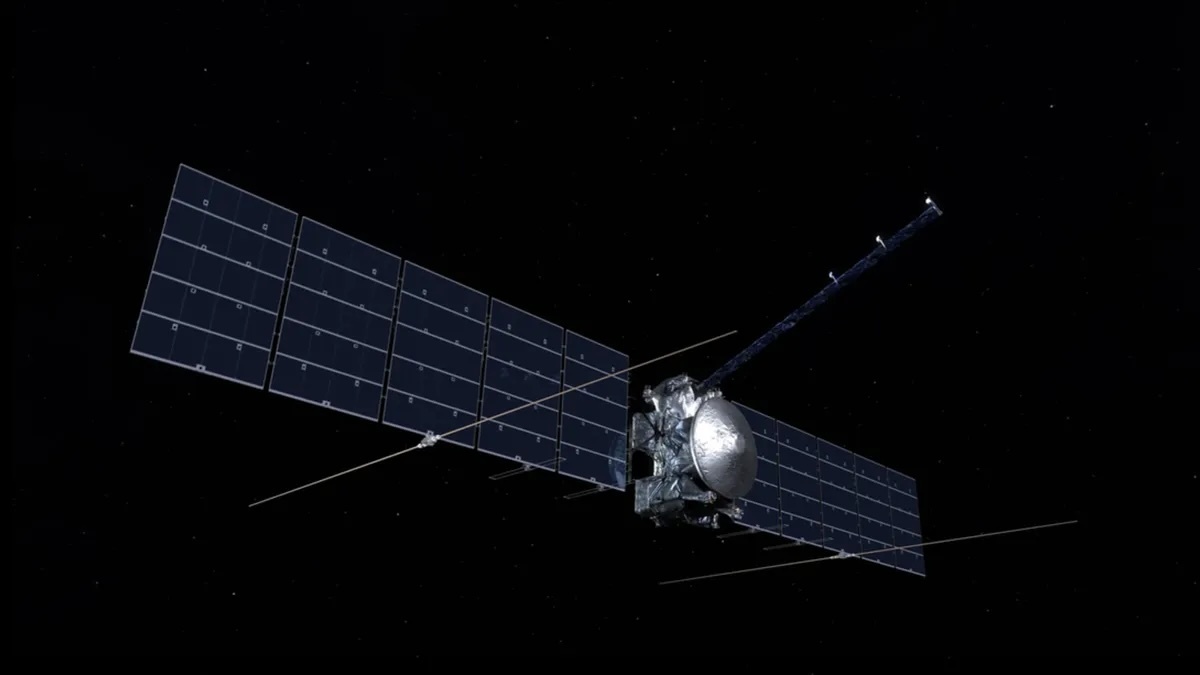
The radar uses two pairs of slender antennas mounted on Europa Clipper's massive solar arrays to transmit and receive signals. The antennas span roughly 58 feet (17.6 meters), while the solar arrays to which they are attached are the size of a basketball court, designed to capture as much sunlight as possible in Europa's dim environment, where sunlight is only about 1/25th as strong as it is on Earth.
While engineers at NASA's Jet Propulsion Laboratory (JPL) conducted extensive prototype testing outdoors using towers on a hilltop above the lab, the final flight hardware had to be kept sterile and tested indoors — limiting full-scale trials. A proper echo test of the fully integrated system would have required a chamber at least 250 feet (76 meters) long, nearly the length of a football field, the statement read.
That made the Mars flyby the first opportunity to test the radar system in its complete, operational form in space.
"All of us who had worked so hard to make this test happen — and the scientists seeing the data for the first time — were ecstatic, saying, 'Oh, look at this! Oh, look at that!' Trina Ray, the deputy science manager for Europa Clipper at JPL, said in the statement.
The spacecraft is currently about 280 million miles (450 million kilometers) from Earth and is set to receive another gravity assist — this time as it whips around Earth — in December 2026. It is expected to arrive in the Jupiter system in 2030, where it will begin a 40-flyby mission of Europa.
Quelle: SC
----
Update: 16.05.2026
.
Scientists propose new way to find aliens — and we may already have a spacecraft that can help
The trick isn't to just search for biosignatures, but rather to look at how they are organized — and the Europa Clipper has an instrument for this.

Researchers may have just revealed a new way of looking for alien life — it's based on the idea that it isn't just the type of biosignatures that are important, but also how they are organized.
"Our approach could help make the search for life more efficient. If a molecular assemblage shows no life-like organization, that may make it a lower priority target," Fabian Klenner of the University of California, Riverside told Space.com.
Let's break down the concept.
First, it should be noted that life uses and produces a range of biologically useful materials such as amino acids, peptides, proteins, fatty acids and so forth. These compounds are therefore considered potential "biosignatures" — if we find them on another world, it is quite possible that they have been produced by life's processes (life as we know it, at least).
However, these compounds are not exclusively biological — abiotic chemical reactions that have no connection to biology can also produce them, and distinguishing between the two possible sources is one of astrobiology's greatest challenges. For example, methane plumes on Mars could be biological or geological in origin, and the same uncertainty also clouds the detection of phosphine in Venus' atmosphere, or the potential discovery of dimethyl sulfide (DMS) in the atmosphere of the exoplanet K2-18b.
This sows confusion because detecting biosignatures does not necessarily mean we have detected life.
However, Klenner is part of a team led by Gideon Yoffe of the Weizmann Institute in Israel that showed there may be a way to distinguish between biological and abiotic origins.
To do so, they took a leaf out of ecologists' book, where life is measured by two metrics: its diversity and how evenly spread its distribution is.
They focused on two biological compounds: amino acids and fatty acids. Amino acids form long chains called peptides that assemble into proteins that are the workhorses inside biological cells. Fatty acids form part of the structure of those cells. Both can be produced by life or by non-living processes.
"We focused on amino acids and fatty acids because they are central molecular classes for life as we know it and because suitable datasets exist," said Klenner.
Indeed, Yoffe and Klenner's team were able to delve into about 100 datasets including samples from asteroids, fossils, meteorites, microbes, soils and synthetic laboratory samples.
They showed that amino acids are more diverse and more evenly distributed when they are created by living organisms than when produced by non-living processes. Fatty acids are the other way around — they are less diverse and less evenly distributed when created by biology.
This is not a foolproof method of detecting life, warn the researchers. First of all, they have only shown that it works with amino acids and fatty acids. "In principle, similar organizational trends may exist for other molecular classes but this still needs to be tested," said Klenner.
Second, the diversity and distribution of these bio-compounds needs to be placed into context with other molecules, otherwise it is impossible to say how diverse and evenly distributed they really are. This means that it cannot be applied to the DMS detection on K2-18b, as we simply don't know enough about that exoplanet's atmosphere to quantify the diversity and distribution.
"For a single molecule like DMS, the situation is different," said Klenner. "For K2-18b, DMS alone would not be enough for our analysis — we'd need a broader inventory of related molecules."
However, the technique may be more useful closer to home, in our solar system, where samples and datasets are more complete. One useful facet of the research is that the organizational patterns hold up no matter how degraded the biological sample is. For example, fossilized dinosaur eggs retained traces of the distribution and diversity of amino acids and fatty acids.
This could come in useful for Mars, where astrobiologists are searching for evidence of life on the Red Planet from billions of years ago when Mars was warmer and wetter.
"Biological samples do not simply become meaningless once they degrade," said Klenner. "Some organizational information can persist, which makes this approach useful for ancient Mars."
The technique on its own cannot confirm the existence of life — in general, the discovery of alien life would be such a profound revelation that we would need multiple lines of evidence to be absolutely sure.
It can, however, direct us towards the best places to look.
One of those places may be Jupiter's moon Europa, which harbors a global ocean of water beneath a thick shell of ice. Astrobiologists are undecided as to whether that ocean is capable of supporting life or not. While NASA's forthcoming Europa Clipper mission, currently on its way to Jupiter to arrive in 2031, won't be able to look under the ice, it will be able to study possible locations where the ocean has erupted onto the surface.
"One of the instruments on board Clipper, the Surface Dust Analyzer, will be able to measure the abundance ratios of organic molecules in ice grains emitted from Europa," said Klenner. "If families of organic molecules are detected, then our diversity based approach will help interpret whether these molecules look more consistent with abiotic chemistry or biological organization."
The findings were published on May 11 in Nature Astronomy.
Quelle: SC