
12.05.2026
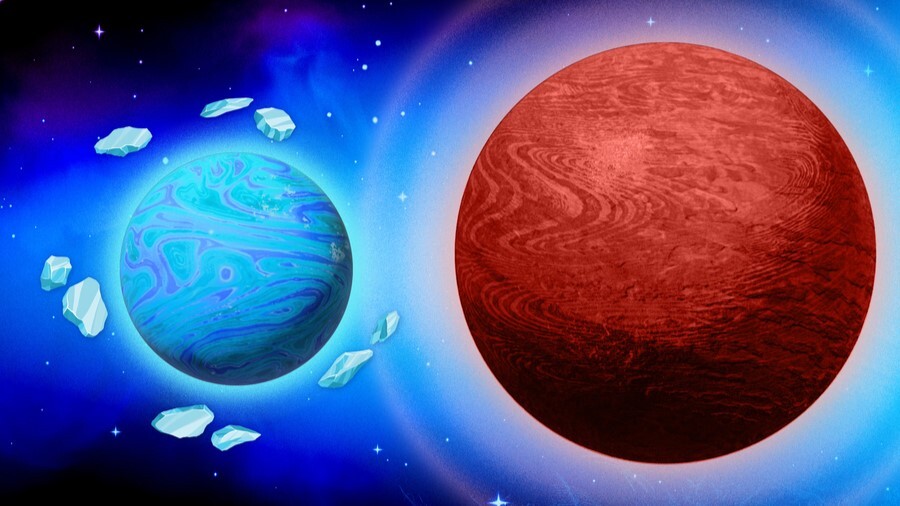
The planetary odd couple of a mini-Neptune and hot Jupiter. Credit: Jose-Luis Olivares, MIT
A “one-of-a-kind” pair of planets has had astronomers scratching their heads since the system was discovered in 2020. Now, the planetary “odd couple” might have an origin story thanks to new data from NASA’s James Webb Space Telescope (JWST).
TOI-1130 is a star about 190 light-years from Earth. It has at least 2 planets orbiting it.
One of the planets, dubbed TOI-1130 b, is a small gas planet about 20 times heavier than Earth. It has been referred to as a “mini-Neptune” because it shares many characteristics of Neptune but is about 10% smaller.
Mini-Neptunes are the most common type of planet among the more than 6,000 found orbiting other stars in the Milky Way.
But this mini-Neptune comes with a seemingly impossible set of circumstances.
The other planet in the system is TOI-1130 c – a so-called “hot Jupiter”. These hot gas giants are normally alone, not sharing their orbital region with any other planets. In the case of the TOI-1130 system, however, the mini-Neptune circles the star inside the orbit of TOI-1130 c.
New analysis published in Astrophysical Letters reveals another bizarre set of characteristics which may shed light on the origins of this odd pair of planets.
“This was a one-of-a-kind system,” says co-author Chelsea Huang who discovered the planets in 2020 and is now a researcher at Australia’s University of South Queensland.
“Hot Jupiters are ‘lonely,’ meaning they don’t have companion planets inside their orbits. They are so massive and their gravity is so strong that whatever is inside their orbit just gets scattered away. But somehow, with this hot Jupiter, an inner companion has survived. And that raises questions about how such a system could form.”
JWST measurements of TOI-1130 b show a “heavy” atmosphere rich in water vapor, carbon dioxide, sulphur dioxide and traces of methane. It is the first atmospheric data of a mini-Neptune.
Such a heavy atmosphere should be impossible for a planet forming so close to its host star.
“The beauty of JWST is that it does not observe just in one colour, but at different colours, or wavelengths,” explains lead author Saugata Barat, a postdoc in the Kavli Institute for Astrophysics and Space Research at Massachusetts Institute of Technology (MIT) in the US. “And the specific wavelengths that a planet absorbs can tell you a lot about the composition of its atmosphere.”
The findings suggest the mini-Neptune and the hot Jupiter formed much further out in a colder part of the system’s protoplanetary disc before being slowly dragged by gravity closer to the star.
It’s the first indication that mini-Neptunes can form beyond a star’s “frost line” – the point beyond which temperatures are so low that water instantly condenses into ice.
“This is the first time we’ve observed the atmosphere of a planet that is inside the orbit of a hot Jupiter,” says Barat. “This measurement tells us this mini-Neptune indeed formed beyond the frost line, giving confirmation that this formation channel does exist.”
“This system represents one of the rarest architectures that astronomers have ever found,” Barat says. “The observations of TOI-1130b provide the first hint that such mini-Neptunes that form beyond the water/ice line are indeed present in nature.”
Quelle: CONNECTSCI