
26.11.2026
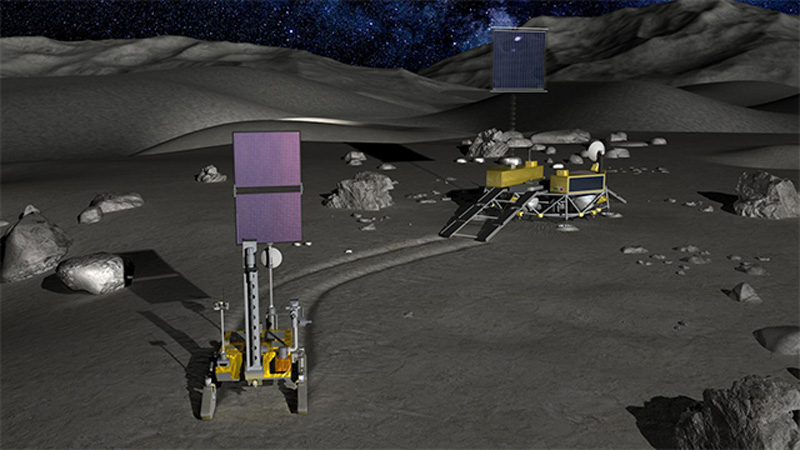
JAXA
In the last few years, the analysis of observational data has suggested the existence of water in the polar regions of the Moon. JAXA is working with ISRO to plan an international collaborative mission to obtain the data on the quantity and forms of the water resources present on the Moon, in order to determine the feasibility of utilizing such resources for sustainable space exploration activities in the future.
- Quantity: Our aim is to obtain actual data (ground truth data) regarding the quantity of water (H₂O) from in-situ observations of areas where water is anticipated to exist, based on the available past observational data.
- Quality: We aim to understand the distribution, conditions, form and other parameters of the lunar water resources through in-situ observations in the polar regions of the Moon.
Through this mission, we also seek to improve the technology needed to explore the surface of low-gravity celestial bodies in order to support future lunar activities. These advancements include technology for mobility, lunar night survival and mining excavation.
Quelle: JAXA
+++
Japan's space agency unveiled Wednesday a test model of a rover that will travel to the Moon's south pole in a search for water, which could potentially be used for rocket fuel.
Dubbed LUPEX -- Lunar Polar Exploration -- the mission aims to send a Japanese rover to the Moon in 2028 in collaboration with India, which successfully landed a spacecraft near the lunar south pole last year.
The Moon's polar regions contain areas known as permanent shadows, which never see sunlight, and scientists say it is highly likely that water exists there near the lunar surface.
The LUPEX team hopes the rover will gather data on the quantity and quality of the water, helping to determine if it could one day be used to make space exploration more sustainable.
"We ultimately want to use lunar water for rocket fuel," project manager Takeshi Hoshino told reporters on Wednesday.
On the International Space Station, more than 90 percent of water is recycled. But when rockets fly by burning oxygen and hydrogen, that water produced cannot be recovered for reuse, Hoshino explained.
"That's why a key objective is to produce fuel on the Moon for future missions, whether returning to Earth or heading onward to Mars," he said.
The Japan Aerospace Exploration Agency (JAXA) unveiled the four-legged test model that will form part of the LUPEX rover to reporters in Tokyo.
Scientists have been testing its performance under a variety of conditions, including "climbing slopes using a single leg, continuous driving using two legs, and mobility trials under vacuum conditions", Hoshino said.
The rover is expected to identify potential water sources once it lands and drill into the site to collect samples, according to JAXA.
Last year, Japan and India agreed to jointly pursue the LUPEX mission, with India developing the lander and Japan supplying the rover.
Amid an intensifying space race globally, JAXA landed in 2024 an unmanned probe on the Moon -- albeit at a crooked angle -- making it just the fifth country to achieve what is known as a "soft landing".
But Tokyo-based firm ispace last year failed in its attempt to become the first private firm outside the United States to achieve a controlled arrival on the Moon.
Last month, JAXA successfully launched a spacecraft to one of Mars's moons on a world-first mission to retrieve samples, potentially helping unlock the origins of the Solar System and life on Earth.
Quelle: AFP