
22.07.2026
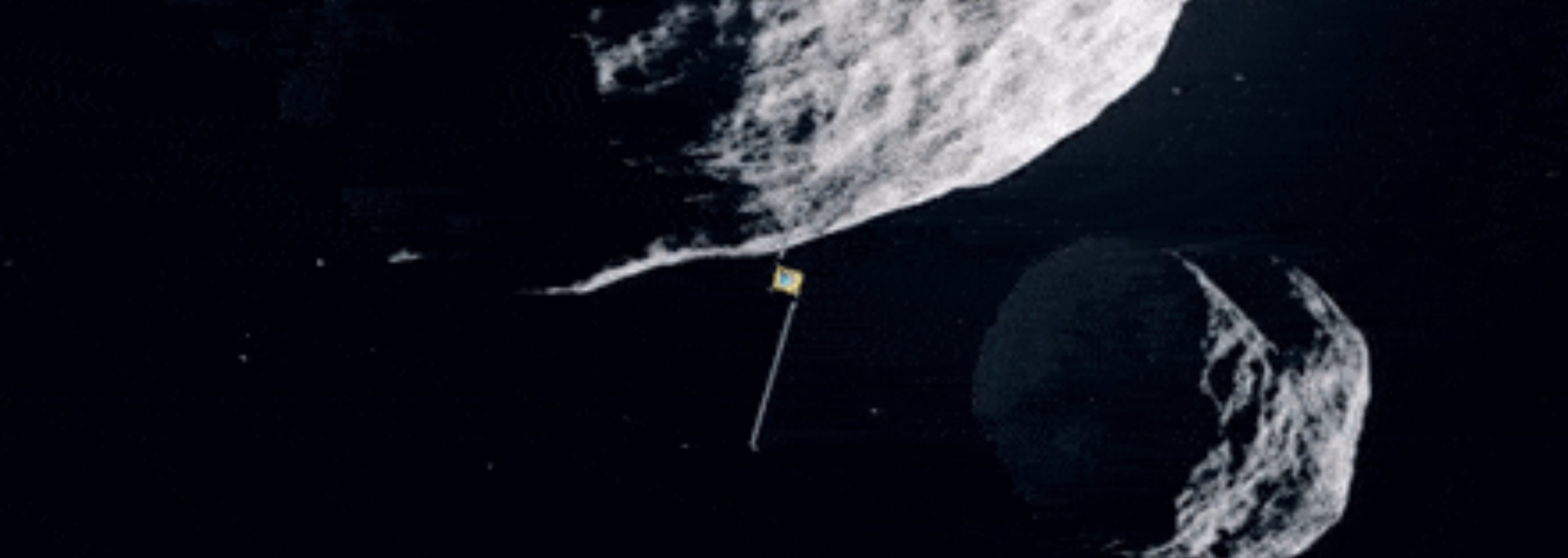
NASA's DART mission proved that a spacecraft can alter an asteroid's trajectory. But it also taught us something equally important: to do so efficiently, you first need to understand your target. That makes reconnaissance the essential first step in any deflection effort – and right now, even the fastest mission ESA can mount takes several years from the start of construction to launch.
ESA is preparing to set a new benchmark for rapid asteroid reconnaissance with RAMSES, which will rendezvous with asteroid Apophis just 3.5 years after the start of construction. Yet even this pace could, in a real-world scenario, mean missing the window to reach a threatening asteroid in time. So ESA is launching a new SysNova challenge calling for novel and advanced concepts for a fast asteroid reconnaissance mission, open now on the Open Space Innovation Platform (OSIP).
Minimising time and cost
Traditionally, exploring the solar system requires hundreds of millions of euros and several years of effort. This campaign asks whether that can be changed. Leveraging modern advances in satellite bus miniaturisation and the growing range of launcher options, ESA hopes to develop a capable reconnaissance mission for well below €100 million – and ultimately bring costs down to tens of millions of euros, with development timelines measured in months rather than years.
"In a real impact scenario, time is everything," says Richard Moissl, Head of ESA's Planetary Defence Office. “RAMSES will set a new record for how quickly we can reach an asteroid, but we need to go further. This campaign is about finding out how fast and how affordably we can really move when it matters most."
What we are looking for
ESA is seeking mission concepts that define a lightweight reconnaissance spacecraft carrying a minimum effective sensor payload suite. A first demonstration mission would establish what is technologically possible; the longer-term goal is a fast reconnaissance capability that is both affordable and rapidly deployable – a strategic asset for the global planetary defence effort.
"This campaign is about pushing boundaries," says Juan Luis Cano, ESA's Planetary Defence Information Provision Coordinator. "We want to hear from teams who can show us what a lean, fast reconnaissance spacecraft could look like – and what it would take to make it a reality."
This campaign runs through SysNova, ESA's technology assessment scheme for advanced mission concept studies, and is funded by the Preparation element of ESA's Basic Activities. Up to five ideas will be selected for a funded pre-Phase A study. Teams can submit their proposals on the OSIP campaign page, where full details on eligibility, evaluation criteria, and the submission process are available.
Quelle: ESA