
21.04.2026
NASA's Curiosity rover has found a diverse mix of organic molecules on Mars, including chemicals considered building blocks for the origin of life on Earth.
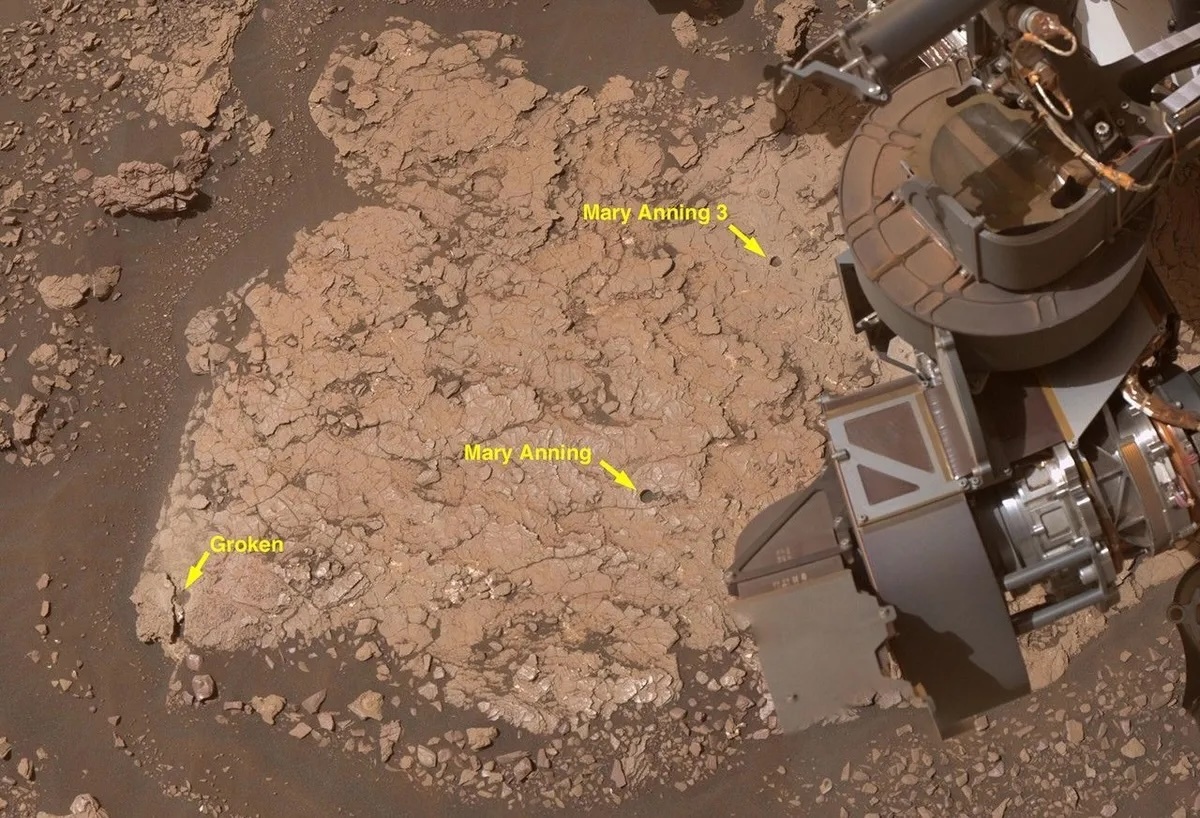
Mars machinery has detected more than 20 organic molecules from clay-bearing sandstones in Glen Torridon, Gale crater, work done by the Sample Analysis at Mars instrument suite onboard the Curiosity rover. Three drill samples were taken and diverse organic molecules were found on Mars. (Image credit: NASA/JPL-Caltech/Malin Space Science Systems)
NASA's Curiosity Mars rover has found a diverse mix of organic molecules on Mars, including chemicals widely considered building blocks for the origin of life on Earth. The finding marks the first time a new kind of chemical experiment has been performed on another planet.
Curiosity rover has been dutifully probing Mars' Gale crater and Mount Sharp since the robot plopped down on the Red Planet on Aug. 6, 2012. The car-sized Mars rover is now wheeling about in the Glen Torridon region of Gale crater, a place that scientists believe could have supported conditions that were favorable to supporting ancient life, if it was ever there in the first place. While in the region, Curiosity recently utilized its onboard Sample Analysis at Mars (SAM)instrument suite, built to search for compounds of the element carbon that are associated with life and investigate ways in which these compounds are generated and destroyed in the Martian ecosphere.
Curiosity's SAM instrument was able to use a chemical known as tetramethylammonium hydroxide (TMAH) to detect organic molecules in the region's clay-rich sandstone. The newly identified chemicals include nitrogen and sulfur-bearing molecules that are similar to the raw material that helped spur life on Earth. However, the experiment can't tell if the chemicals come from ancient Martian life or non-biological geological processes.
The study of Curiosity's first SAM TMAH experiment was led by Amy Williams, an associate professor in the Department of Geological Sciences at the University of Florida in Gainesville. The research has been published in the journal Nature Communications.
"This experiment and its results have been a labor of love and science," Williams told Space.com. "This was the first time that TMAH had been used on another world and our team worked extensively to interpret and confirm the molecules detected in this first-of-its-kind experiment."
Clay-bearing sandstones
Curiosity's experiment detected more than 20 organic molecules from clay-bearing sandstones in the roughly 3.5-billion-year-old Knockfarrill Hill section of Glen Torridon. The variety of organic molecules observed suggests that some chemical diversity has been preserved in ancient Martian sediments despite billions of years of diagenesis (the process by which sediment turns to rock) and radiation exposure.
"We propose that this suite of organics represents TMAH thermochemolysis breakdown products from ancient organic macromolecular material that has been preserved in billions-of-years-old sedimentary rocks in Gale crater," explains the research paper.
Williams said the rover's discoveries were confirmed with other instruments aboard. "We iterated on molecule identifications using some of the SAM flight spare equipment to confirm our findings," Williams said. "I think the time was well spent, as we now have evidence that the suite of molecules broken apart by the TMAH reagent derived from more complex macromolecular carbon that is preserved in the martian subsurface."
Native martian organics
The newly-issued paper explains that the ongoing characterization of organic matter on Mars "is a pillar of modern robotic exploration, as space agencies send rovers and landers to explore Mars' past and present habitability and to search for signs of life."
Furthermore, within a decade of time, researchers have advanced from the search for organic molecules on Mars to identifying native Martian organics.
"We are now poised to address the source of these organics, whether exogenous (e.g., meteoritic, cometary, or interplanetary dust particles) or endogenous (e.g., abiotically or biologically produced)," Williams and colleagues report in the study.
As noted in the new research paper, the confirmation of macromolecular organic matter "supports the possibility that future optimized TMAH thermochemolysis experiments can liberate ancient biosignatures preserved in macromolecules on Mars (if present)."
The results of the SAM TMAH experiment "expand the library of confirmed and suggested organic molecules preserved over deep geologic time in the Martian near-surface and confirm the presence of macromolecular carbon on Mars," the paper concludes.
Different locations on Mars
The scientists say that Curiosity's discoveries could tie into observations from NASA's other on-duty Mars rover. "Our findings are aligned with some observations of organic matter with the Perseverance rover," Williams said.
The TMAH experiment on Curiosity was used to identify cyclic (or aromatic) organic compounds that derived from more complex macromolecular carbon, Williams said. Meanwhile, the Perseverance rover has used a different instrument to find evidence for both cyclic organic compounds and macromolecular carbon.
"We now have evidence for diverse and potentially complex organic matter, preserved in different locations on Mars and detected with different instrument suites. This suggests that organic carbon is better preserved over long time periods on Mars than we expected, given the harsh radiation environment," Williams said.
Future life detection instruments
These new results could be useful for future life detection instruments done robotically or by astronauts, Williams said, calling the TMAH experiment a "trailblazer for upcoming planetary missions."
Versions of the TMAH experiment are flying with the Mars Organic Molecule Analyzer (MOMA) on the European Space Agency's Rosalind Franklin roverdestined for Mars' Oxia Planum plain, and on the Dragonfly Mass Spectrometer (DraMS) instrument being installed on the Dragonfly rotorcraft destined for Saturn's moon Titan.
Williams said that the new results can help inform the experimental design for these future missions.
"The TMAH experiment revealed that macromolecular carbon is preserved over long time periods in some of the rocks on Mars. This is powerful information for future life detection missions and instruments, as we now know that larger molecules that could have been made by life can be preserved in the Martian near surface," Williams added.
Next generation instruments, Williams concluded, "can focus on techniques to more fully extract these organics and glean new information about their identity and potentially their origin, be it geologic, meteoritic, or biologic."
Quelle: SC