
13.11.2026
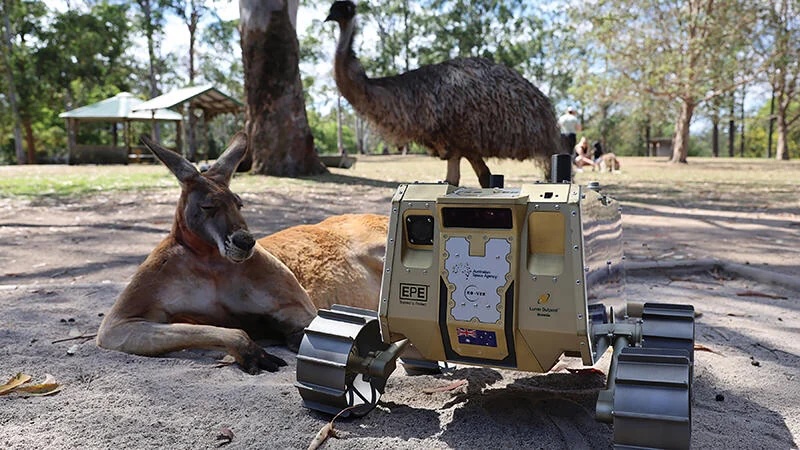
Australia’s Roo-ver lunar rover is undergoing final design work prior to a planned Moon landing in 2030.
Almost 60 years ago, Australia proved its space club credentials by becoming only the seventh country to launch a satellite from its own territory and by building ground stations that provided vital telemetry for NASA’s Apollo lunar missions.
Fast-forward to 2026, and driven by the bright prospects of a new space economy, Australia is laying out ambitious growth plans for the sector. Building on six decades of progress, it aims to nurture sovereign capabilities in areas ranging from space services and spaceflight ecosystems to technologies for in-space microgravity and exploration.
- Canberra aims to bring Australia’s space vision to fruition
- The space plan targets five growth areas
- Roo-ver lunar rover set for 2030 mission
The sector already generates an estimated AU$8 billion ($5.6 billion) annually, but the Australian government has ambitions to grow this significantly. Through the Australian government-backed National Reconstruction Fund Corporation (NRFC), more than AU$200 million has been invested in space-related companies since 2024—which, together with capital raises, represents a combined total investment of more than AU$600 million.
To guide the way, Canberra has crafted a vision statement laying out key focus areas for fostering growth that will form the basis for a strategic space action plan.
First released in July, the government targets cover five growth areas. The first prioritizes further development of Australia’s existing capabilities in trusted space services, such as positioning, navigation and timing (PNT), communications, Earth observation and space monitoring.
Other targets include expanding the country’s spaceflight ecosystem across the launch, reentry and ground segment. The plan also involves focused growth for satellites and multi-orbit constellations as well as greater Australian involvement in the emerging microgravity ecosystem of in-space manufacturing and biotechnology. Canberra’s fifth priority is further development of exploration technologies for remote operations and lunar applications.
The Australian Space Agency (ASA) is helping transform the vision into reality. Established only eight years ago, the agency was “formed to catalyze the growth of the sector,” ASA Head Enrico Palermo says. “Australia’s had a long, proud history in space. There are Aussies working all over the planet in major space agencies and commercial companies.
“So we produced the talent needed, but by forming the agency, there was a convening power to bring together the policy to put a regulatory framework in place that’s allowing this spacewide ecosystem to really blossom,” Palermo adds.
ASA’s five core functions support the government’s growth vision, he says. “No. 1 is we coordinate and develop space policy, and the statement on space from government is an example of that,” he notes. “But we do that across more than 27 agencies across the Commonwealth that use space services one way or another, but also with states and territories around the nation.”
The agency’s second function is building national capability. “So how can we provide a vision?” Palermo muses. “The statement does this, but also through grant programs, which are similar to the Small Business Innovation Research system in the U.S.” Grant programs have helped boost technology readiness levels, build infrastructure and enable Australian companies to join international supply chains.
Like other space agencies, ASA also plays a key role in working internationally with partners both bilaterally and multilaterally. In 2024, a Technology Safeguards Agreement (TSA) with the U.S. came into force that enables space launch and return from Australian territory by U.S. companies and research entities.
“We’re also negotiating a treaty with the European Space Agency (ESA) at the moment, so we are busy in international space,” Palermo says. Australia is looking to expand links with ESA and is in talks to secure a flight to the International Space Station for Australian astronaut Katherine Bennell-Pegg. ASA also acts as a regulator and is tasked with educating and inspiring future generations.
The five focus areas of the government’s space vision were developed through consultation, Palermo says. “We are now in Phase 2, which is: How do we turn those into practical things government can do? The government is already fostering growth in these focus areas, but what are we going to do in the future?
“That is taking place right now,” he says. “We are consulting with industry across government, across the research sector and other stakeholders to really firm up what those actions are.”
Phase 2 is expected to wrap up by year-end. “We will go through that consultation for the next few months, and then we’ll give advice to government,” Palermo says. “They will decide when to publish, but it will be in an order of months—not years—out.”
The first focus area in trusted space systems is “a clear reflection on the criticality of space across our defense, our prosperity, our economy and the well-being of our communities,” Palermo says. “How do we, through industry, continue to bring resiliency to our trusted space services, and what are the offerings that we add that can really boost that up?”
In particular, the vision outlines opportunities for Australia to strengthen its sovereign capabilities in trusted national communications, resilient multi-orbit architectures, ground segment platforms, space monitoring and data fusion, and wider development of operational and data-driven applications such as disaster monitoring and emissions detection.
The initiative also builds on Australia’s long-standing experience in space domain awareness. “If you look at our latitude and geographical expanse, we will be the first place to sense what has happened on orbit as things come up from the South Pole or come over the Indian or Pacific Ocean,” Palermo says. “So we have an important view to contribute to global observations.”
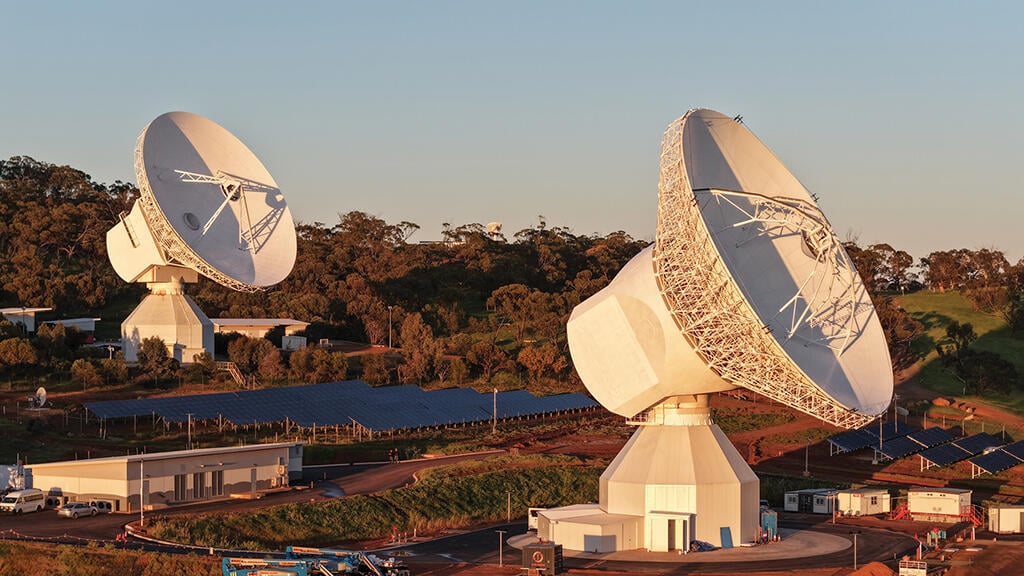
Understanding the space environment also builds on the country’s deep background in radio astronomy as well as its radio frequency (RF) expertise developed for surveillance systems like the Jindalee Operational Radar Network, an advanced, over-the-horizon, high-frequency radar network that monitors northern maritime and air approaches out to thousands of kilometers. Additional examples of space surveillance RF experience include South Australia-based Silentium Defense’s passive radar expertise and the low-frequency Square Kilometer Array at the Murchison Radio-astronomy Observatory in Western Australia.
The second focus area in developing a spaceflight ecosystem puts the spotlight on maximizing Australia’s natural geographic advantages for launch, reentry and ground segment.
“I’m very confident we will continue to see a vibrant space launch and returns market growing in Australia,” Palermo says. “There’s a lot of inbound investment, including from the [Australian government’s] NRFC, but Australia right now is the only place returning commercial capsules into a commercial spaceport and doing it regularly.”
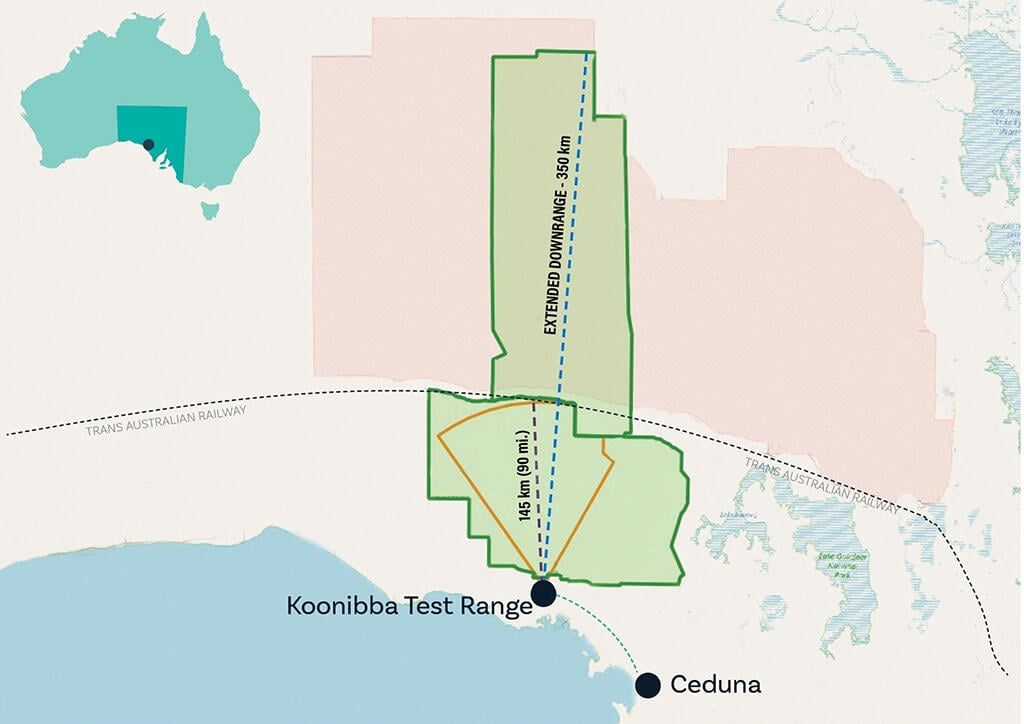
Palermo cites the ongoing partnership between U.S. company Varda Space Industries and Australia-based Southern Launch to manage the reentry and landing of capsules in South Australia’s Koonibba Test Range. The capsules carry payloads ranging from hypersonic and thermal test materials to pharmaceuticals made in microgravity. Four recoveries were made on the range through May.
A further three Varda vehicles are due to reenter for recovery at Koonibba before year-end, with seven more missions planned in 2027. Varda and Southern have agreed to additional launches under an expanded deal covering 20 launches through 2028.
“The beauty of that is, as the capsules reenter, they are just crossing the Southern Ocean, the [Great] Australian Bight, and landing,” Palermo notes. “They are not crossing other countries or heavily populated areas.
“We have sparsely populated areas where you can do tests and evaluation, and we have relatively low maritime and air traffic,” he adds. “We do not have some of the overflight constraints that other nations have, and through the TSA we are trusted with this sensitive technology.”
Other spaceports are in development, too, including the Gilmour Space Technologies-operated Bowen Orbital Spaceport in North Queensland; Whalers Way Orbital Launch Complex in South Australia close to Koonibba; the Atakani Space Center in Cape York, Queensland; and Arnhem Space Center in the Northern Territory. NASA used the Arnhem facility in 2022 for its first commercial sounding rocket launches outside of the U.S. Australia’s long-established Woomera Test Range, in the south of the country, also provides limited availability for suborbital launches and capsule returns.
“We have got great entrepreneurs that are investing and developing these capacities and international partners wanting to work with us,” Palermo says. “A company is also looking at a spaceport in Western Australia as well,” he adds, referring to Perth-based Space Angel. The company won a $1.75 million contract in August under the Western Australian Government’s Spaceport Establishment Support Grant to advance commercial spaceport proposals in the state.
The third focus area regarding space platforms concerns building Australian capability and involvement in satellites and multi-orbit constellations. “Our credibility internationally is growing rapidly in different payloads and things we do,” Palermo says, pointing out companies such as Fleet Space Technologies, startup Myriota and quantum clock innovator QuantX Labs as homegrown examples.
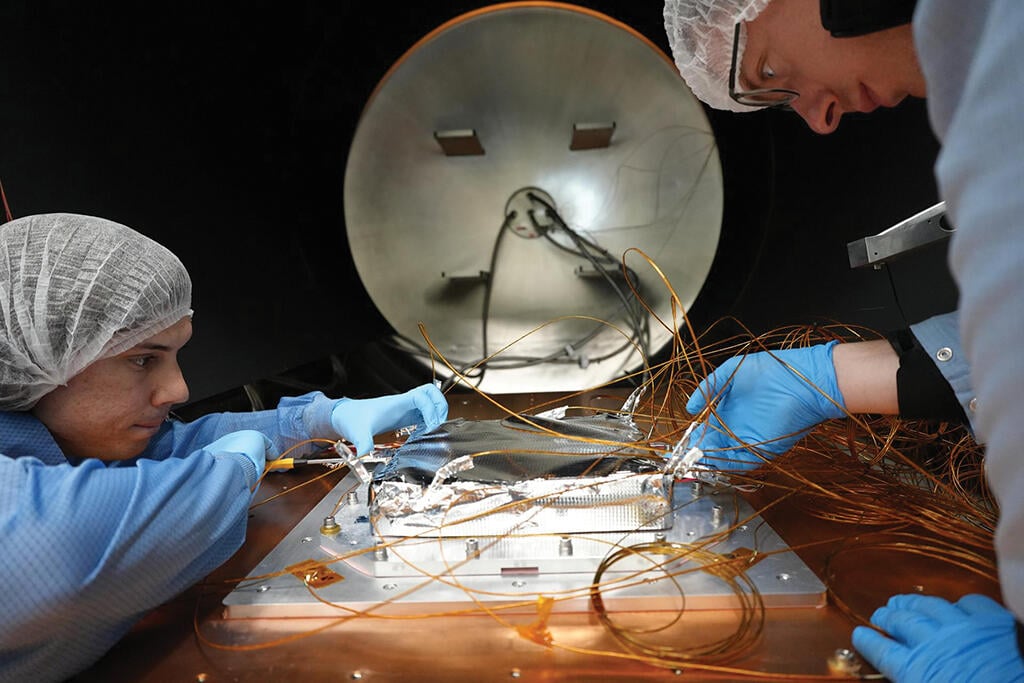
“We are working with QuantX to get them space-qualified at the moment for the next-generation PNT,” he adds. The company’s optical frequency comb—a laser device that produces a spectrum of evenly spaced frequency lines—was launched on Exotrail’s Spacevan orbital transfer vehicle in March from Vandenberg SFB, California, as part of SpaceX’s Transporter-16 rideshare mission. The comb under test is a key part of QuantX’s future optical atomic clock technology. “There are a lot of exemplars of Australian ingenuity in space platforms,” Palermo notes.
The focus on the microgravity ecosystem is a response to growing interest from industry in areas such as advanced manufacturing and pharmaceutical research. “If we’re going to have a vibrant spaceflight ecosystem in Australia, how do we ensure Australian industry and adjacent sectors like pharma, agriculture and semiconductor companies are benefiting from this?” Palermo asks. “We have this concept of a microgravity-to-market corridor, and that’s a huge part.”
Exploration technology is the focus of the government’s fifth area, with an emphasis on remote operations and lunar applications. “This is realizing what we can bring to space from our deep expertise in mining resources,” Palermo says, citing ASA’s partnership with Dutch geo-data company Fugro to develop the Space Automation AI and Robotics Control Complex (SpAARC).
Based in Western Australia, where mining operations in hostile environments are routinely conducted remotely from thousands of kilometers away, the SpAARC demonstration and test facility is designed to support software simulation of space vehicles, space robotic systems and planetary exploration systems, including orbital mechanics and simulated communication links with time delays. “This is also the only place in the world where they’re doing remote subsea pipeline inspections,” Palermo notes.
Australia’s poster child for its space exploration hopes is its first lunar rover. Dubbed the Roo-ver, the suitcase-size vehicle is due to be transported via an Intuitive Machines Nova-D lander to the lunar south pole region in 2030 as part of a NASA Commercial Lunar Payload Services mission.
“This will be the first Australian-designed and -built object to go off planet to another celestial body, so it is quite a milestone,” Palermo says. The vehicle itself is aimed at data collection on the lunar surface, but he stresses, “one of the important things we say at the agency is: ‘The journey is more important than the destination in many respects.’”
Development of the Roo-ver is leading to new skills, a wave of research graduates and doctorates, and the creation of an infrastructure of test and advanced manufacturing facilities. “We’ve got graduates out of university going straight into the program,” Palermo says. “Overall it is quite transformational.”
Quelle: AVIATIONWEEK