
27.07.2026
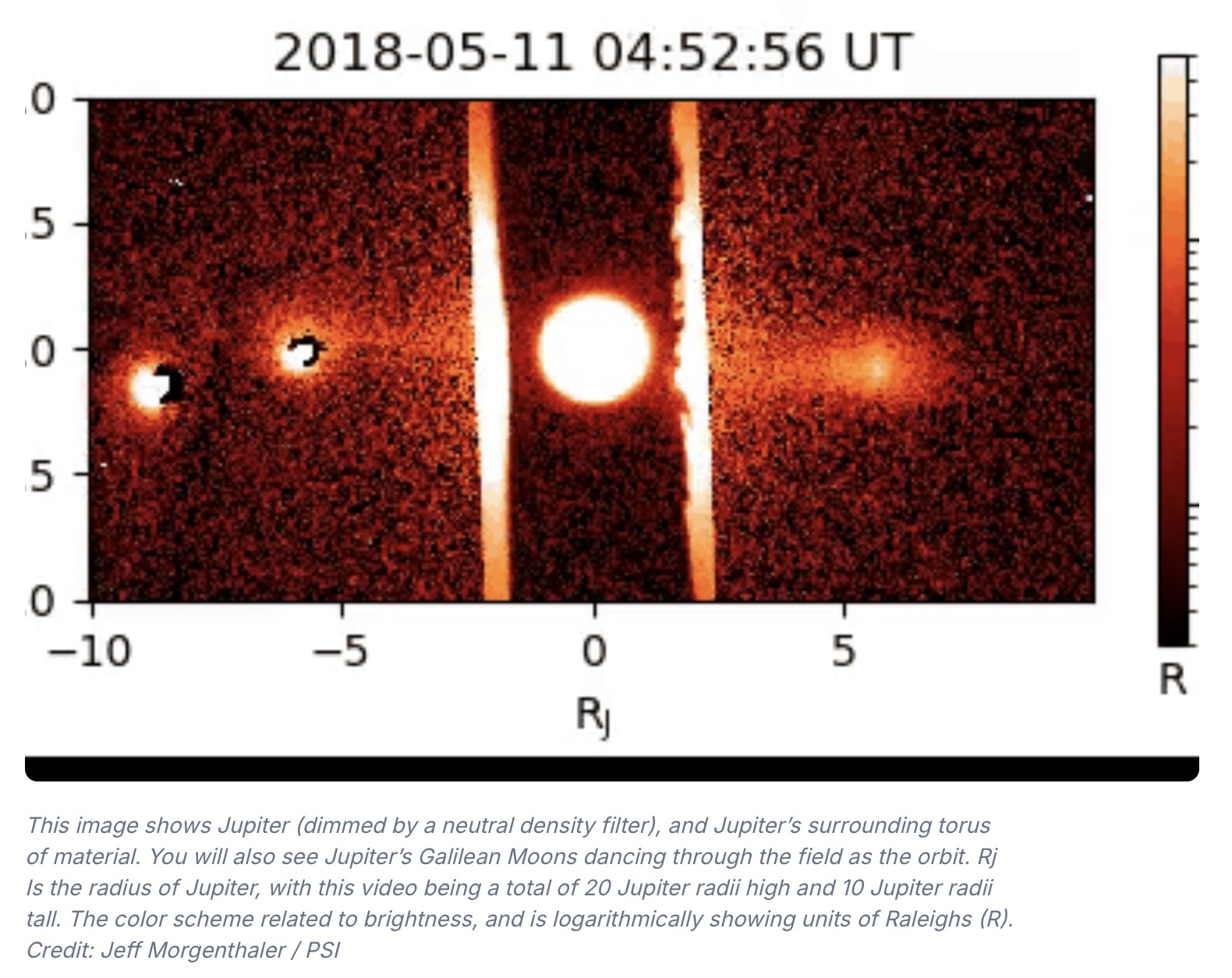

This image shows Jupiter (dimmed by a neutral density filter), and Jupiter’s surrounding torus of material. You will also see Jupiter’s Galilean Moons dancing through the field as the orbit. Rj Is the radius of Jupiter, with this video being a total of 20 Jupiter radii high and 10 Jupiter radii tall. The color scheme related to brightness, and is logarithmically showing units of Raleighs (R). Credit: Jeff Morgenthaler / PSI
TUCSON, Ariz. — A careful statistical study between observations recorded by NASA’s Juno mission and observations recorded by The Planetary Science Institute’s Io Input Output observatory (IoIO) shows that IoIO observations reliably predict the density of Jupiter’s plasma disk, an important part of Jupiter’s magnetosphere, a new Geophysical Research Letters paper on which Planetary Science Institute Senior Scientist Jeff Morgenthaler is coauthor, says.
Jian-Zhao Wang of the University of Colorado Boulder is lead author on the paper.
Nearly all the material in Jupiter’s magnetosphere comes from its volcanic moon, Io. As ionized material spirals outward from Io, it curiously piles up into a complicated structure known as the Io plasma torus. Detailed theoretical studies of the Io plasma torus (IPT) using space-based ultraviolet observations predict that it takes about 40 days for material to move through the outermost portion of the IPT, known as the “warm torus.” But detecting the warm torus from the ground is difficult. Rather, ground-based observatories, like IoIO, focus on emission from the “ribbon” which lies inside the warm torus.
The paper demonstrates that major enhancements in the brightness of the IPT ribbon consistently occur about 40 days prior to enhancements in the density of Jupiter’s plasma disk.
“This paper provides important information about the Jupiter environment as the scientific community prepares for NASA’s Europa Clipper and ESA’s JUICE tours of Jupiter’s moons and magnetosphere,” Morgenthaler said.
Just like Juno, Europa Clipper and JUICE (Jupiter Icy Moons Explorer) will be flying through Jupiter’s magnetosphere. The paper shows that IoIO can provide reliable predictions for the overall density of material that these spacecraft will be flying through. This greatly improves scientists’ ability to interpret the rare two-spacecraft measurements of Jupiter’s magnetosphere made possible by these missions.
“Observations of the torus can determine, for instance, whether or not Europa Clipper and JUICE are seeing denser plasma in the magnetosphere because more material is coming from Io or because there is a localized knot of plasma moving through the magnetosphere,” Morgenthaler said.
“Detecting the latter would be very exciting, as it would enable study of the details of how plasma travels in Jupiter’s magnetosphere,” explains Morgenthaler. “The basic physical processes of plasma transport are the same in all planetary magnetospheres, but Jupiter is unique in that Io provides a significant internal source of mass. This makes many effects, like radial transport of plasma, much easier to measure accurately. The combination of IoIO, Europa Clipper, and JUICE magnetospheric measurements at Jupiter can ultimately help us understand our home planet better.”
IoIO has been supported by NSF grants 1616928 and 2109219 to the Planetary Science Institute.
Quelle: Planetary Science Institute Senior Scientist Jeff Morgenthaler and the PSI’ IoIO Telescope.