
19.06.2026
SESAR-LITE, a radar instrument designed to search for water ice and map lunar subsurface terrain, has completed critical thermal vacuum and preliminary antenna testing at the U of A ahead of humanity's planned return to the moon.
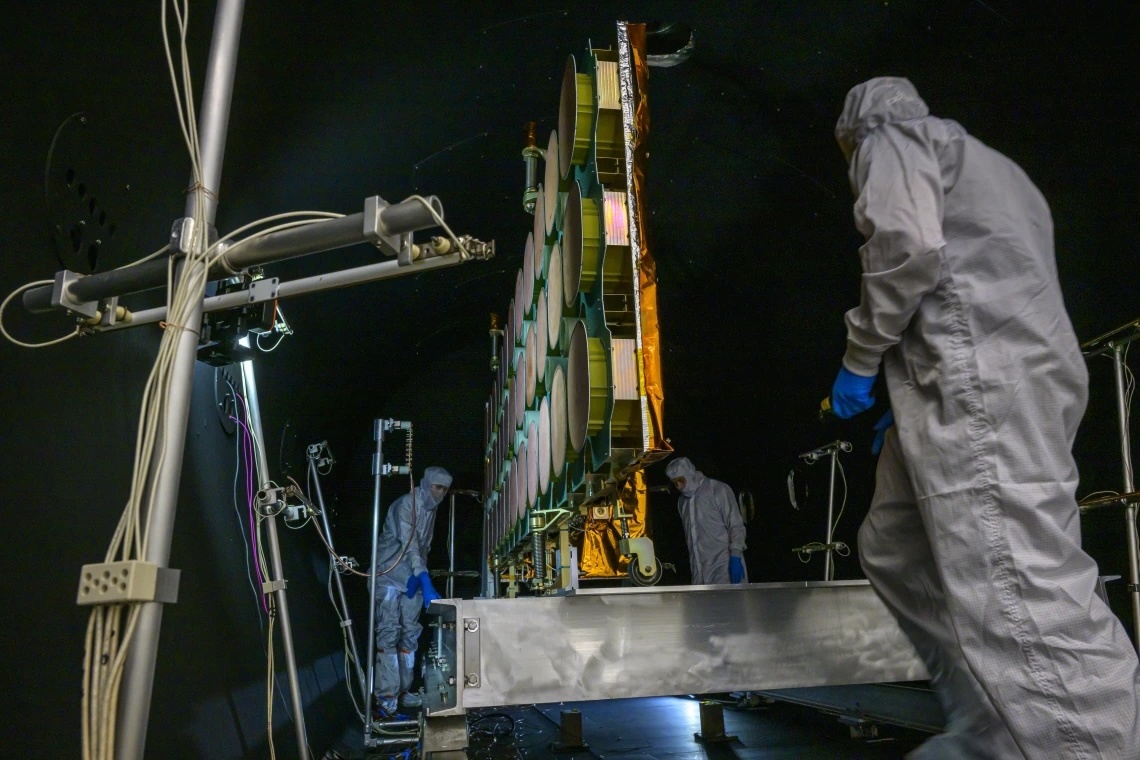
NASA’s SESAR-LITE radar instrument inside the University of Arizona’s giant thermal vacuum chamber, located in the Applied Research Building.
Photo by Kris Hanning, U of A Office of Research and Partnerships
University of Arizona engineers and NASA radar technicians rotate the heavy chamber door, revealing the thermal vacuum chamber's dark, expansive stainless-steel interior. The lunar radar rolls slowly across the pristine clean room floor before being wheeled into the chamber's depths. The door seals behind it, and as the air pressure slowly drains from the chamber, the radar is left to endure the empty vacuum of space.
The U of A Thermal Vacuum Chamber, or TVAC, which is the largest such equipment hosted by any university worldwide, has its first test subject.
The Space Exploration Synthetic Aperture Radar – Lunar Investigations Targeted Experiment, or SESAR-LITE, is a high-resolution low frequency, or P-band, radar instrument designed to peer beneath the surface of the moon in search of layers of water ice and other underground structures that reside within the upper layers of the lunar crust.
The compact instrument was developed at NASA's Goddard Space Flight Center and by principal investigator Lynn Carter, U of A Lunar and Planetary Laboratory professor and distinguished scholar. It sends radar waves at a frequency long enough to penetrate several meters underground to reveal subsurface structures that could directly inform future mission sites and exploration. The instrument was funded for development by NASA’s Development and Advancement of Lunar Instrumentation, or DALI, program, which develops and demonstrates instruments that show promise for use in future announcements of NASA flight opportunities.
Part of SESAR-LITE’s development process involves proving that it could survive the brutal conditions of space. NASA shipped it across the country to the U of A Space Institute for testing.
Over roughly two weeks at the Applied Research Building, NASA radar and mechanical engineers Rafael Rincon and Peter Steigner worked alongside university TVAC experts. The team put SESAR-LITE through its paces in the chamber, which replicated the airless conditions of space and extreme temperature swings of lunar orbit. With more time allotted, the building’s anechoic chamber – a room engineered to absorb all external electromagnetic signals – is available for future testing to evaluate the instrument’s radar antenna system in an interference-free environment.
The instrument successfully passed TVAC testing and preliminary radar tests.
The TVAC’s inaugural test subject marks the university's entry into an exclusive testing arena, positioning the Space Institute alongside established government and commercial testing facilities. Carter, who helped to facilitate the connection between NASA and U of A testing facilities, hopes this opportunity is only the beginning.
"Being able to conduct end-to-end development and testing directly at the university is incredibly valuable, and we hope it will lead to future projects and collaborations," Carter said. "This is a chance to demonstrate that we do have extensive instrument testing capabilities here that our future clients could utilize in tandem with our scientific expertise, and at much lower cost than having to go to a commercial facility."
The TVAC is available for other users, including external companies, and stands as a central test facility within the Applied Research Building.
The chamber’s first operational tests
The building’s team of engineers refurbished and modernized the TVAC extensively over the last three years in preparation for testing. The vacuum chamber acquired from Grumman Aerospace is around 40 years old. The internal, cylindrical chamber is capable of draining out all the air and replicating temperature extremes like those found in space.
“We needed to re-design the chamber so that testing would be much more efficient,” said Mark Matusko, director of Space Institute Advanced Technology and Testing Laboratories. “Originally, this TVAC used diffusion pumps, but nowadays we use turbo pumps that are cleaner and start-up faster for the specific applications we plan on using the chamber for. We installed those and ensured everything was leak tight, from the chamber’s subsystems, pumps, cryogen input and so on. We also designed custom computer software for the chamber, so now it’s easier for us to control.”
Before thermal cycling began, TVAC engineers and NASA personnel moved SESAR-LITE through the ARB's series of progressively sterile clean rooms. It was then sealed inside the TVAC and placed under vacuum conditions, where infrared lamps heated the instrument through an initial “bake-out” phase, Matusko explained. This process drives off any residual water molecules absorbed into the instrument’s materials that would otherwise prevent the chamber from reaching the near-airless pressure levels required for testing.
According to lead TVAC testing engineer Jake Roberts, SESAR-LITE then underwent “three full thermal cycles” – moving between a high temperature of roughly 122 degrees Fahrenheit and a low of −22 degrees F to represent the extreme swings the instrument might experience passing between sunlight and shadow in lunar orbit. Between cycles, engineers held the instrument at each temperature extreme in what is called a “soak,” monitoring for any signs of expansion, contraction, component failure or electronic malfunction while under deep vacuum conditions.
The data gathered will also serve as a thermal calibration baseline that scientists could reference during lunar operations, should the instrument be selected for a future flight opportunity.
Next-generation lunar radar imaging
What specifically sets SESAR-LITE apart from previous lunar radars is how its beam shape and direction are controlled. Rather than relying on mechanical components to redirect the radar signal, SESAR-LITE manages everything through its digital domain processor.
With more streamlined commands, the antenna elements can be immediately reprogrammed to either scan a broad section of the lunar surface or focus on a narrower target, all without physically moving any components.
SESAR-LITE operates at a central frequency of 435 MHz (70-centimeter wavelength), which is long enough to pass straight through the moon's rocky and dusty outer layer, known as lunar regolith, and penetrate around 30 feet into the subsurface. According to Carter, as the instrument orbits the moon, it is designed to continuously ping radar signals down to the surface and collect the returning signals to build detailed images of shallow lunar terrain.
SESAR-LITE's full polarimetry capability – its ability to measure precisely how the orientation of radar waves shifts upon bouncing back off the subsurface – gives it an advantage in the search for water. Water ice produces a distinct pattern of internal reflections called a polarization ratio. Detecting that signature on the moon would confirm whether substantial water ice deposits exist.
"We have seen evidence that there's probably water ice on the moon, but is it dispersed among the regolith in smaller bits or collected into more massive ice sheets below the surface?" Carter said. "This is the main scientific question we want to address."
Among areas of interest is the lunar South Pole, where permanently shadowed craters are thought to harbor deposits of water ice. Transporting water from Earth to support human missions carries an enormous logistical and financial cost, making an accessible lunar water source potentially transformative for a sustained presence on the moon.
"Even if no ice is found, the instrument would still yield significant science," Carter said. "If this were to travel to the moon, we would be able to learn about the regolith structure, look for buried channels or lava tubes that could potentially serve as underground shelters for astronauts and get an idea of what may lie directly beneath potential landing sites."
NASA recently announced a phased approach for building a permanent lunar base, ultimately targeting a continuous human foothold on the moon. The buried geology and ice deposits SESAR-LITE is designed to reveal could be useful to determine where astronauts can safely and sustainably build that base.
Carter hopes the radar might be able to hitch a ride into lunar orbit as part of a science payload on a future Artemis mission – NASA's missions to return humans to the moon.
“If we truly want to build a base, we're going to need more orbiters,” Carter said. “We engineered SESAR-LITE to be compact enough so that it’s compatible with smaller satellite missions. Maybe a commercial company will be interested in it, and we could ride along with other instruments to the moon.”

Engineers make final adjustments to SESAR-LITE inside the thermal vacuum chamber before sealing the radar in for testing.
Photo by Kris Hanning, U of A Office of Research and Partnerships
Quelle: University of Arizona