
18.06.2026
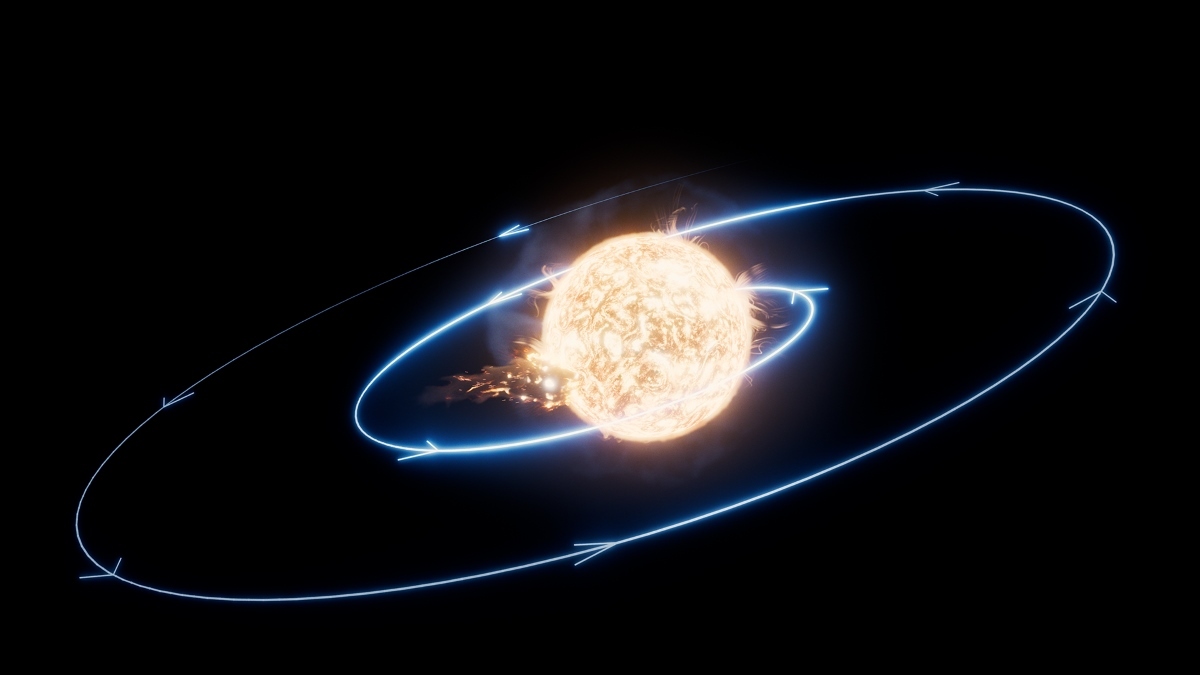
An artist's conception of a star engulfing a planet. The blue line traces the path of the planet as it spirals toward the star and ultimately collides with it. Credit: NASA, ESA, CSA, Ralf Crawford (STScI)
Astronomers examining the chemical composition of TOI-588, a Sun-like star 1,300 light-years away, have discovered clues which point towards an engulfment event – when a star consumes a planet.
The star, TOI-588, has an unusually high concentration of lithium for its size and age.
"You are what you eat, right?" says Brooke Kotten, a PhD student at the University of Michigan in the US and lead author of the report presenting the findings in the Astrophysical Journal.
"We know that there's much more lithium in planetary material than there is in stars. So if a star eats a planet, it's going to take on a bunch of lithium."
The lightest elements on the periodic table – hydrogen, helium and lithium – were formed in the first minutes after the Big Bang.
Stars that fuse hydrogen to helium at their cores are known as main-sequence stars.
During this stage of a star’s life the outward force of energy released from nuclear fusion balances the inward pull of gravity. More massive stars burn their fuel quicker and have shorter main-sequence lifespans.
Young, low-mass stars have abundant lithium in their outer layers. As they evolve along the main sequence this lithium mixes inwards to deeper and hotter regions where it is destroyed.
As a result, lithium depletes as a star ages. But a small fraction of stars defies the trend.
In 2024, astronomers discovered J0524-0336 – a red giant star about 40 times the size of our Sun but containing 100,000 times more lithium. A red giant forms when a main sequence star less than 8 times the Sun’s mass runs out of hydrogen at its core, causing it to expand.
In roughly 5 billion years the Sun will swell into a red giant which will engulf Mercury, Venus and perhaps Earth.
Like the Sun, TOI-5882 is a G-type main-sequence star and has not reached red giant stage. So, expansion likely doesn’t explain how it came to consume a planet.
Instead, a brown dwarf orbiting the star might be to blame.
The giant ball of gas is 22 times the mass of Jupiter and orbits TOI-5882 closely, completing one revolution every 7 days.
Massive companions on tight orbits can excite the trajectories of a planetary system's inner planets such that they spiral inwards and are engulfed by the star.
Based on the amount of lithium observed, the researchers estimate the engulfed body had a mass somewhere between a super-Earth and Neptune-sized planet.
"The fact that we can look at a star 1,300 light-years away and say with confidence, 'this star has more lithium than you would expect', is a testament to both the precision of modern instrumentation and the hard interpretive work that goes into making sense of that signal," says Melinda Soares-Furtado, a senior author of the study and assistant professor at the University of Wisconsin, USA.
Quelle: CONNECTSCI