
2.05.2026
Plans are under way to add three more modules to the Chinese facility but no timeline has been released to complete the work
The ISS, led by Nasa and built with contributions from 15 countries, is the biggest structure in space and has been a laboratory for more than 3,000 experiments.
Nasa plans to retire the ISS in early 2031, using a dedicated deorbit vehicle being developed by SpaceX to guide it into a controlled re-entry over the South Pacific.
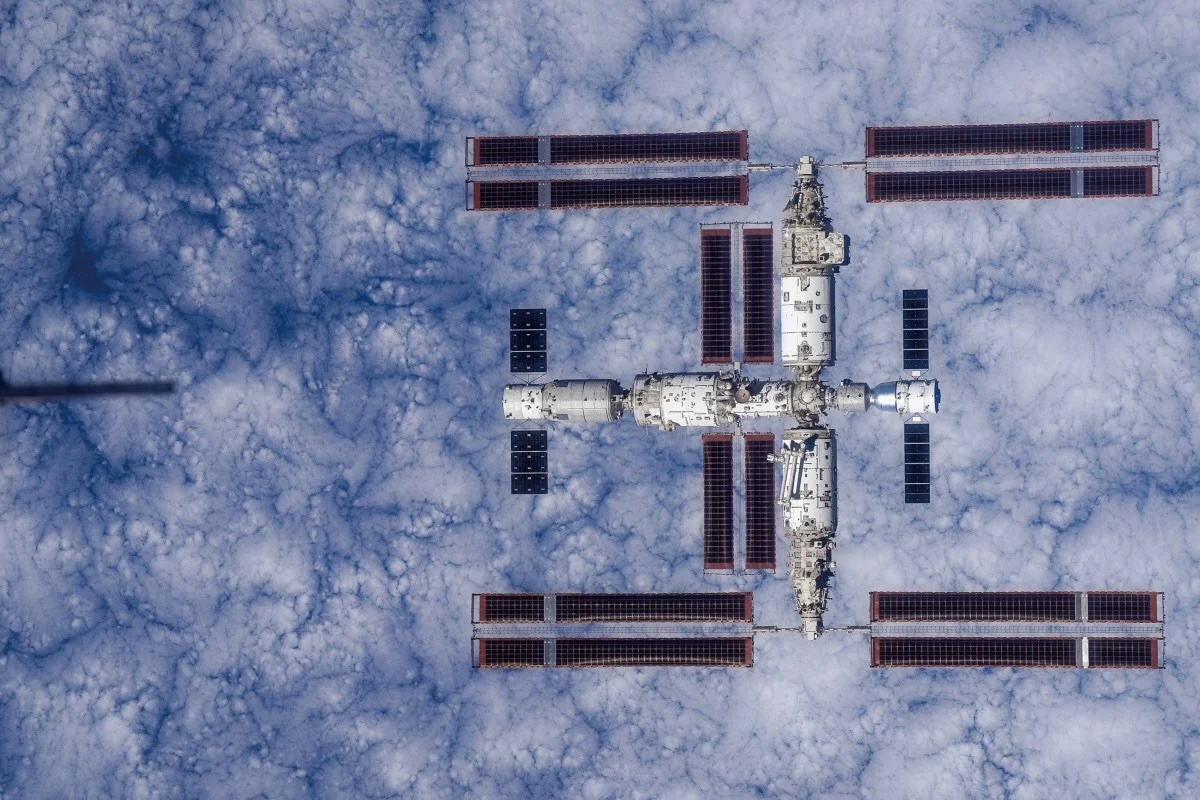
China’s T-shaped Tiangong space station will first be fitted with a fourth module – a multifunctional extension to the Tianhe core – turning it into a cross-shaped configuration, according to state broadcaster CCTV.
The new module will have multiple docking ports, including for a pair of future laboratory units, paving the way for a six-module structure with a total mass of about 180 tonnes.
No timeline for the expansion has been released.
The T-shaped Tiangong was completed in 2022, and since then astronauts have used it as a base for more than 260 scientific experiments and 26 space walks.
More than two dozen Chinese astronauts have lived and worked aboard the structure and astronauts from Pakistan, Hong Kong and Macau are expected to join missions as early as this year.
The Tiangong now has about 110 cubic metres (3,900 cubic feet) of habitable space – roughly the size of a three-bedroom flat. It is designed to support three astronauts for longer missions, with capacity for up to six during crew handovers.
Meanwhile, international payloads selected under China’s cooperation with the United Nations Office for Outer Space Affairs are adding to demand for space on board. “At this pace, the Tiangong will soon run out of space,” the CCTV report said.
The planned multifunctional module will be larger than Tianhe and include a new airlock for spacewalks, helping handle the growing traffic of cargo and crewed missions, it said.
To support the expansion, engineers are upgrading the Long March 5B rocket, including a larger payload fairing and another stage to increase its lift capacity for future space station missions.
Hou Yongqing from the China Academy of Space Technology – which designs and builds many of China’s spacecraft, including space station modules – told CCTV last week that designers were also improving the station’s robotic arms to handle a wider range of more complex tasks.
The Tiangong has a designed lifespan of 15 years. During its first five years of operation, Chinese astronauts set a record for the longest single spacewalk. It lasted nine hours and six minutes – surpassing the previous 22-year-old record of eight hours and 56 minutes set by Nasa.
Quelle: South China Morning Post