
14.04.2026

How Artemis 2 commander Reid Wiseman saved the mission's moon mascot: 'It's hard not to love this little guy. I can't let Rise out of my sight'
"I stuffed that little guy in a dry bag we had in our survival kit, and hooked the bag onto my pressure suit."
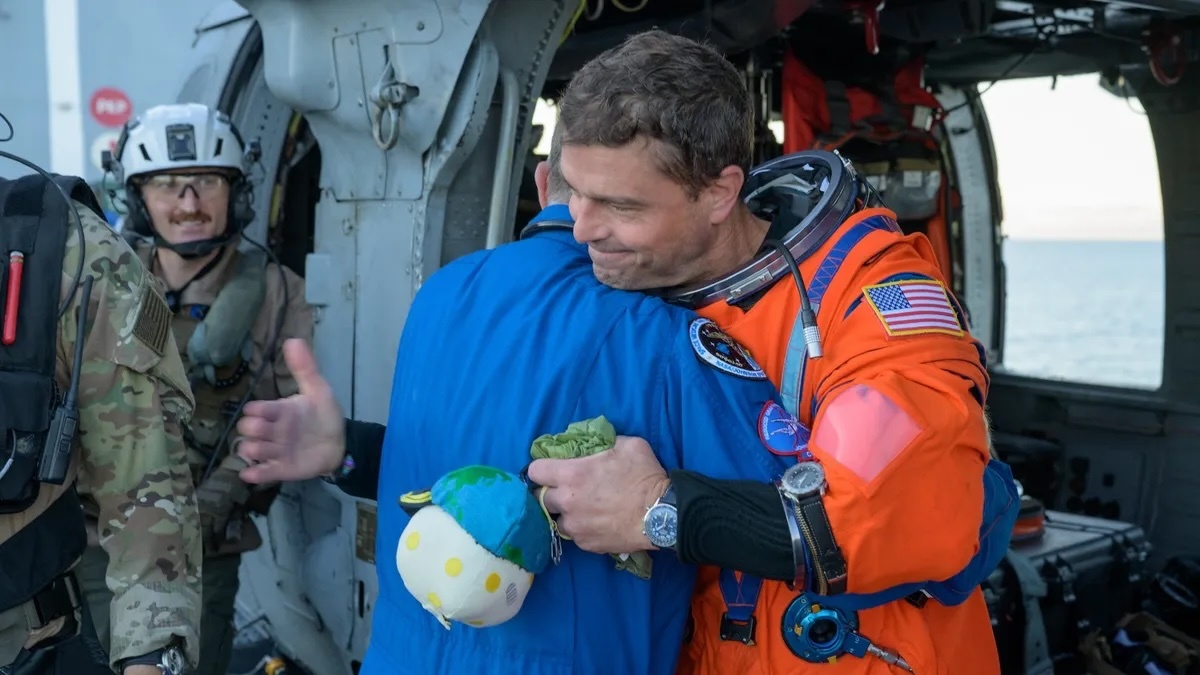
NASA astronaut Reid Wiseman, Artemis 2 commander, gives NASA Flight Surgeon Richard Scheuring a hug next to a Navy MH-60 Seahawk from Helicopter Sea Combat Squadron (HSC) 23 on the flight deck of USS John P. Murtha after splashdown, Friday, April 10, 2026, in the Pacific Ocean off the coast of California.(Image credit: NASA/Bill Ingalls)
Reid Wiseman had one last decision to make before leaving his spacecraft post-splashdown: leave something behind in accordance with NASA's post-splashdown checklist, or not?
Reid Wiseman, the NASA Artemis 2 commander, was supposed to leave a little plushie moon toy — called Rise — for later retrieval from his Integrity Orion spacecraft. But after 10 days floating alongside the mascot to the moon and back again, Wiseman had a different thought about that procedure.
"I was supposed to leave Rise in Integrity ... but that was not something I was going to do," Wiseman wrote on X on Saturday (April 11).
Officially, Rise is a zero-gravity indicator created by Lucas Ye, a third grader from California. It's a mini-moon, with an Earth-colored cap brimmed with stars. Inside the little toy are over 5 million names on an SD card, submitted by folks around the world looking to fly their monikers to the moon.
Rise floated on camera in front of the crew after they reached space April 1, before the eyes of Wiseman, NASA's Victor Glover, NASA's Christina Koch, and the Canadian Space Agency's Jeremy Hansen. But during the unfolding of the historical lunar flyby mission — the first human moon visit in nearly 54 years — Rise also became a symbol far beyond serving as a demonstration of when Integrity left Earth's gravity.
Moon memorial
Crew members often played with Rise during livestreamed conversations with Earth, and the toy also took over NASA's social media streams mid-mission. But sharp-eyed folks on social media caught something very special in a NASA picture of Ye's family posted Friday (April 10): at some point, Ye's Rise (a prototype of the mascot) was inscribed with the name "Carroll."
Carroll is the name of Wiseman's wife, who died in 2020 of cancer. The crew suggested naming a moon crater after her, during one of the most touching moments of their lunar flyby livestream. (The suggestion will be sent to the International Astronomical Union, which is the official arbitrator of astronomical monikers).
"A number of years ago, we started this journey in our close-knit astronaut family and we lost a loved one," Artemis 2 mission specialist Jeremy Hansen said to mission control during the April 6 event. "Her name was Carroll: the spouse of Reid, the mother of Katie and Ellie." Following the announcement, the four crew members shared one of their many group hugs on camera, before separating and visibly wiping tears.
Bringing Rise home
Now safely back on his home planet on Friday, Wiseman readied for his self-devised final mission procedure: how to get the palm-sized Rise safely out of the spacecraft to the Pacific Ocean pickup area.
"I stuffed that little guy in a dry bag we had in our survival kit, and hooked the bag onto my pressure suit," Wiseman wrote on X.
This allowed Rise to close out the mission alongside the crew. Secured on Wiseman's suit, Rise briefly waited on a raft in the Pacific Ocean before a dramatic hoist into a waiting U.S. Navy helicopter, which whisked Rise, Wiseman and Hansen to the USS John P Murtha. (Glover and Koch, in their own helicopter, took the same journey to the vessel.)
The next day, Wiseman still had Rise with him. He used a lanyard to secure the toy to a water bottle: "It's hard not to love this little guy. I can't let Rise out of my sight," Wiseman said in a separate X post on Saturday, posted from the crew's next stop at Naval Air Station North Island in California.
As far as we know, Rise is still with Wiseman. Rise appeared on-stage with Wiseman and the rest of the crew in Houston, at Ellington Field near NASA's Johnson Space Center, when they celebrated the end of their mission on Saturday with much of the NASA astronaut corps.
Rise next made a cameo in an image Wiseman posted on X hours later with his daughters, with the simple caption "Mission complete", accompanied by three hearts.
NASA and Wiseman haven't revealed Rise's next adventure yet, but in general, it is up to the agency and U.S. law to determine what happens to space-flown artifacts after a mission (which depends on the program and era).
But folks on Reddit nevertheless joked that Rise is a member of Wiseman's family. "Reid's new child, Rise Wiseman," read one popular comment on Reddit. Or as someone else called the toy: "Rise Weidman."
Quelle: SC
+++
The Artemis II mission: Reflections on an ever-evolving relationship with space exploration
For the first time since 1972, NASA sent humans back to lunar orbit, launching four crew members on a 10-day journey around the moon—at times passing beyond Earth’s view (the “far side”). The goal of the Artemis II mission was to determine human capabilities in deep space to pave the way for long-term exploration and science on the lunar surface.
For those on Earth who followed the astronauts through posts and images, the mission represents something beyond engineering and technical achievement—it reflects the long-standing human fascination with what lies beyond Earth.
To understand this continued fascination and what this mission has revealed about the future of space exploration, Penn Today spoke with Gary Hatfield, the Adam Seybert Professor in Moral and Intellectual Philosophy at the School of Arts & Sciences (SAS); Sandra González Bailón, the Carolyn Marvin Professor of Communication at the Annenberg School for Communication; and Sophie Silver, a Ph.D. candidate in the lab of Doug Jerolmack, Edmund J. and Louise W. Kahn Endowed Term Professor of Earth and Environmental Science at SAS.
Gary Hatfield: How human perception and consciousness makes space feel profound
Since there have been humans, there has been fascination and response to the night sky, with its many stars and a few planets. Early recorded speculations suggest that the night sky was viewed as a dome or as a sphere studded with stars with the Earth at its center.
The Artemis moon mission affects human consciousness by directly confirming through the sense of sight that the universe is very large and perhaps even infinite, while the Earth and moon are comparatively small spherical objects.
By all accounts, actually experiencing the Earth and moon as spherical bodies in space allows one to feel the unity and oneness of our small planet Earth together with the vastness of interstellar space. This direct experience is reported by the astronauts to be profound, and it is not attainable through measurement with instruments or through intricate theoretical calculations. In this case, seeing and experiencing transcend theoretical knowledge.
Sandra González‑Bailón: How social media facilitates organic, real-time engagement
The Artemis II mission couldn’t be more different from Apollo 11. The moon landing in 1969 was a global media event that froze audiences before their TVs, mouths agape, eyes fixed in the glow. The 2026 Orion’s trip around the moon is, instead, a continuous, multiplatform digital story being told in real time. The coverage is as dynamic as the lives of the millions of people following every step of the adventure. We keep up with the crew the way we keep up with loved ones: checking our phones, seeing where they are, tapping “like” on the latest update.
There are so many layers in this story. Instagram reels from the crew, YouTube livestreams from the spacecraft, the astronauts’ selfies and clips are all met by engaged audiences who respond back, all of it feeding into a narrative written by many hands. Audiences are helping tell the story with their questions, their posts, and the remixing of clips that make awe-inspiring moments relatable and viral, as when the jar of Nutella was spotted spinning through the spacecraft. Turns out that small indulgences are also a thing in deep space!
At a time when social media fuels so much division and animosity, it is genuinely stirring to see the Artemis mission use those same channels to remind us of what brings us together: that beautiful blue planet suspended in the dark, rising like a promise behind so many unbelievable selfies.
Sophie Silver: What images reveal and future missions beyond the moon
When mud dries down, it contracts, creating cracks that intersect to form rectangular shapes. When re-wetted, the mud expands and pushes the cracks back into contact with one another. This causes the fractures to rearrange over time, drying down in a different configuration. The shapes gradually become more hexagonal with each wetting and drying event.
Quelle: Penn Today
+++
NASA to Host Artemis II Crew Postflight News Conference
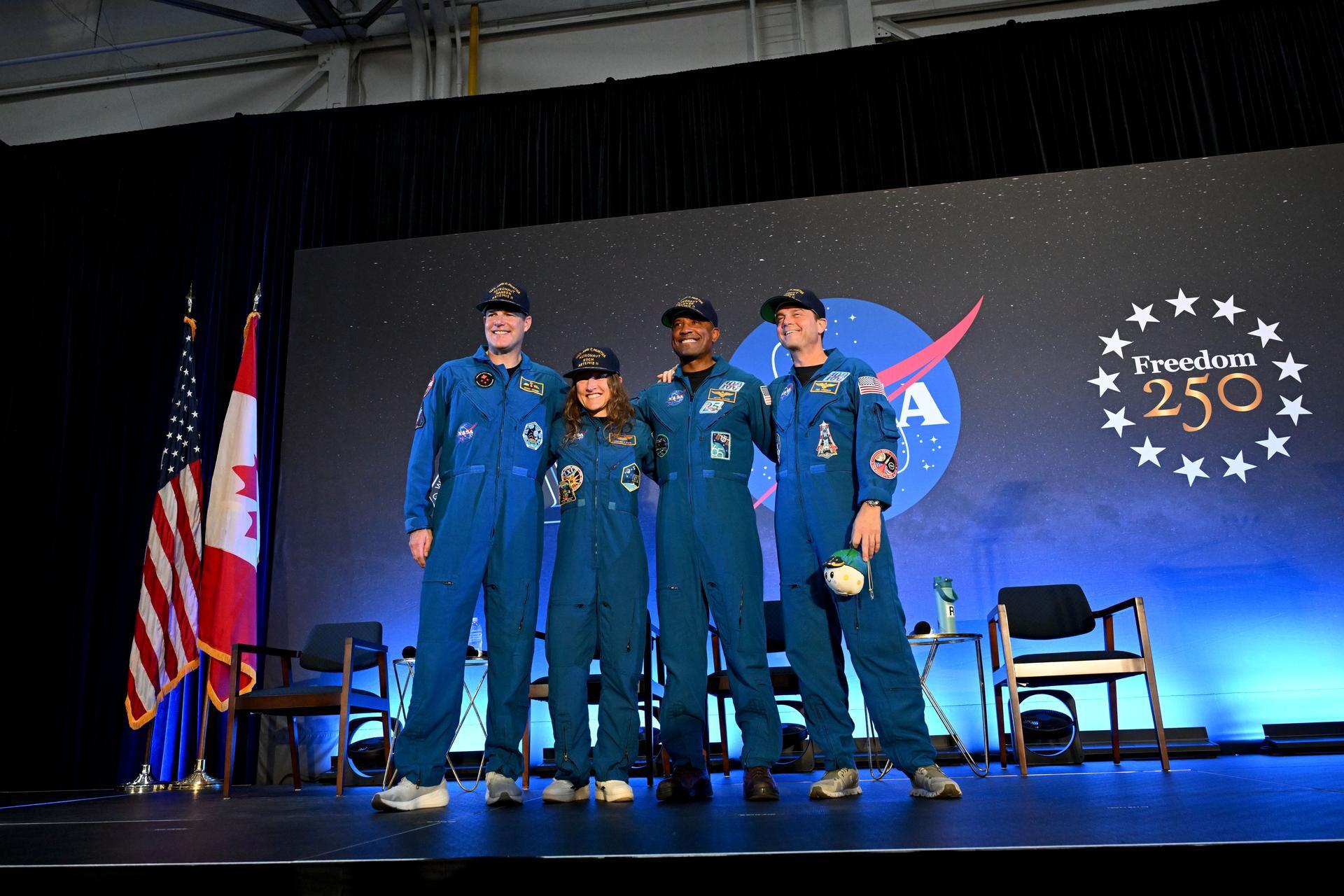
Fresh off their return to Earth, the Artemis II astronauts will hold a news conference at 2:30 p.m. EDT Thursday, April 16, at NASA’s Johnson Space Center in Houston to discuss their historic mission around the Moon.
NASA astronauts Reid Wiseman, Victor Glover, and Christina Koch, along with CSA (Canadian Space Agency) astronaut Jeremy Hansen, will answer questions about their mission. The crew returned to Earth on April 10, splashing down off the coast of San Diego, and arrived in Houston on April 11, where they are undergoing standard postflight reconditioning, evaluations, and lunar science debriefs.
NASA will provide live coverage of the news conference on the agency’s YouTube channel. Learn how to watch NASA content through a variety of additional online platforms, including social media.
Media are invited to attend in person or by phone.
In-person attendance is limited to media previously credentialed by NASA Johnson for the Artemis II mission. To attend in person, contact the NASA Johnson newsroom by 5 p.m. CDT Tuesday, April 14, at jsccommu@mail.nasa.gov.
Media joining by phone must RSVP to the NASA Johnson newsroom via email by 5 p.m. CDT Wednesday, April 15. Those participating by phone must dial in no later than 10 minutes before the start of the event.
NASA’s media accreditation policy is available on the agency’s website.
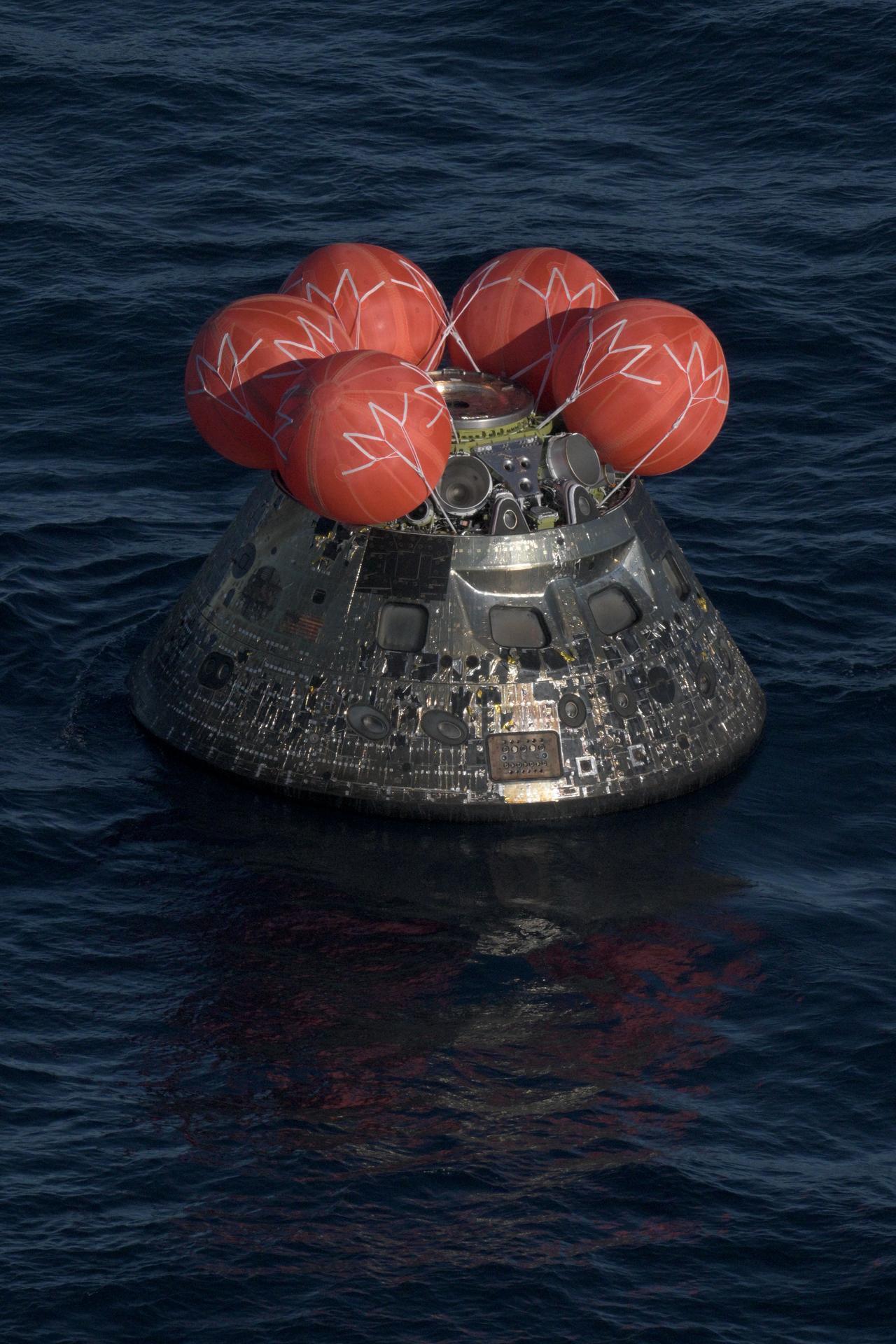
The Artemis II mission launched April 1 on NASA’s SLS (Space Launch System) rocket from the agency’s Kennedy Space Center in Florida. During the nearly 10‑day test flight, the crew achieved the mission’s primary objectives, including testing its life support systems; manually piloting the Orion spacecraft; performing maneuvers to propel Orion to the Moon and adjust its course; conducting a lunar flyby with unprecedented views of the Moon’s far side; and completing a safe re-entry and recovery. The astronauts also set a record for the farthest distance traveled by humans away from Earth.
As part of a Golden Age of innovation and exploration, NASA will send Artemis astronauts on increasingly challenging missions to explore more of the Moon for scientific discovery, economic benefits, establish an enduring human presence on the lunar surface, and lay the groundwork for sending the first astronauts – American astronauts – to Mars.
Quelle: NASA