
6.03.2019
ESA GIVES GO-AHEAD FOR SMILE MISSION WITH CHINA
ESA GIVES GO-AHEAD FOR SMILE MISSION WITH CHINA
The Solar wind Magnetosphere Ionosphere Link Explorer, Smile, has been given the green light for implementation by ESA’s Science Programme Committee.
The announcement clears the way for full development of this new mission to explore the Sun-Earth connection, which will be conducted in collaboration with China.
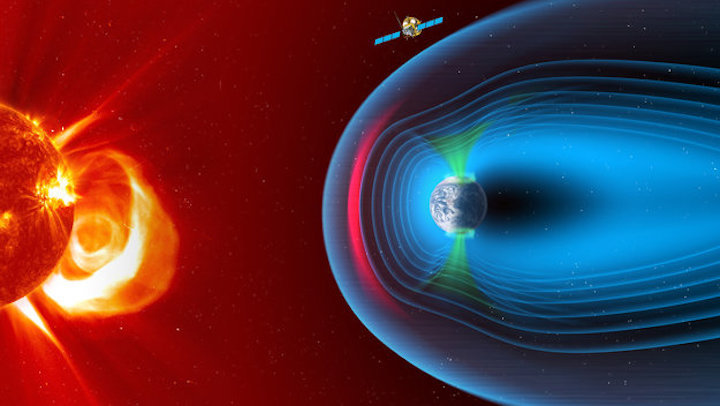
Smile is expected to revolutionise scientists’ understanding of the physical processes taking place during the continuous interaction between particles in the solar wind and Earth’s magnetic shield – the magnetosphere.
The mission will be a major scientific endeavour in collaboration between ESA and China, following on from the success of the Double Star / Tan Ce mission which flew between 2003 and 2008. Unlike Double Star, which started out as a China-only project, Smile is envisaged from the start as a joint ESA-China mission.
The scientific collaboration began with two workshops – one held in China, one in Europe – that were held to facilitate collaboration between Chinese- and European-based researchers. This was followed by a joint call for proposals that was issued in January 2015 by ESA’s Directorate of Science and Robotic Exploration and the Chinese Academy of Sciences (CAS).
Following selection in November 2015, detailed studies by ESA, CAS, three European industrial contractors and the Science Study Team have finalised the mission architecture, including the space and ground elements that are required to fulfil the science requirements.
Under current plans, the 2200 kg spacecraft will be launched by a European Vega-C rocket or Ariane 6-2 in 2023, and subsequently be placed in a highly inclined elliptical orbit around Earth. Every 51 hours, Smile will fly out to 121 000 km – almost one third of the distance to the Moon – giving it a prolonged view of Earth’s northern polar regions. It will then return to within 5000 km of the planet in order to download its treasure trove of stored data to an ESA ground station in Antarctica and the CAS ground station in Sanya, China.
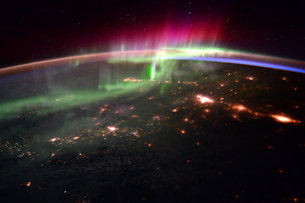
From this unusually elongated orbit, the satellite will be able to make continual observations of key regions in near-Earth space over a period lasting more than 40 hours. These will include simultaneous images and movies of the magnetopause – the boundary where Earth’s magnetosphere meets the solar wind – as well as the polar cusps, and the region illuminated by the Northern Lights, or aurora borealis.
Smile will offer scientists the chance to observe these key regions of Sun-Earth interaction for such long periods of time for the first time. The prime mission will last three years.
The science payload consists of four instruments: two from Europe and Canada, and two from China.
The innovative wide-field Soft X-ray Imager (SXI), provided by the United Kingdom Space Agency and other European institutions, will obtain unique measurements of the regions where the solar wind impacts the magnetosphere. The Canada-led Ultra-Violet Imager (UVI) will study global distribution of the auroras.
The two Chinese instruments, the Light Ion Analyser (LIA) and Magnetometer (MAG), will measure the energetic particles in the solar wind and changes in the local magnetic field.
ESA is also responsible for the payload module, spacecraft test facilities, launcher, launch campaign, the primary ground station; ESA will share science operations with CAS. A contract for industry to build the payload module will be announced in due course, and all spacecraft assembly and test activities will take place in Europe.
The National Space Science Center (NSSC/CAS) in China is responsible for the spacecraft platform, spacecraft testing, and mission and science operations. The platform will be built in Shanghai by the Innovation Academy for Microsatellites (IAMC/CAS).
According to ESA’s Smile study scientist, Philippe Escoubet, the mission will enable important breakthroughs in studies of the ever-changing interaction between Earth’s magnetic field and the solar wind.
“Smile will provide the first X-ray images and movies of the region where the solar wind slams into the magnetosphere,” says Philippe. “It will also provide the longest-ever ultraviolet imagery of the northern aurora, enabling researchers to see how the aurora changes over time and to understand how geomagnetic storms evolve.”
Quelle: ESA
----
Update: 8.03.2025
.
When two become one: engineers get Smile ready for launch
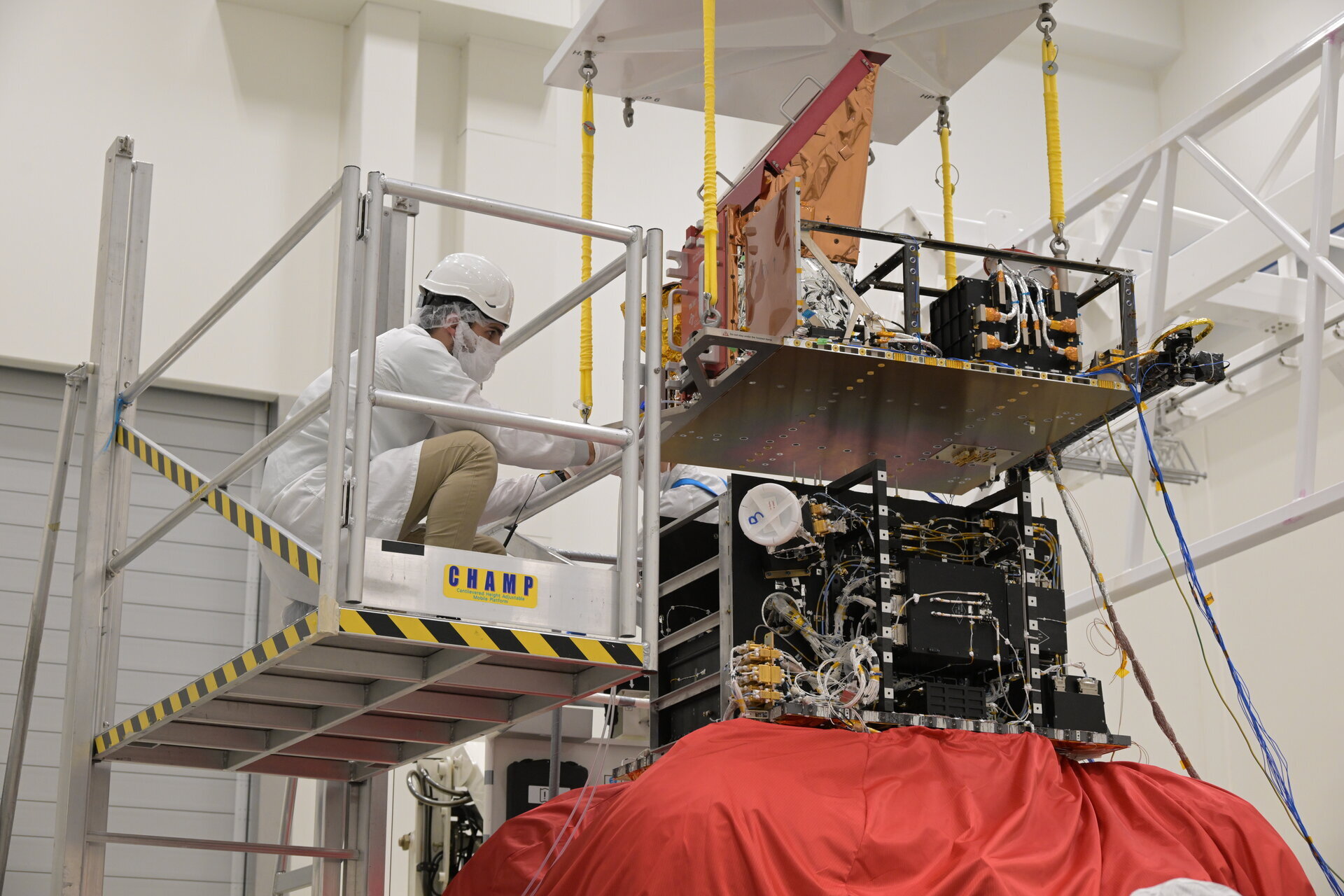
At the European Space Agency’s technical heart in the Netherlands, engineers have spent the last five months unboxing and testing elements of Europe’s next space science mission. With the two main parts now joined together, Smile is well on its way to being ready to launch by the end of 2025.
Smile will give humankind its first complete look at how Earth reacts to streams of particles and bursts of radiation from the Sun. By improving our understanding of the solar wind, solar storms and space weather, Smile will fill a stark gap in our understanding of the Solar System. To make sure that the mission is a success, our teams are working tirelessly behind the scenes.
Watch the video below to get a glimpse into what we’ve been up to recently. [Text continues after video]


Access the video
As a 50–50 collaboration between ESA and the Chinese Academy of Sciences (CAS), Smile is a truly international effort. Pieces of the spacecraft have been built by teams across Europe and China, and are now finally united at ESA’s technical heart (ESTEC).
Smile’s crucial ‘payload module’ – which contains three of its four scientific instruments – was built by Airbus in Spain on behalf of ESA. This major piece was the first to arrive at ESTEC in September last year.
The arrival of the payload module kicked off a year-long integration and testing phase, where colleagues from ESA, Airbus and CAS are all working together at ESTEC to prepare the spacecraft for flight. Step one was to put the payload module through a gruelling test regime to make sure that it was absolutely ready to work perfectly as a complete unit in the challenging space environment.

The process was not always smooth sailing. On 21 November 2024, Airbus and ESA teams looked on nervously as the spacecraft’s 3 m-long magnetometer boom refused to lock into place. Engineers entered into intense discussion and very quickly discovered the cause: a bundle of cables that was too stiff and not mounted correctly.
The team fixed the issue immediately by loosening the bundle and mounting it slightly differently. They successfully released the boom again the following day. A round of applause filled the room when the boom clicked into place. Click on the image below to find out more about the magnetometer boom and the little instrument that sits at its end.

“Overall, the arrival and testing of the payload module went really well and we are confident that the instruments on board are going to collect fantastic scientific data once in space,” says ESA’s David Agnolon, who is managing the European side of the Smile project. “This is the first time that ESA and China are collaborating on a project of this type and scale, and we have already overcome many challenges thanks to an excellent spirit of cooperation on both sides.”
One of the biggest challenges that David refers to relates to working with colleagues in another continent during the COVID-19 era. In 2022, for example, Airbus sent a model of the Smile payload module to China for testing. But because of travel restrictions, Airbus and ESA colleagues were not able to support the testing of their own hardware, and the teams had to resort to ‘online engineering’.
Fortunately, colleagues from around the world are now able to work harmoniously at ESTEC, sharing cultures and traditions as well as engineering knowledge.
On 9 December 2024, Smile’s ‘platform’ arrived on a dedicated flight from Shanghai, together with 15 engineers and managers from CAS. The platform contains the fourth scientific instrument, as well as everything else that the spacecraft needs to function, including the modules responsible for powering, steering and controlling the spacecraft.
Getting Smile’s platform to the Netherlands was no easy feat. It was the first time a spacecraft platform was exported to Europe from China. Special authorisations were needed, for example from Amsterdam Schiphol Airport, Air China Cargo, the Dutch and Chinese civil aviation authorities and ESA’s own transport company.
The arrival of the platform was ultimately delayed because of the huge amount of documentation involved, in particular for the ammonia in the heat pipes labelled as ‘dangerous goods’.

Access the video
Finally, on 21 January 2025, Smile’s payload module could be connected to the platform with 120 bolts. This delicate procedure required perfect precision, with about twenty people from ESA, CAS and Airbus surrounding the spacecraft, fully focused on the task in hand. The engineers wore white cleanroom suits, hair and beard nets, and shoe coverings to protect the spacecraft from dust and dirt.
As they say, the devil is in the detail, and the team quickly encountered an obstacle. They realised that when they would place the payload module onto the platform, some cables would slightly cover up the bolts, making the attachment tricky.
Engineers put their heads together (literally – the cleanroom environment can be busy!) and quickly came up with a solution. They made a last-minute adjustment to the integration procedure, deciding to place some bolts before lifting the payload module, to ensure that the later attachment would go as smoothly as possible.
-

Engineer inspects Smile spacecraft segment -

Smile spacecraft before two become one -

Smile payload module’s first taste of flight -

Smile payload module turns aerial dancer -

Perfect placement for Smile’s payload module -

Smile spacecraft: two become one -

Smile spacecraft is complete for the first time
Finally, the payload module was ready to move. Engineers attached hooks and used a hoisting device to lift it very slowly, at about a centimetre per second. Smile’s ‘assembly, integration and testing’ manager from ESA, Benjamin Vanoutryve, looked on attentively.
“This moment was finally happening, after so many years of meticulous preparation work on two sides of the world. In just a moment, we would finally see ‘our’ Smile spacecraft as a real object for the first time,” says Benjamin.
An Airbus engineer used a remote-control belt to carry the payload module over to the platform, and lower it slowly, millimetre by millimetre, to line up perfectly with the platform below. When the two were separated by just 20 cm, Airbus handed over to CAS, who took care of the very final attachment. CAS and Airbus colleagues in safety harnesses up on aerial platforms closely monitored the operation.
As the payload module was lowered into place, the engineers could start bolting the two parts of the spacecraft together. For the first time, the teams are now dealing with a complete spacecraft.
So, what’s next for this little spacecraft with big ambitions?
From this month, Smile will be tested for the first time as a complete unit. Engineers will have to get it to pass tough checks with flying colours before being allowed out on its own, including making sure that the entire system can operate properly in the vacuum of space, that the different parts of the spacecraft don’t create too much electromagnetic disturbance for other parts, and that the violent launch won’t shake the spacecraft apart.
Airbus engineers will continue to support the CAS and ESA teams throughout the entire test campaign to ensure that the platform and payload module work perfectly well together and help to resolve any issues.
By September 2025, Smile should be ready to go, and our ESTEC colleagues will wave goodbye as it ships off to Europe’s Spaceport in French Guiana. From there, the team will prepare Smile for launch on a Vega-C rocket, hopefully by the end of this year.
Quelle: ESA
----
Update: 17.07.2025
.
Smile passes gruelling set of tests
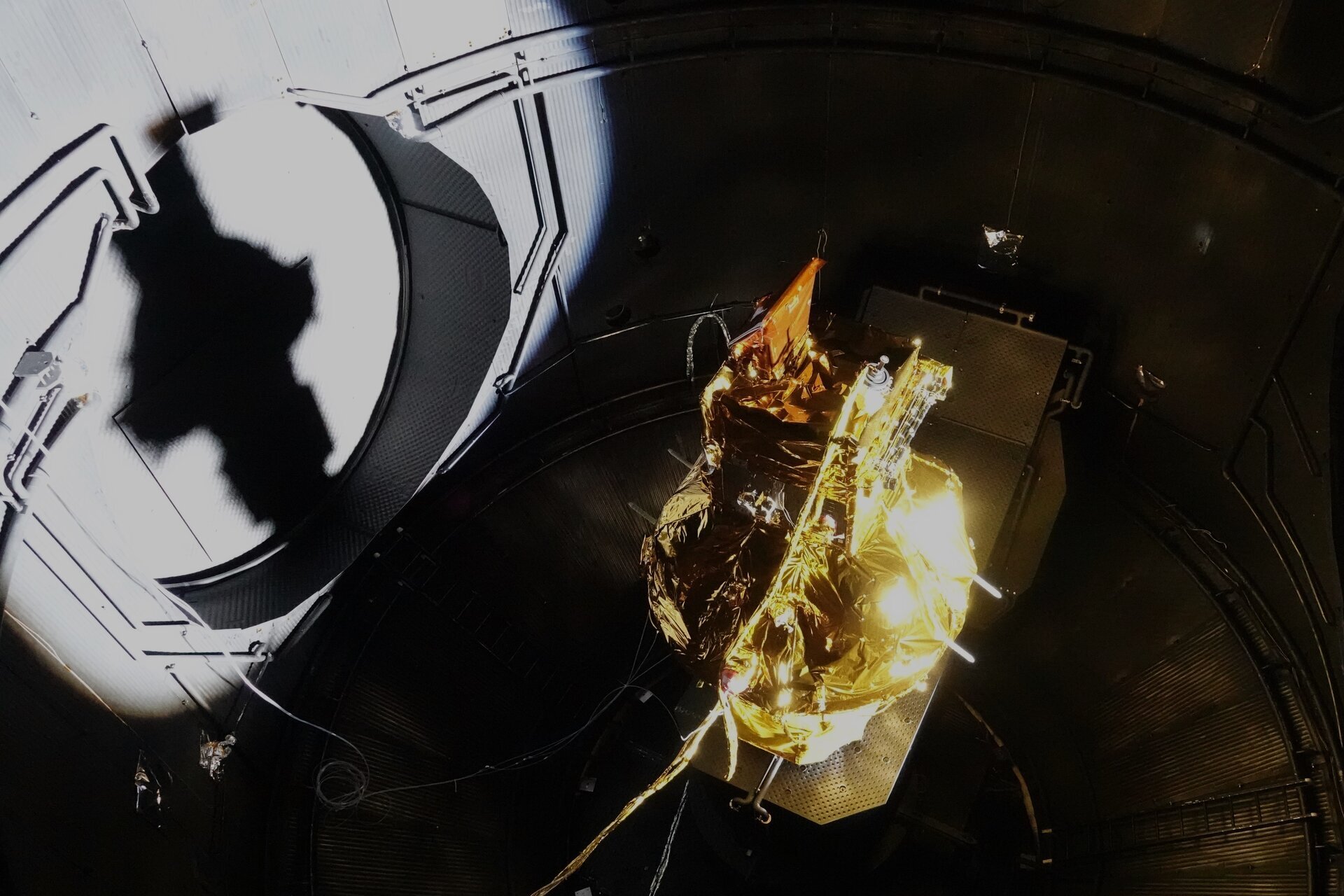
All its parts have been built and put together. It has been wrapped in shiny gold insulating foil. Its launch is getting closer. But the Smile spacecraft had one major phase to pass before it could be certified ready for space – and it involved testing, testing and yet more testing.
Since March, engineers have been busy getting Smile through tough checks at ESA’s technical heart, ESTEC, in the Netherlands. After all, if you’re going to spend years developing a spacecraft to watch how Earth’s magnetic field responds to the solar wind, you’d better make sure it can handle the shaky rocket launch, the vacuum of space, and the extreme temperatures it will face in orbit around Earth.
With Smile being a joint effort between the European Space Agency (ESA) and the Chinese Academy of Sciences (CAS), engineers from both organisations, as well as from the companies Airbus and European Test Services, have been working together.
Test 1: Smile meets the spikes
This testing phase began when engineers moved Smile into the Maxwell Test Chamber.
Like most spacecraft, Smile is very sensitive. It is designed to pick up weak magnetic field signals, as well as very faint light from the magnetic bubble surrounding Earth, and ultraviolet light from the auroras. At the same time, it will transmit a lot of data down to Earth with high-power antennas.
Engineers used the absorbent nature of Maxwell’s spiky walls to make sure that there was no ‘crosstalk’ between all the spacecraft’s electronics.
As Smile Systems Engineer Chris Runciman puts it, "it’s like when you have your phone beside a speaker and it starts making funny noises before your text message comes in" – that interference is exactly what we don’t want to see happening in Smile.

Knowing that Smile’s electronics are not interfering with each other, our engineers are now confident that its science instruments will work excellently in space, and that we will get the images we need of Earth’s magnetic environment.
The Maxwell Chamber tests also confirmed that Smile is safe to launch inside the Vega-C rocket that will take it to space. Because the rocket carries lots of electronics, we had to be sure that they will not be disturbed by Smile, and vice versa.
Test 2: hop on the scales
Our engineers quickly moved Smile out of the Maxwell Chamber and onto the next set of tests: measuring how much it weighs and where exactly its centre of gravity is.
Engineers spent four days making these measurements using some of the most advanced scales in Europe. Thanks to the information they collected, we know that the spacecraft is compatible with Vega-C, and spacecraft controllers have all the knowledge they need to properly manoeuvre Smile once it is in orbit around Earth.


Test 3: feeling all shaken up
At the end of April, the spacecraft was placed on the ‘shaker’. Standing on the shaker feels like experiencing an earthquake; it’s a simulation of the intense vibrations Smile will feel as its rocket takes off.
Smile got through the gruelling test in one piece, giving us complete confidence that it will make it to space in perfect working order.
Interlude: Smile takes a stretch
A quick stretch before our final big test. Smile’s solar panels are vital for supplying power to its onboard systems and scientific instruments. In other words – no solar power, no mission!
During the launch, the solar panels will remain safely folded up. Once in space, a little mechanism will activate that lets them fully stretch out. On 15 May, engineers checked that this mechanism works for both ‘wings’. As the image below shows for one wing, Smile gets another green tick.

Test 4: Smile enters the darkness
Finally, at the end of June, Smile was put into the Large Space Simulator – Europe’s largest vacuum chamber. This massive machine does what it says on the tin, recreating the strange vacuum and tough temperatures of outer space. It even includes a Sun simulation to imitate how Smile will feel super-hot on its Sun-facing side, and super-cold on its shaded side.
It’s the final, and possibly most complicated, part of the spacecraft environment testing phase. In early July, Smile Project Manager David Agnolon confirmed its success.
“Running 24/7, the thermal test has been very intense but highly satisfying. It was completed smoothly, in record time and yielded very good results. This outcome is largely thanks to the impressively good preparation and excellent execution of the team,” says David.
“We can now say that Smile is 100% ready for space and ready to deliver its scientific data to better understand our planet’s magnetic shield and how it responds to the solar wind. This is testament to years of hard work from industry across Europe and China.”

The images below show more of the space environment testing at ESTEC.
-

Smile meets Maxwell -

Smile in the Maxwell Test Chamber -

Smile on the scales -

Smile during space environment testing -

Polishing Smile’s solar panels -

Testing Smile’s solar arrays -

Smile in the Large Space Simulator -

Smile sees the light
Last week, Smile was carefully removed from the Large Space Simulator. But it’s still not quite ready to go.
During the second half of July, engineers are re-checking parts of two of Smile’s science instruments – the boom that holds its magnetometer at the end, and the cover of its ultraviolet camera – to make sure nothing was damaged during the thermal testing. After that, Smile will go through a last few software and operational tests, before finally being packed up safely, ready for shipping to Europe’s Spaceport in French Guiana around two months before launch.
Quelle: ESA
----
Update: 20.03.2026
.
T-20 days: Smile to launch on 9 April
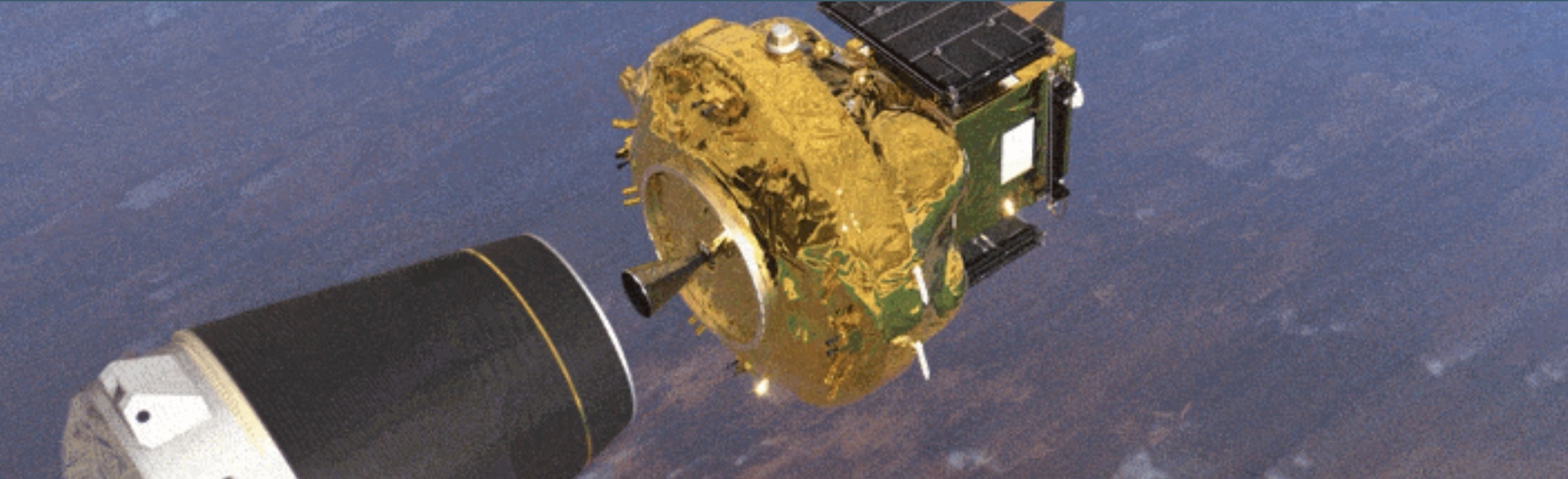
The Smile mission is set to launch on a Vega-C rocket from Europe’s Spaceport in French Guiana on Thursday 9 April at 08:29 CEST/07:29 BST/03:29 local time. Follow along as we communicate on the final preparations for launch. Journalists are invited to join online media briefings in English, French, Spanish, Italian and German.
Smile is a collaboration between the European Space Agency (ESA) and the Chinese Academy of Sciences (CAS). It will reveal how Earth responds to the streams of particles and bursts of radiation from the Sun, using an X-ray camera to make the first X-ray observations of Earth’s magnetic field, and an ultraviolet camera to watch the northern lights non-stop for 45 hours at a time.
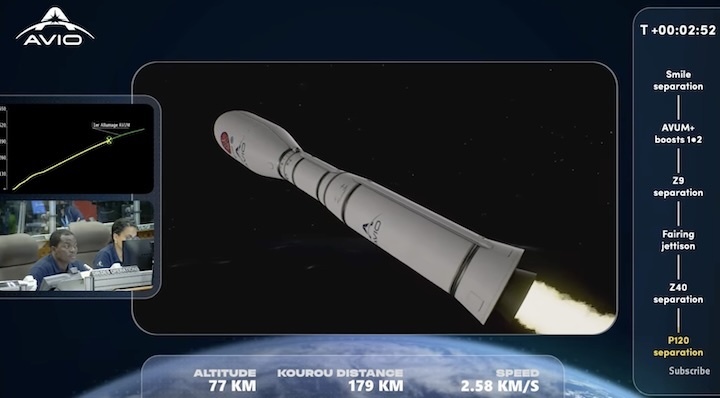
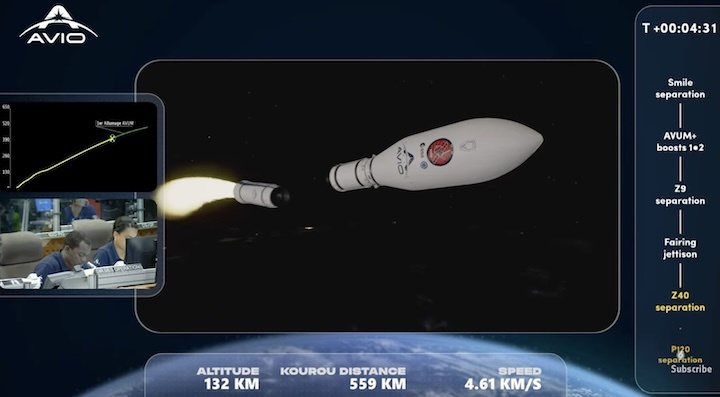
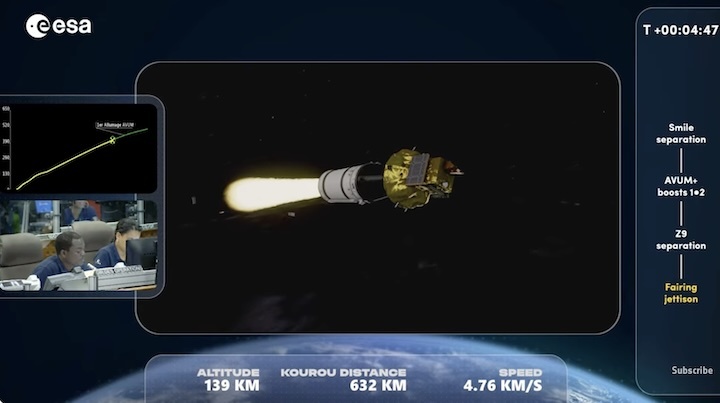
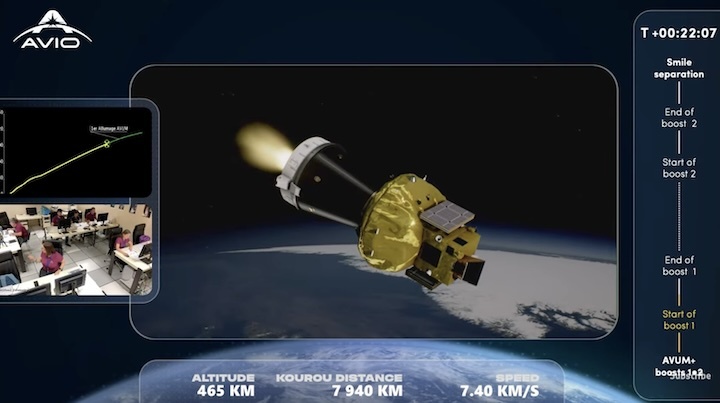
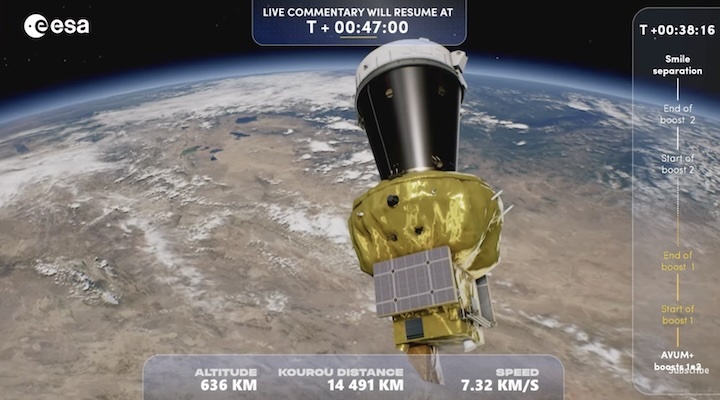
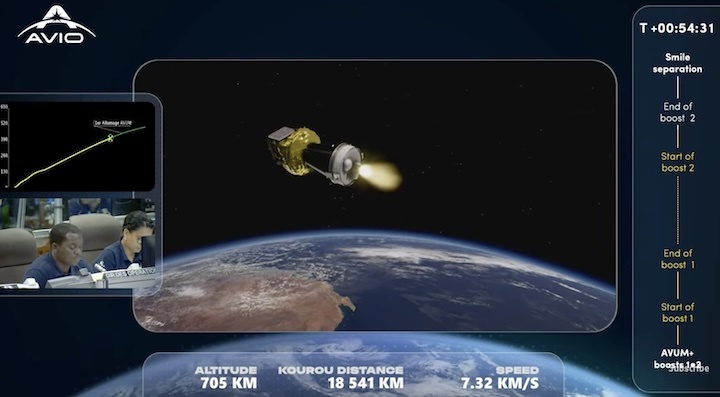
During the launch, the four stages of the Vega-C rocket will separate one by one, before finally releasing Smile after 57 minutes. Smile’s solar panels will unfold after 63 minutes – the milestone that confirms launch success.
The launch will drop Smile off into a low-Earth orbit. From there, the spacecraft will take over to bring itself to its final, egg-shaped orbit that goes 121 000 km above the North Pole to collect data, before coming 5000 km above the South Pole to deliver it to waiting ground stations.
Launch preparations are progressing well, with the spacecraft and all rocket parts having now arrived at Europe’s Spaceport. The four rocket stages are stacked, ready and waiting for Smile on the launch pad.
For the latest updates, visit our dedicated page and follow @science.esa.int and @transport.esa.int(Bluesky) and @esascience and @ESA_transport (X).
Our Smile launch kit is a set of infographics providing an overview of the mission, its science goals and the launch timeline. It is available in English, French, German, Spanish, Italian and Dutch.
Our mission minisite gives an overview of all-things-Smile.

China-Europe SMILE satellite ready for launch
The Solar wind Magnetosphere Ionosphere Link Explorer (SMILE), a satellite jointly developed by the Chinese Academy of Sciences (CAS) and the European Space Agency (ESA), has completed all pre-launch preparations at the space launch site in Kourou, French Guiana, and is scheduled for launch on April 9 local time, according to the CAS on Thursday.
The SMILE satellite mission represents China's first mission-level, all-around in-depth cooperation with the ESA in the field of space science exploration.
The satellite will apply soft X-ray imaging technology to achieve, for the first time, a global view of the large-scale structure of Earth's magnetosphere. It is, notably, expected to yield a series of scientific breakthroughs in areas such as space weather forecasting and fundamental understanding of magnetospheric physics.
The SMILE satellite has been mounted on a Vega-C launch vehicle.
At present, the launch window has been determined, and the joint team is closely monitoring and verifying weather conditions at the launch site, as well as the final technical status of both the rocket and satellite.
Quelle: Xinhua
----
Update: 19.05.2026
.
Smile lifts off on quest to reveal Earth’s invisible shield against the solar wind
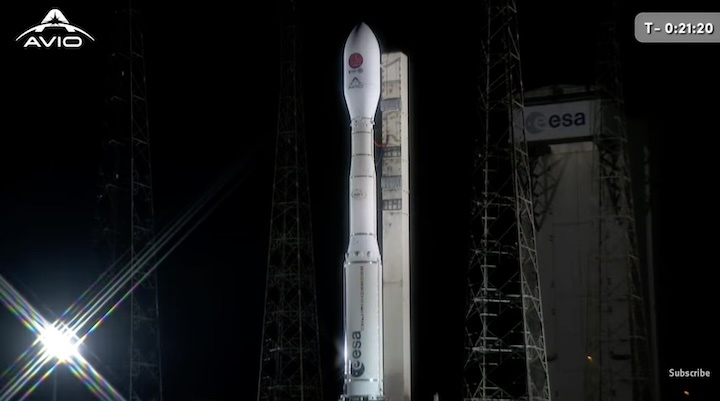
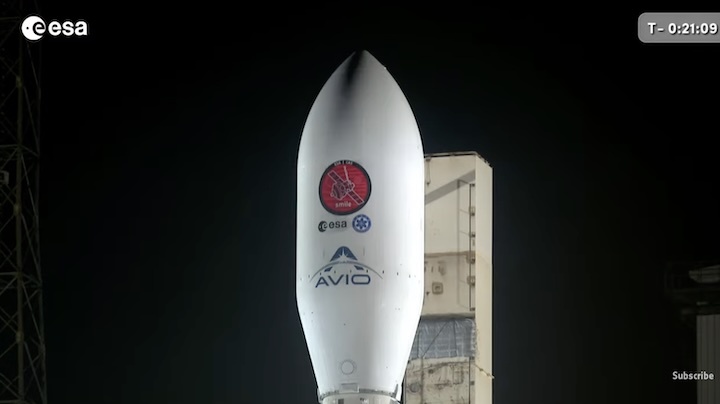
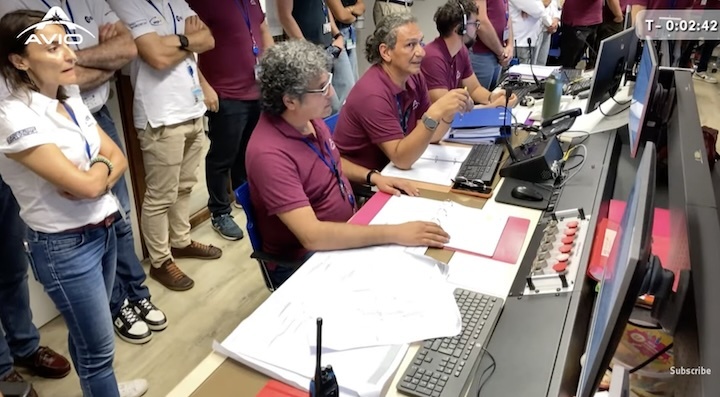
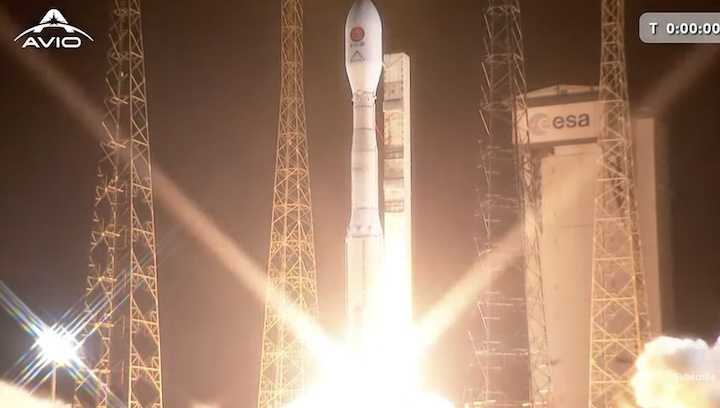
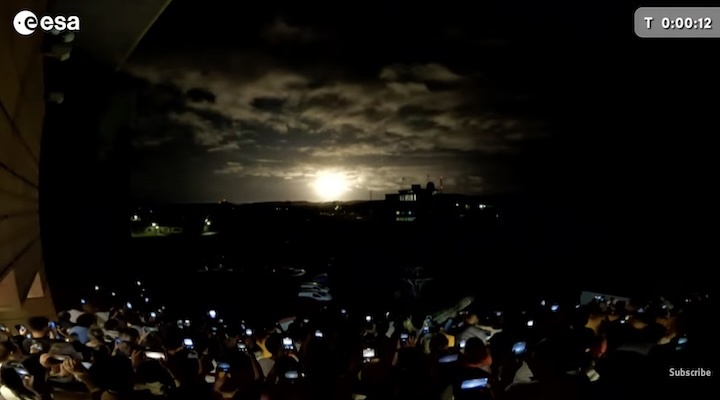
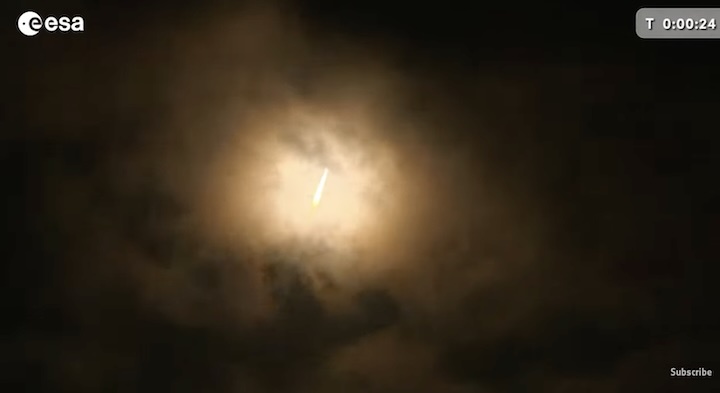
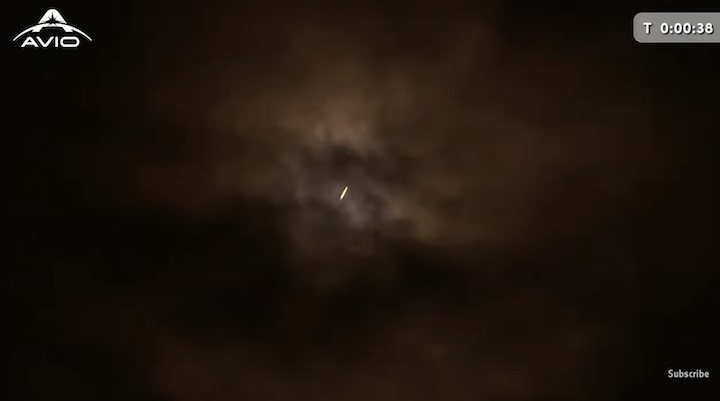
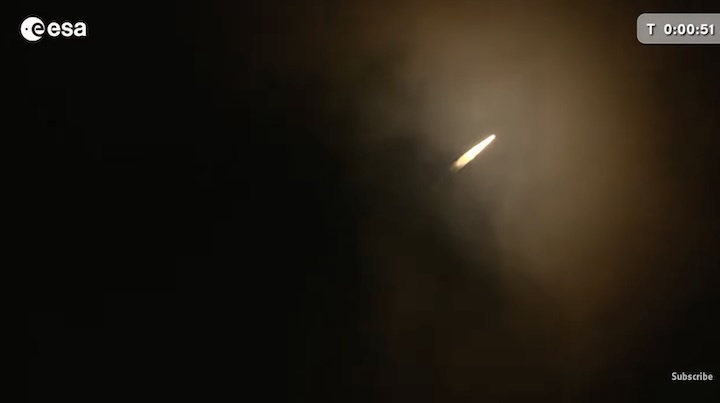
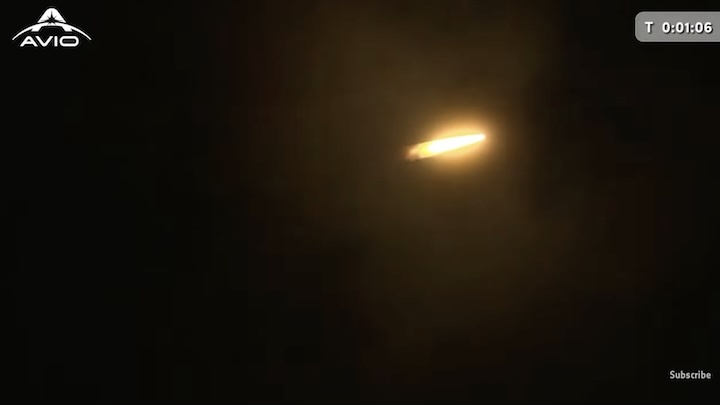
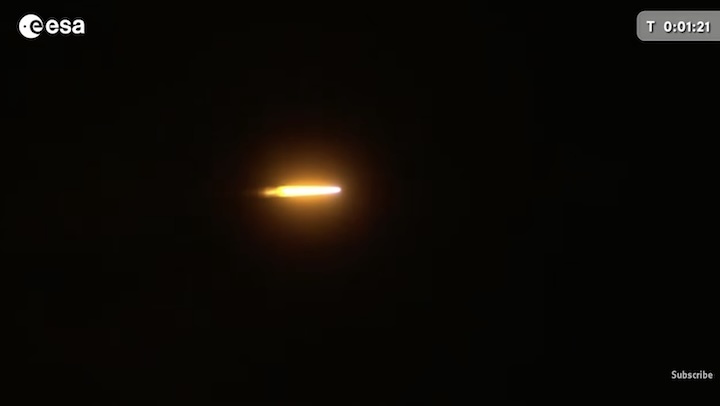
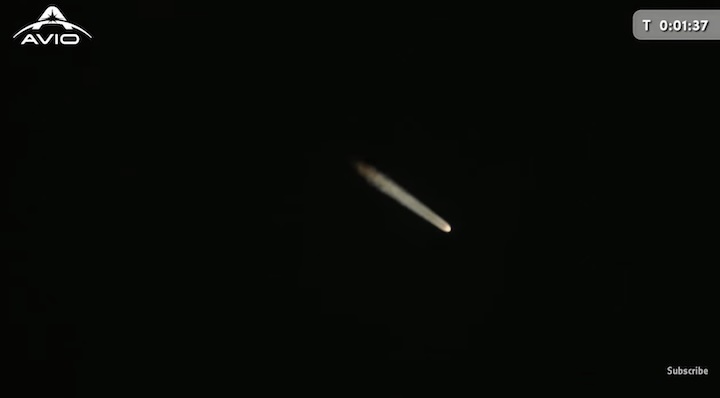
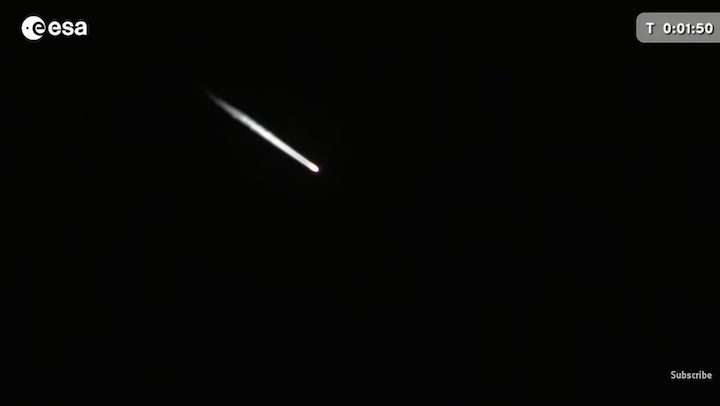
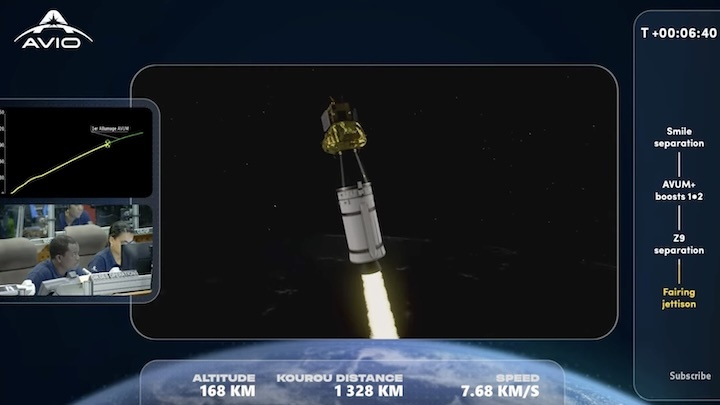
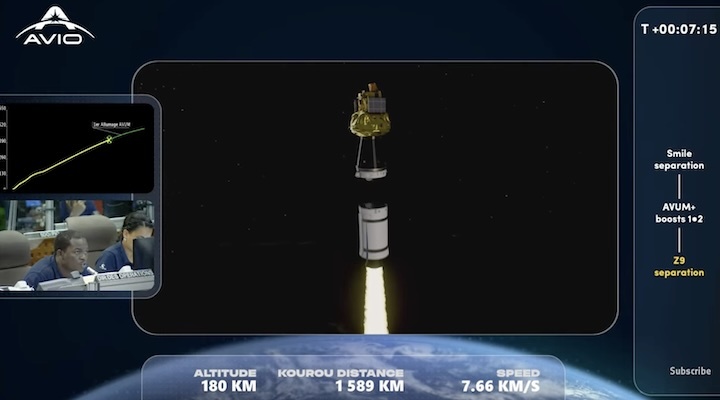
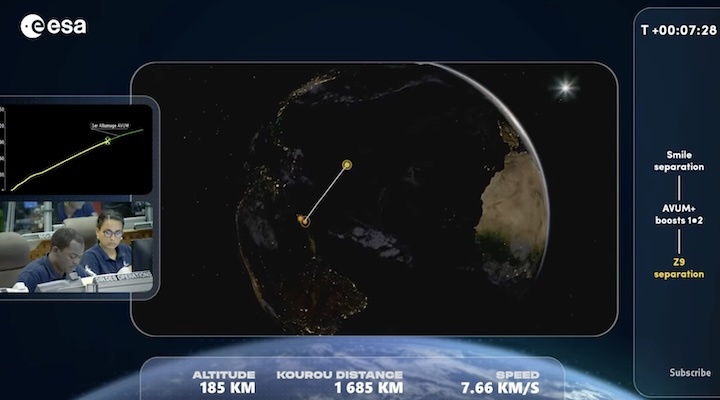
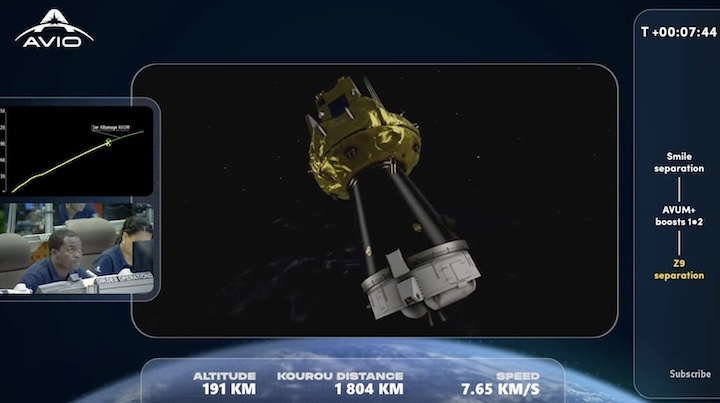
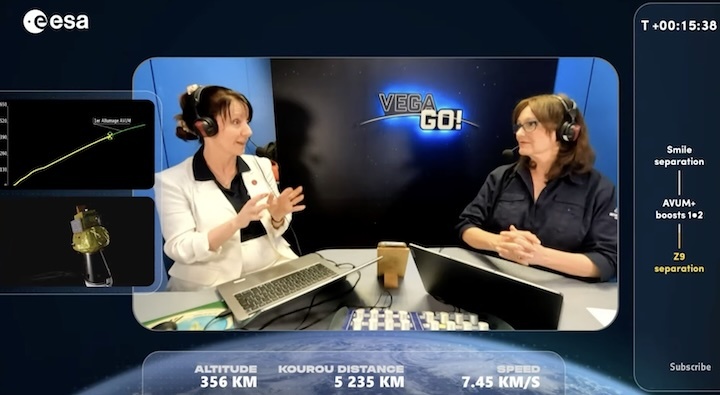
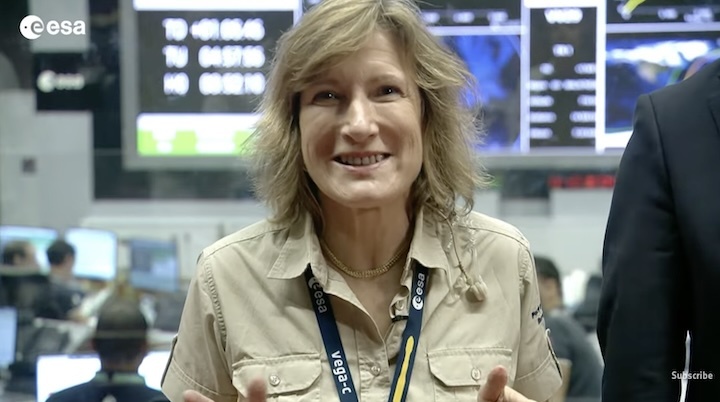
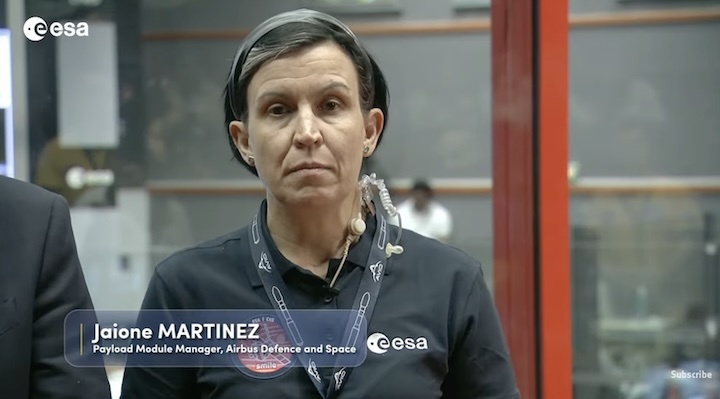
The Smile spacecraft lifted off on a Vega-C rocket from Europe’s Spaceport in French Guiana at 04:52 BST / 05:52 CEST (00:52 local time) on 19 May 2026. The launch marks the beginning of an ambitious mission to better understand solar storms, geomagnetic storms, and the science of space weather.
Following launch and separation from the rocket, the first signal from Smile was received by ESA’s New Norcia ground station in Australia at 06:48 CEST. The spacecraft’s solar panels then deployed at 06:49 CEST, meaning that Smile can now collect sunlight to power its systems and science instruments. The completion of this operation marked the launch a success.
Smile is a collaboration between the European Space Agency (ESA) and the Chinese Academy of Sciences (CAS). It will reveal how Earth responds to the streams of particles and bursts of radiation from the Sun, using an X-ray camera to make the world’s first X-ray observations of Earth’s magnetic shield, and an ultraviolet camera to watch the resulting northern lights non-stop for 45 hours at a time.
“We are about to witness something we’ve never seen before – Earth’s invisible armour in action,” says ESA Director General Josef Aschbacher. “With Smile, we are pushing the boundaries of science in an effort to answer big questions that have remained a mystery since we discovered, over seventy years ago, that Earth sits safely within a giant magnetic bubble.”
He adds: “ESA and China have a long-standing record of cooperation spanning 25 years, from early data-sharing arrangements in the 1990s to the co-developed Smile mission. This mission stands as a testament to ESA’s commitment to international collaboration, advancing scientific knowledge and promoting the peaceful use of space.”

Quelle: ESA
+++
China Focus: SMILE in sky: a new chapter in China-Europe space science cooperation
The China-Europe jointly developed Solar wind Magnetosphere Ionosphere Link Explorer (SMILE) was launched into orbit on Tuesday, expected to usher in a new era in space weather forecasting and mark a deeper, more exemplary phase in China-Europe space science cooperation.
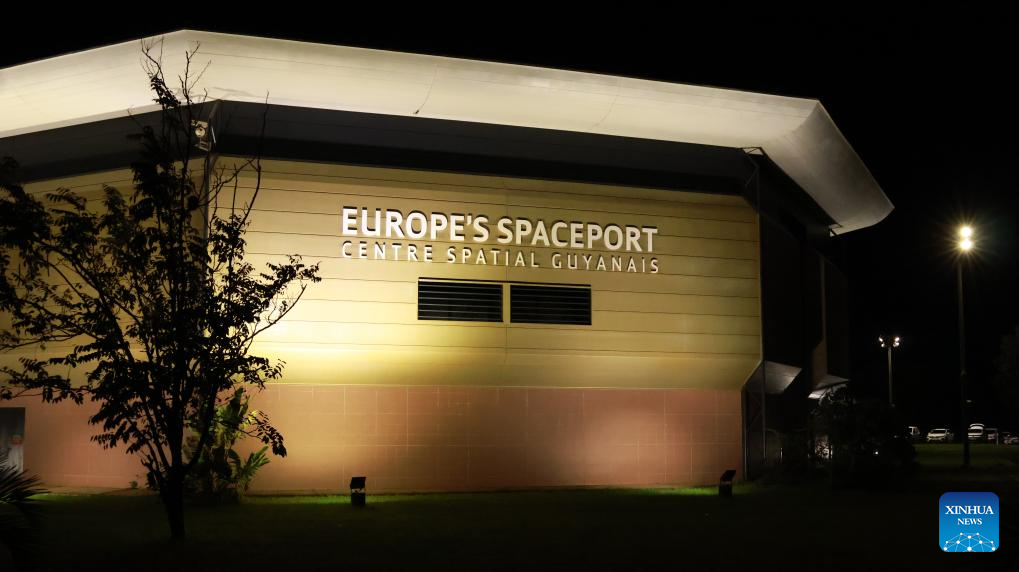
The satellite was launched by a Vega-C rocket at the Kourou launch center in French Guiana.
The SMILE mission is the first mission-level, all-round, in-depth collaborative space science exploration project between the Chinese Academy of Sciences (CAS) and the European Space Agency (ESA), aiming to reveal the mysteries of the interaction between the solar wind and Earth's magnetosphere.
According to the plan, after approximately 42 days of orbital maneuvering following its entry into orbit, the satellite will reach its observation orbit. It will then undergo two months of in-orbit testing before entering a three-year routine scientific observation phase.
UNPRECEDENTED SPACE WEATHER OBSERVATION
The Earth's magnetosphere acts as a "protective umbrella," shielding the planet from direct impacts of the solar wind. However, for a long time, scientists could only observe the magnetosphere locally through in-situ or point measurements, making it difficult to grasp the complete picture.
As Wang Chi, an academician of CAS, director of the National Space Science Center (NSSC) of CAS and Chinese principal investigator of the SMILE satellite, put it: "Previously, we could only see the trees, not the forest."
The core scientific objective of the SMILE mission is to achieve, for the first time, global imaging observations of solar wind-magnetosphere interactions, presenting the complete chain of how solar wind energy enters, propagates through, and dissipates within Earth's space, according to Wang.
To realize this goal, the mission employs a groundbreaking design: it carries the world's first spaceborne soft X-ray imager (SXI), which can transform the previously "invisible" magnetospheric boundary into images.
Additionally, the satellite carries an ultraviolet auroral imager (UVI), a light ion analyzer (LIA), and a magnetometer (MAG). This observation system enables simultaneous global-scale imaging to track magnetospheric evolution while measuring in situ solar wind physical parameters, providing unprecedented observational capabilities for studying space weather processes such as magnetic storms and substorms.
NEW MODEL FOR SPACE COOPERATION
Originating from a cooperative initiative jointly launched by CAS and ESA in 2015, the SMILE project has established an equal, mutually beneficial, and complementary mechanism for cooperation.
China is fully responsible for satellite platform development, telemetry and control, ground support, and the construction of science application systems, and leads the development of the UVI, LIA, and MAG payloads. The European side is responsible for the payload module and SXI development, and provides the launch vehicle, launch site, and active-phase telemetry and control support.
The satellite's main payloads are all jointly developed by China and Europe. The SXI is led by the University of Leicester in the UK, with Chinese participation; the UVI is led by China, with Europe providing critical components; the LIA and MAG are led by China, with multiple leading European research institutions participating in development and calibration.
During in-orbit operations, Chinese and European scientists will jointly conduct data processing and analysis, with scientific data openly shared with research institutions worldwide.
"The satellite's long-term, stable observational data is expected to fundamentally enhance human understanding of solar wind-magnetosphere interactions and space weather mechanisms, providing crucial support for improving space weather forecasting accuracy and ensuring near-Earth space safety," Wang said.
He noted that this mission is another landmark collaboration in space science between China and Europe since the Double Star mission of the last century, and represents one of China's most deeply international collaborative aerospace projects to date. The model of "joint knowledge creation, shared risks, and shared outcomes" offers a replicable and scalable paradigm for new forms of international scientific and technological cooperation in outer space.
Dai Lei, chief designer of the SMILE science application system at NSSC, recalled that in the early stages of the project, the Chinese team had to adjust to ESA's strict engineering testing standards. Even payloads already tested in China needed to undergo ESA's testing procedures.
"After ten years of mutual adaptation, we have not only become familiar with each other's workflows but also ensured the satellite and instruments meet both Chinese and European standards. This close collaboration has created a strong foundation for broader cooperation in the future," Dai said.
SHARED FUTURE IN SPACE
The implementation of the SMILE mission represents a key step in China's contribution of cutting-edge, original knowledge to humanity's space science repository, advancing China's historic transformation from a participant to a core contributor in international space science, Wang said.
During the 15th Five-Year Plan (2026-2030) period, China will advance its space science program. China is actively exploring further cooperation with ESA in scientific data sharing, joint telemetry and control, and mission coordination, according to Wang.
"The foundation of international cooperation is mutual trust, followed by friendship, and comparable capabilities between both parties," Wang said. "We hope to build a community with a shared future for mankind in space, and SMILE is precisely a vivid practice of this vision."
"We have only one space, only one Earth. The SMILE satellite is not merely a scientific satellite; it is a bridge spanning national borders, carrying humanity's shared hope and wisdom in addressing the challenge of space weather together," Dai added.
Quelle: Xinhua