
29.10.2026
Company expects first commercial flight of new ‘Apeiron’ vehicle in the early second quarter of 2027.
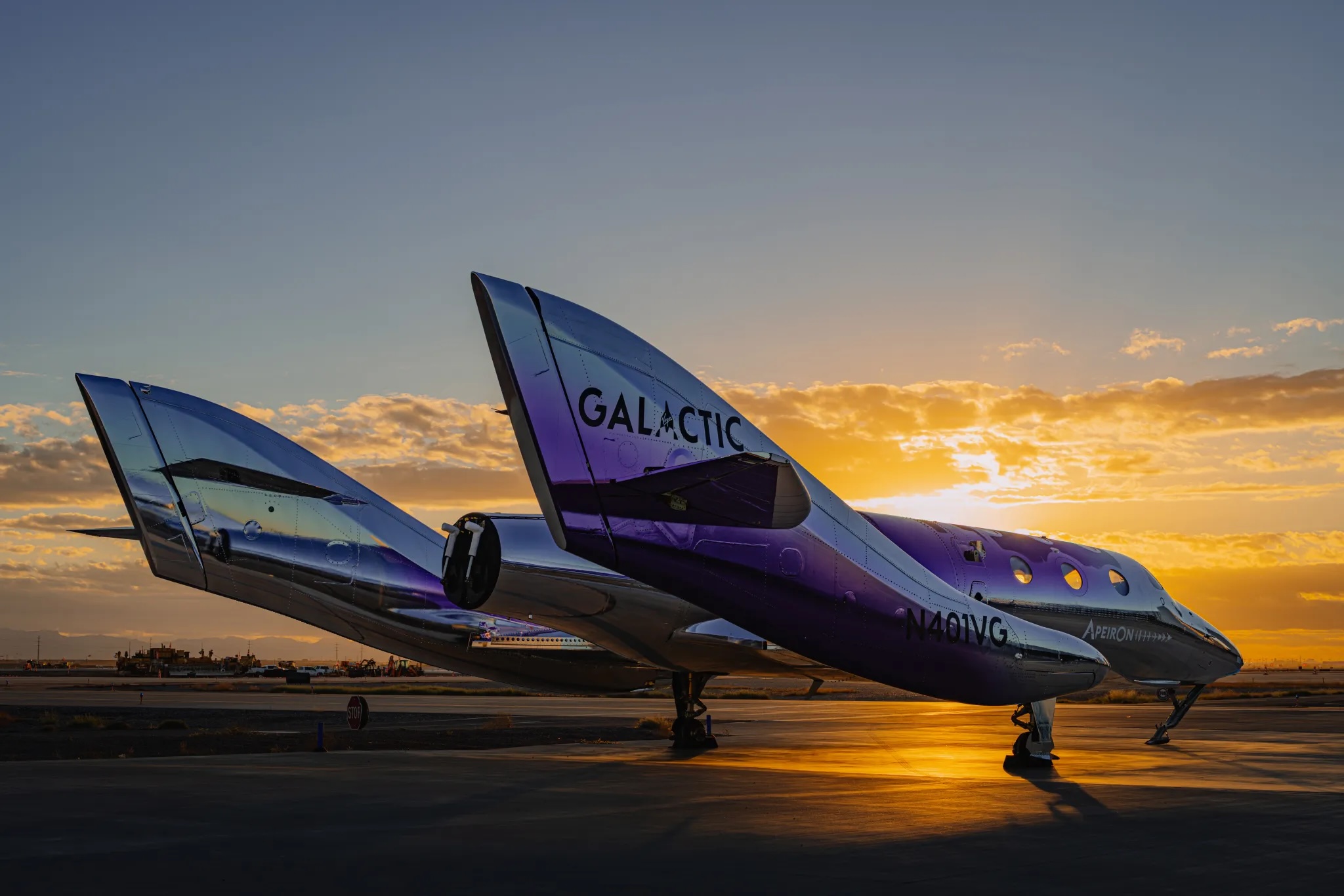
Virgin Galactic revealed the name of its first ‘Delta-class’ spaceplane, Apeiron, ahead of its delivery to the company’s operations base at Spaceport America in New Mexico. [Credit: Virgin Galactic]
Virgin Galactic, which offers high-flying commercial tours using suborbital spaceplanes, is preparing its first “Delta-class” vehicle for service in early 2027.
The company said Wednesday that the spaceplane, named Apeiron, will be delivered from its factory in Arizona to its operations base at Spaceport America (9NM9) in New Mexico. According to FlightAware, it is expected to depart Mesa Gateway Airport (KIWA) and arrive at the spaceport around 2:15 p.m. EDT. The vehicle bears the tail number N401VG.
Apeiron is not yet flying under its own power. Rather, it will be mated to VMS Eve, a Scaled Composites White Knight Two quadjet that serves as Virgin Galactic’s carrier mothership.
Flight tests are expected to begin in the months following the spaceplane’s arrival in New Mexico. First, it will undergo avionics software validation testing, as well as structural test assembly of the wing and fuselage, Virgin Galactic said Monday.
The company said it would provide more information on its third-quarter 2026 earnings call in November.
What’s in a Name?
The word “apeiron” comes from ancient Greek philosophy and is often translated as “unlimited,” “boundless,” or “infinite.”
The name was selected by a public vote comprising respondents from 83 countries across six continents. According to Virgin Galactic, “it captures what astronauts actually see from above: a view so vast that borders dissolve and the divisions we live inside fall away.”
The company in August said that Apeiron would be the name of its second Delta-class vehicle and that the first was preparing for flight testing. But it said Monday that Apeiron will be the “lead spaceship” in its next-generation fleet.
“The arrival of our lead spaceship at Spaceport America will be an enormous milestone in a years-long journey to build the world’s first human spaceship platform designed for regular commercial spaceflight,” said Virgin Galactic CEO Michael Colglazier.
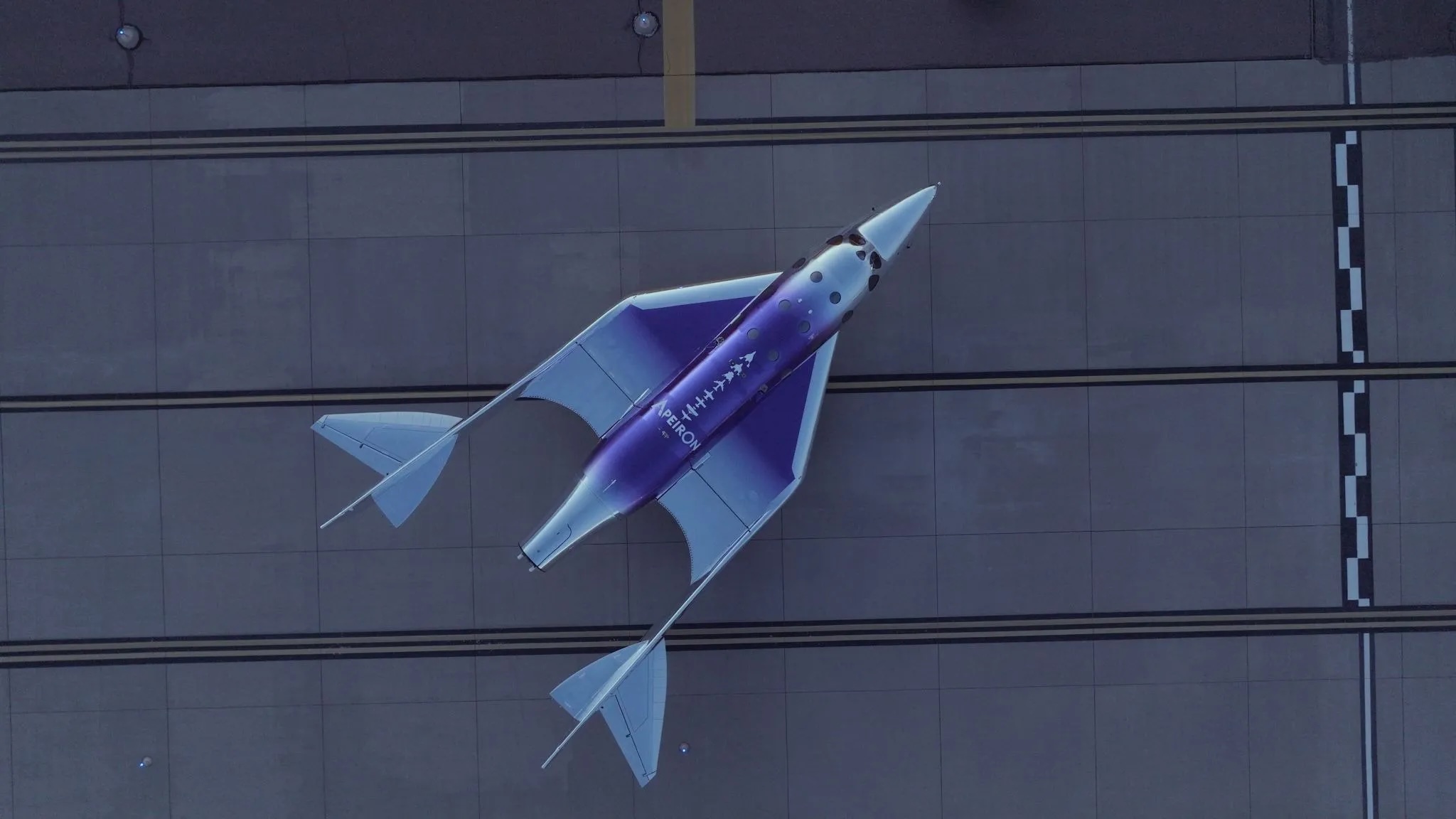
An aerial view of the Apeiron spaceplane [Credit: Virgin Galactic]
Though Virgin Galactic describes its aerial tours as spaceflights and its customers as astronauts, previous missions have not surpassed the Kármán line—the World Air Sports Federation-defined boundary of space that is commonly accepted by the international community.
Earlier trips have flown past the FAA and U.S. military-defined boundary of space at about 50 miles but fallen short of the Kármán line at about 62 miles. That means they were technically suborbital, though the FAA previously awarded astronaut wings for people who flew above 50 miles.
Virgin Galactic has not made clear whether Apeiron will pass the Kármán line. Like the company’s earlier spaceplanes, it is designed to mate with VMS Eve and take off from a runway. Eve will lift the vehicle to an altitude of about 45,000 feet before releasing it for a 60-to-90-minute suborbital tour. The spaceplane would land on the same runway used by the mothership.
Back in Action
Virgin Galactic has not flown a commercial mission since 2024. Its previous SpaceShipTwo-class vehicle, the Scaled Composites Model 339 VSS Unity, launched on its first commercial mission in June 2023 and was retired in 2024. It completed a total of seven commercial suborbital flights.
The company said Monday that Apeiron’s first mission with paying customers will fly in the early second quarter of 2027, and a second vehicle—which it said has not yet been assembled—will hit the same milestone in the late second quarter or early third quarter.
The company had previously been targeting a resumption of commercial service this year. But Colglazier said in August on the company’s second-quarter 2026 earnings call that it would be pushed to February due to delays in building the first Delta-class vehicle.
The firm said Monday that the updated timeline “reflects additional time for completing avionics software integration and validation, which uses an exhaustive testing process.” It added that more than 100 people are beginning mission preparations.
Virgin Galactic chief financial officer Doug Ahrens estimated in August that each Delta vehicle will cost about $60 million to produce. Colglazier said the plan is to charge more than $750,000 per seat.
Blue Origin, the company’s chief competitor, said in January that it would halt commercial operations with its New Shepard for at least two years. That could leave Virgin Galactic as the only commercial suborbital flight provider in 2027.
Unity vs. Apeiron
Unity returned to flight in May, conducting a handful of glider flights to train pilots for its two Delta-class vehicles. Like Unity, they will be designed to seat up to six passengers, though the former never flew with more than four passengers and two crew.
With Apeiron, Virgin Galactic aims to increase that capacity as well as the spaceplane’s cadence. It said in May that the Delta vehicles are designed for up to two weekly flights. But Ahrens in August said it hopes to fly 10 or more times per month by mid-2027. Unity achieved a peak cadence of about one flight per month in mid-late 2023.
The company earlier this month said it is “planning for around 125 flights a year, scaling to many more than that as the fleet grows.” It also announced a research agreement with the Air Force Research Laboratory to study the integration of sensor systems for space weather data collection during flight.
Quelle: FLYING