
12.09.2026
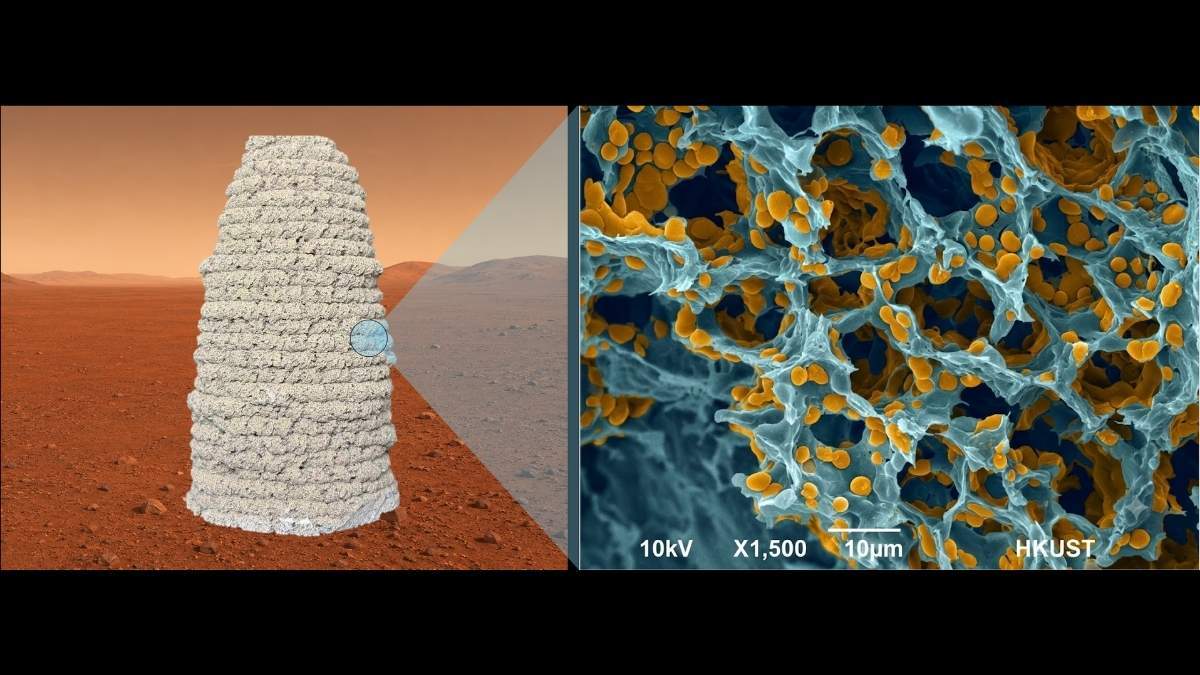
A material which dries and hardens to concrete-like strengths under freezing temperatures and near-vacuum pressures could one day be used to 3D-print human settlements on Mars.
It contains gelatine, sand and yeast which are genetically engineered to produce adhesive proteins on their surfaces. It can be broken down, recycled and brewed again into new construction materials.
The research is published in the journal Chem Circularity.
Building a home on Mars
When humans set foot on the surface of Mars, they will need to build permanent homes capable of protecting against conditions very different from those on Earth.
Vulnerable astronauts will require structures that can maintain breathable air at an appropriate pressure like bubbles in the Red Planet’s extremely thin, carbon dioxide-rich atmosphere.
Habitats will also need to withstand huge temperature fluctuations (-150°C to 20°C), shield against cosmic radiation and keep out raging dust storms.
But, as senior author Jishen Qiu of the Hong Kong University of Science and Technology says to ConnectSci News, there are unique engineering challenges on Mars.
“Near-vacuum plus freezing temperature makes material fabrication (most methods designed for the air pressure of Earth) almost impossible.”
Qiu says that there are no readily available material resources on Mars except for soil, sand and rocks.
While these can used as concrete aggregates, there is no readily usable energy source on Mars, he adds.
This is a problem, because most proposed methods for converting regolith into structural materials involves sintering it into bricks and other construction materials which requires temperatures greater than 1,000°C and substantial amounts of power.
Living building materials
Qiu and co-authors propose a solution for low-energy construction on Mars – Martian living building material (MLBM) composed of sand and a liquid binder of gelatine and yeast (Saccharomyces cerevisiae).
The yeast is genetically engineered to express the protein AGA2 on their surfaces, which helps the cells, gelatine polymers and sand particles stick together in a dense network.
On Mars, local regolith would be used instead of Earth sand, and the ingredients would be mixed with water from Martian ice in pressurised and thermally insulated bioreactors.
Qiu and the team used 3D printing to extrude MLBM into small domes (4.5cm tall and 3cm wide) under ambient conditions in the laboratory. They then exposed the mixture to simulated Martian conditions – a pressure of 0.01 Earth atmospheres and temperature of -30°C.
The material immediately freeze-dried. All water turned directly from ice into vapour leaving behind microscopic pores.
The light and porous foam was then allowed to cure for a further 48 hours.
Once hardened, the MLBM achieved average strengths of about 12 megapascals (MPa) under compression and 6MPa under a bending force.
“It is as strong as low-grade concrete, which is adequate for a 2–3 story building under the gravity of Earth,” says Qiu.
“Luckily, the gravity on Mars is significantly smaller, the material can easily stand as a 5–6 story structure.”
Qiu says the MLBM can be used as a loading-bearing structural material like an outer shell or dome, but an air-proofing membrane would still need to be applied to the interior of the habitat.
Crucially, the fabrication process is energy efficient. It requires only an estimated 0.02–0.12 gigajoules per m3 of MLBM produced, which the authors say is “several tens of times lower than regolith sintering”.
Reduce, reuse, recycle
Establishing a sustainable human presence on Mars will not be possible without recycling and reusing resources to reduce how much must be transported there from Earth.
Initial laboratory tests suggest MLBM is recyclable.
The researchers showed that hardened MLBM can be crushed, redissolved in water at mild temperatures and remade into a paste to be 3D printed once more.
This can be done at least 4 times without significant loss in mechanical performance or yeast viability.
“As long as there's one yeast that’s still alive, you can grow them again,” says Qiu.
Further research is needed to assess the engineering challenges of fabricating MLBM at a large scale, as well as the material’s long-term durability under the full range of Martian environmental stressors, including radiation.
The team also plans to explore how organic compounds in the Martian atmosphere could be converted into nutrients and feedstocks to reduce the need for terrestrial resources.
“Ultimately, our hope is to transfer the CO2, CH4 and H2O (ice) into organic matter, which can be used to grow microbes and biologically synthesise binder proteins,” says Qiu.
“We are eager to know how the printing will be affected or perhaps facilitated by the lower gravity [on Mars], to do that we need a testing bed with reduced gravitational acceleration which is really challenging, and that’s why we hope our project [will] get more attention.
“Besides that, having bigger testing environment (low temperature, air pressure full-size printer-controller, full-size bioreactor) will be important to our next steps too.”
Quelle: CONNECTSCI