
10.08.2026
The LUX concept would use a fiber-optic tether to explore lunar caves that could shelter future moon bases.
There were caves beneath the Moon’s surface. NASA wants to fly some laser drones all up in them to find out what’s going on in there, and it expressed this desire by awarding a $175,000 preliminary research grant to Austin, Texas-based Stone Aerospace Inc. According to NASA, the project could become the first mission designed to explore caves on another world.
That’s a bigger deal than it sounds because scientists think lunar lava tubes can stretch for hundreds of meters across, making some of them roughly 1,000 times larger than volcanic tunnels on Earth. They’re also naturally shielded from radiation by thick layers of rock, a fact that really stirs excitement in people who want to build settlements on the moon.
And if we truly are serious and have real aspirations about living on the moon, we should probably survey its caverns to make sure they’re safe, make sure there were no giant moon rock worms hiding in them that brave astronauts have to then fly out of like it’s The Empire Strikes Back.
Stone Aerospace’s proposed Lunar Underground eXplorer, or LUX, would descend into a massive hole in Mare Tranquillitatis, the same general area where Apollo 11 landed. The cave entrance was confirmed as part of a larger underground network after researchers analyzed radar data collected by NASA’s Lunar Reconnaissance Orbiter.
A LASER-POWERED DRONE COULD BE THE FIRST MISSION TO EXPLORE CAVES ON ANOTHER WORLD
The drone itself sounds like the stuff of science fiction. It doesn’t carry a bulky battery, and instead would remain connected to a rover on the surface via a fiber-optic tether. It’s a multipurpose tether that allows the drone to transmit data, deliver laser-powered electricity, and help drive the drone’s cold-gas propulsion system, which would be necessary to avoid contaminating the cave.
It sounds like they’re just flying a drone into a cave, something that any weekend warrior dad capturing drone footage of his kids in a bounce house could do, but unsurprisingly it’s much more complicated than that, as the caves have no light at all, there will be no GPS, and there are no maps. The drones would be wandering into the complete unknown.
The grant is part of NASA’s Innovative Advanced Concepts program, which funds risky ideas that push the envelope in terms of the ways the agency can explore space.
Quelle: VICE
+++
Power-over-Fiber to Enable a Lunar Underground eXplorer (LUX)
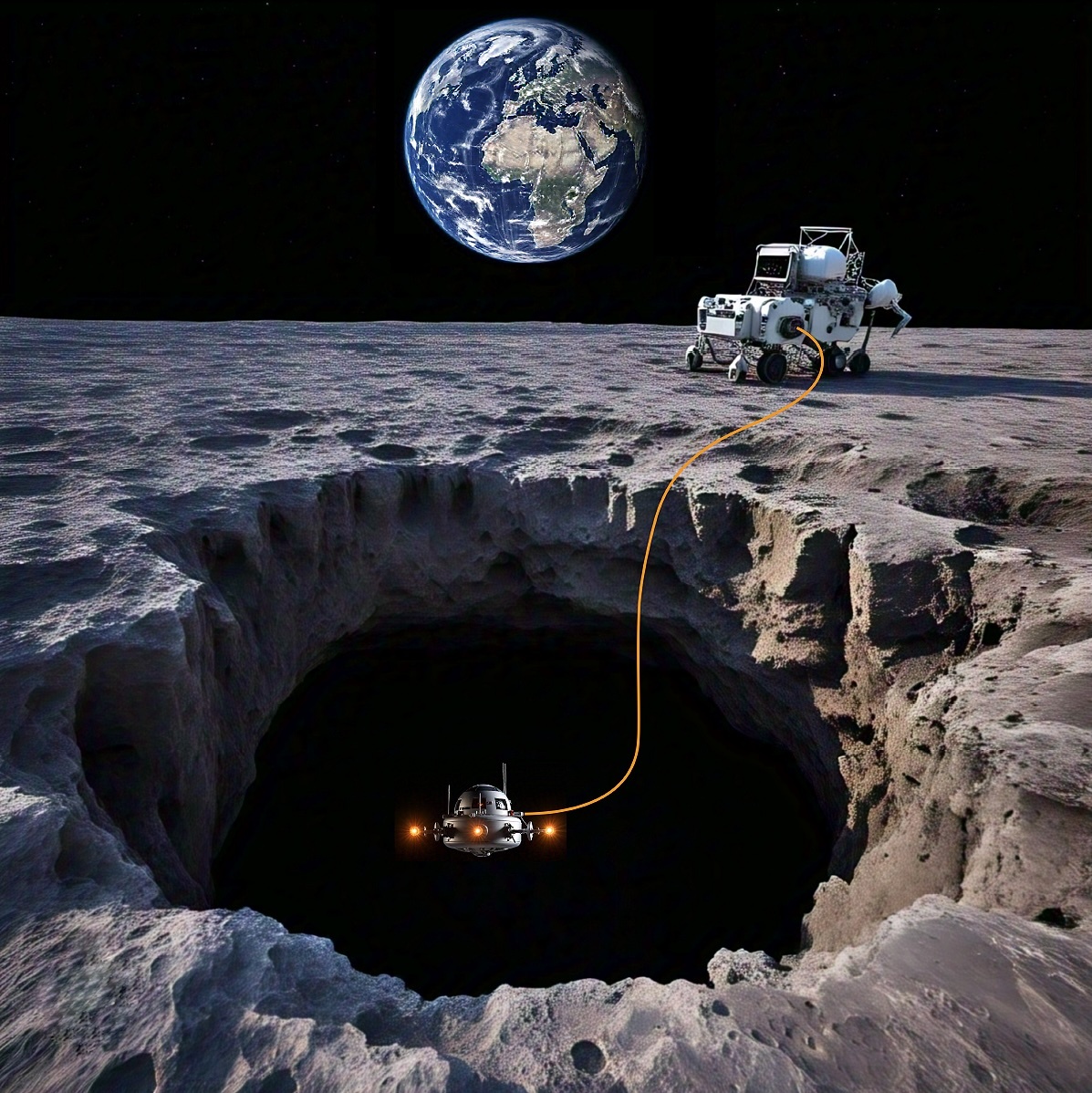
Lava tubes are one of the most interesting and entirely uncharted targets for lunar science and exploration. The Mare Tranquillitatis lunar skylight measures approximately 100m by 88m across and is 133m deep. Lunar Reconnaissance Orbiter data indicates the pit leads to an extensive subsurface lava tube that may continue for kilometers. The Lunar Underground eXplorer (LUX) mission seeks to explore and map these tunnels to assess their merits as sheltered sites for crewed lunar bases (naturally protected from cosmic radiation), and address scientific questions that could lead to discoveries in planetary geology and astrobiology. There are serious challenges with such exploration. It requires vertical entry; the morphology will be complex; there is no possibility of wireless data transmission to the lander; it will be energetically demanding (due to complete darkness); exploration and navigation within completely un-mapped 3D overhead environments is energy intensive and there is no GPS navigation aiding; critically, the system must be non-polluting so as to not affect sensor measurements of the pristine environment.
We propose transmitting laser power-over-fiber (PoF) to enable a hovering robotic lunar lava tube exploration and scientific mission. As one or more LUX vehicles descends down the Mare Tranquillitatis pit (and into the tunnels beyond) a thin, light, robust, optical waveguide (fiber) is spooled out from an on-vehicle spooler. A lander or rover carries a laser (and its power source) which delivers PoF to a LUX exploration vehicle. A vehicle-deployed fiber waveguide will enable three novel capabilities: assured high speed non-line-of-sight data transmission; onboard electrical power generation; and laser enhanced specific impulse (Isp) for a non-polluting cold-gas propulsion system. Taken together we posit that these will significantly enhance the range, duration, and quality of science and exploration for subsurface lunar (and eventually Martian) exploration. While other lunar lava tube mission proposals exist, none have the unique combinations of enabling elements of our concept.
The proposed NIAC work will be a feasibility study to demonstrate that PoF technology could enhance range and duration sufficiently to enable the LUX mission. Our prior work shows that vehicle-deployed fiber is highly effective for data transfer and extending mission duration, even with a small board-level (1-2 kW) laser. The key unknown is the potential Isp (and therefore range) improvement from PoF laser-heated propulsion. This will be assessed through a full end-to-end SWaP-optimized system design, focusing on laser heating effectiveness for a given propellant and thruster design. We will consider various heat transfer strategies to maximize Isp for a fixed propellant mass. Design choices will balance LUX’s size, mass, payload, and propellant with the laser power needed to achieve substantial penetrations in the lava tube. A LUX mission CONOPs will evaluate the ability to meet science goals within mass and duration constraints, accounting for mission uncertainties and mitigation strategies. Our Mission CONOPS team blends a unique combination of expertise in terrestrial analog cave exploration with planetary mission planning. By addressing risks tied to the cave’s unknown nature, our Phase I final report will also serve as a guide for any future lunar cave mission planning. Phase II would involve sub-scale laboratory tests to quantifiably measure increased Isp using a 1070nm fiber laser transmitted over a kilometer of fiber-optic waveguide.
The proposed study could enable the first off-world cave exploration. This could also advance other planetary exploration applications requiring non-line-of-sight power delivery to remote locations. Additionally, our technology has broad dual-use potential for terrestrial applications, enabling long-range continuous optical power transmission to mobile platforms on land, in air, or underwater.
Quelle: NASA