
13.07.2026
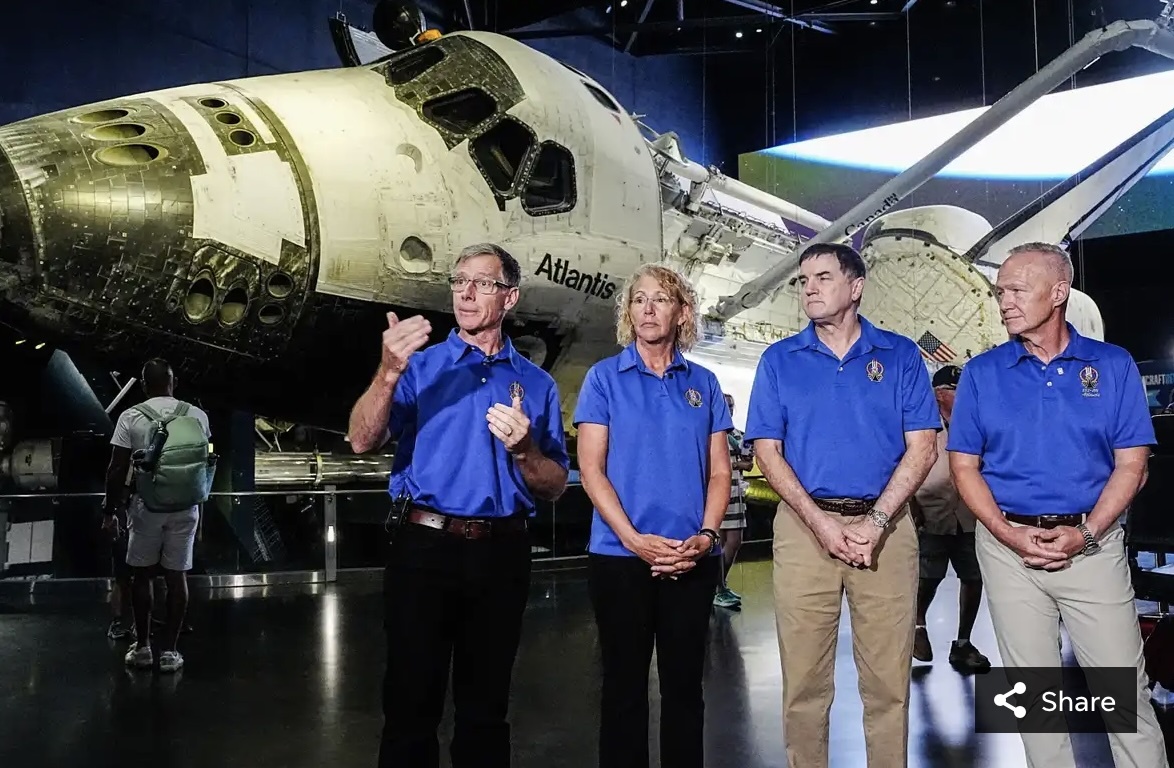
The astronauts of STS-135, the final Space Shuttle mission, answer questions as they pose for pictures in front of shuttle Atlantis at Kennedy Space Center Visitor Complex July 11, 2026. 15 years ago, Chris Ferguson, Sandy Magnus, Rex Walheim and Doug Hurley launched aboard shuttle Atlantis on the final mission of the program. Craig Bailey, FLORIDA TODAY via USA TODAY NETWORK
The final four shuttle astronauts addressed a crowd July 11 underneath their ride, Space Shuttle Atlantis, reflecting on that last flight of the space shuttle era 15 years ago.
Commander Christopher Ferguson, Pilot Douglas Hurley, and Mission Specialists Sandra Magnus and Rex Walheim launched aboard Atlantis on July 8, 2011, from Pad 39A at NASA’s Kennedy Space Center. After 30 years of missions, NASA’s Space Shuttle chapter had come to a close.
The mission to the International Space Station lasted 13 days, landing back at KSC's Shuttle Landing Facility on July 21.
“It was a very interesting launch sequence. We had this really interesting hold,” Ferguson told FLORIDA TODAY. “We were all very interested in what was going on and if we were going to launch that day.”
The countdown had proceeded smoothly that day, despite earlier weather concerns, but at T-31 seconds, the countdown was put on hold to determine if the gaseous oxygen vent arm had fully retracted. The issue was resolved and Atlantis launched near the end of the window.
During his remarks to the audience at the KSC Visitor Complex July 11, Hurley recalled just how well that final flight went.
“Just being the last flight, being the last orbiter that got to fly, and just how well it preformed … we had literally almost a flawless mission,” Hurley said. “And that’s just a testament to the folks that processed and worked on this vehicle and kept it in such good shape.”
Walheim said he feels gratitude as he reflects back. Gratitude not only for the great performance of Atlantis and the chance to fly on it, but for the people who worked to make the mission a success.
Of course, that final flight came with some unforgettable moments of its own.
Hurley recalled the master alarm causing a scare about a week into the flight as the crew were sleeping onboard Atlantis.
“It ended up being one of our five general purpose computers was not having a good evening,” Hurley said, explaining the crew had to spend two hours troubleshooting the computer.
Walheim recalled a strange quirk of Atlantis, which caught his attention every one of the three times he flew aboard this shuttle. When it came time for landing, the vibrations caused the bathroom door to swing open and slam against the ladder.
“The bathroom door comes swinging open, slamming against the ladder, and there’s this huge ‘bang’ that goes (on) downstairs,” said Walheim as his crewmates nodded and agreed.
“We were like less than a minute away from landing, too,” said Ferguson. “That was way too many heartbeats in there.”
Magnus recalled the mission being “incredibly busy”, but the one thing that still stands out to her is the sheer amount of cargo that was moved on and off the space station. Around 8,000 pounds of supplies were moved from the shuttle to the ISS, and about 6,000 pounds of supplies were loaded on the shuttle to bring back to Earth.
“What you didn’t see off camera was just the mess we were making at the space station, because we had to put these bag somewhere, and there wasn’t enough room,” said Magnus. “It looked like somebody blew up a closet. It was just such a mess.”
Ferguson said that it wasn't until the night before landing that the crew had time to sit and look out at Earth.
The crew stayed active after the retirement of the space shuttle. Ferguson joined Boeing to work on the company’s Starliner spacecraft program. Walheim went to work on Blue Origin’s suborbital New Shepard spaceflight program. Hurley joined Northrop Grumman to work as senior director of strategy and business development.
After the space shuttle retired, crewed flights to orbit were only possible through the Russian Soyuz spacecraft. While NASA had already contracted SpaceX and Boeing to develop spacecraft as part of the Commercial Crew Program, a solution was not ready in time. This left a nine-year gap in orbital spaceflight from America.
After commanding STS-135, Hurley went on to command the first crewed SpaceX Dragon spacecraft mission, Demo-2. The May 2020 flight certified Dragon to ferry NASA astronauts to ISS and saw the return of crewed orbital launches from Florida for the first time since that final shuttle mission.
Having flown both the space shuttle and Dragon, Hurley was asked which he would prefer to fly if he had the chance to do it again.
“I choose the shuttle because I could actually fly it most of the time,” Hurley said noting how Dragon can fly autonomously. “(As) test pilots, we just like to be in control.”
Quelle: Florida Today