
24.06.2026
A leading military expert has warned China could launch a crippling attack on Australia’s satellites that would leave us “deaf, dumb, and blind”.
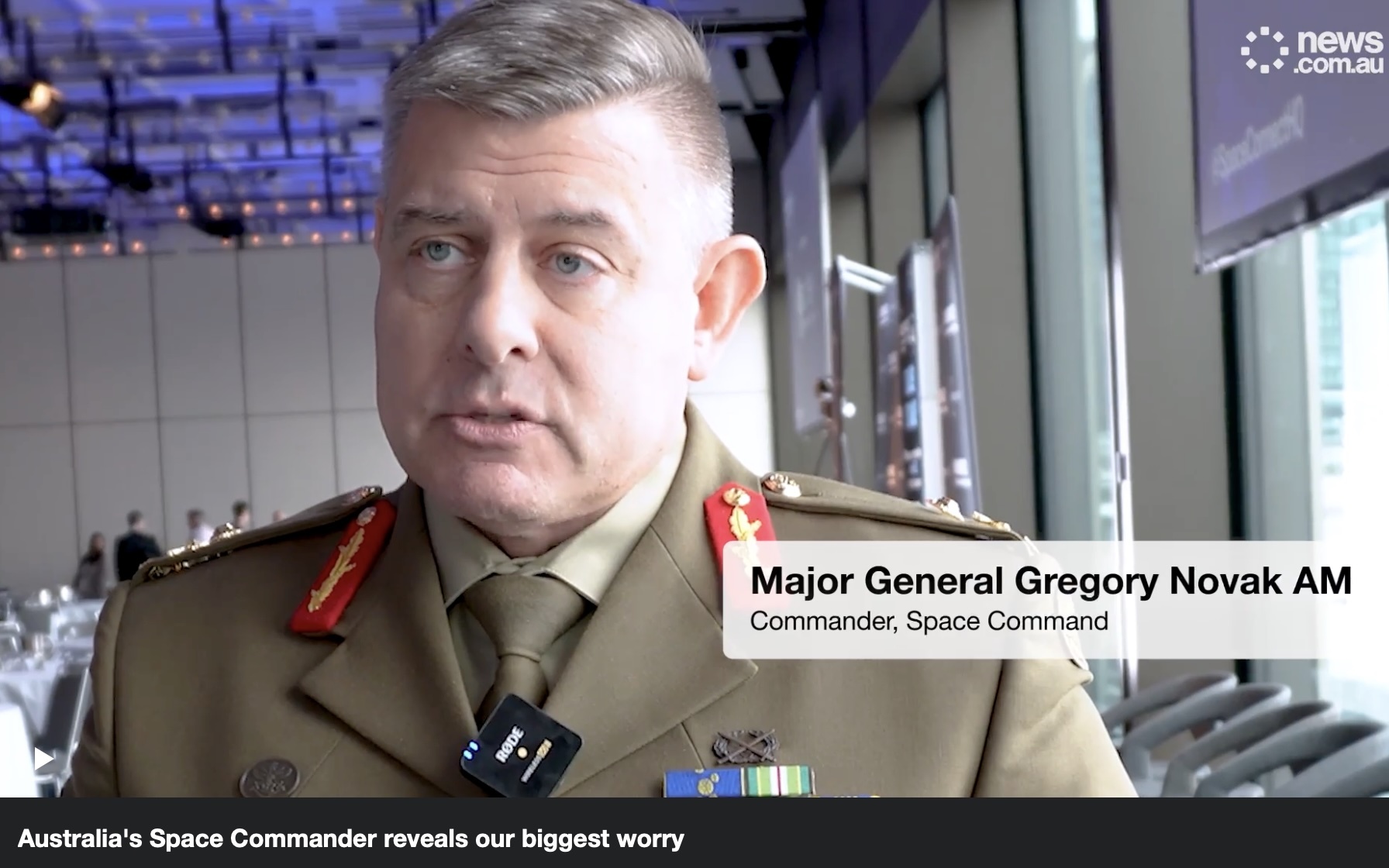
Major General Gregory Novak heads Australia's Space Command and told news.com.au the 'pace' of the space race keeps him up at night
Chinese and Russian space weapons could leave Australia “deaf, dumb, and blind” at the beginning of a war, a military expert has warned.
Dr Malcolm Davis from the Australian Strategic Policy Institute said Australia’s enemies could target GPS satellites, leaving our forces unable to communicate and completely unaware of what’s happening on the battlefield.
“It’s often what’s referred to as the Pearl Harbour in space. It would be a coordinated attack on multiple satellites,” Dr Davis exclusively told news.com.au on the sidelines of the Australian Space Summit and Exhibition in Sydney on Wednesday, June 17.
“Imagine GPS, satellite communications, potentially missile early warning, certainly spy satellites — that could be done in a coordinated way so basically what it does is leave us deaf, dumb and blind at the beginning of a war.
“Without GPS, we can’t do command and control because the timing signals from GPS manage that. It also drives navigation and targeting.”
The dire assessment comes as the United States Space Force (USSS) said Beijing is rapidly improving space-based capabilities and growing a deadly arsenal of weapons capable of long-range precision strikes against the US and allied forces.
It’s also believed China tested two hypersonic “space nukes” in 2021.
Meanwhile, Russia is believed to be building nuke-carrying space weapons and has repeatedly warned “quasi-civilian” commercial satellites were a “legitimate target for retaliation,” according to the USSS.
In a show of force in the lead up to the war in Ukraine, Moscow blew up a defunct Soviet satellite, creating a cloud of space junk that endangered the International Space Station and China’s Tiangong Space Station.
It’s under this cloud of great uncertainty that Australia established its first-ever space command centre in 2022 - a joint-capabilities group tasked with strategic space planning as well as designing and operating space facilities.
The 2024 National Defence Strategy also promised $12bn under the Integrated Investment Program to enhance Australia’s space capabilities while Space Command is offering a new range of specialist roles to lure new talent and knowledge.
Experts say the moves are Australia flexing “serious muscle” in the space domain. Others are expressing alarm and say the funding can’t come quick enough.
“The next step is, rather than simply watching as the Chinese attack our satellites, let’s have the means to protect our satellites and that’s where space control comes in,” Dr Davis said.
“We’re going to be much more reliant on satellites in coming years, including our own satellites to take joint, integrated operations, so we need to recognise there is a real threat out there.”
‘China wants space dominance’
Dr Davis said Beijing could easily knock out critical Aussie comms satellites using ground-based missile systems or fry them by blasting high-powered microwave radiation using military hardware located in space. They can also shove satellites out of orbit using grappling machines.
He said China could also exploit chaos wrought by Russia’s alleged building of nuke-carrying weapons to multiply numbers of its own deadly kit in space.
“If the Russians go ahead and deploy this capability, it would be a deliberate and gross violation of the 1967 Outer Space Treaty, which is the foundation for all space law and arms control…The Chinese can then exploit that and move much more aggressively in space in terms of space weaponisation and space warfighting,” he said.
“I think the Americans don’t want to see that, but they’re also taking steps in terms of weapons capabilities and warfighting, so there is a clear move by the US to think about space warfighting.”
The detonation of nuclear weapons in space would create massive amounts of radiation and electromagnetic pulse that would “fry indiscriminately any satellites in visual range for that detonation,” Dr Davis warned.
Retired Royal Australian Air Force commander Terry van Haren said recent events, such as Russia’s downing of defunct Soviet satellite Cosmos 1408 in November 2021, should be a wake-up call for Canberra.
He said Space Command has been operating on a shoestring budget for too long and called on Canberra to front-end its $12bn funding package now so space scientists can use the pool of cash now to develop our capabilities.
He said Australia has been “highly reliant” on US assistance for too long and needed to bring that space tech expertise and production, as well as the supply chain, onto Aussie shores - a term known in the space defence community as sovereign capability.
“We haven’t really taken a sovereign approach at all, except for standing up Space Command and resourcing it,” he said.
“That’s an important one because now you’ve got a command in itself and, actually, to build a capability and operate that capability, which is very important,” he said.
But he warned China’s “rapid advances” in space were worrying.
“What should keep us all awake at night should be the rapid advances of the adversary and that’s the capability and capacity, more so of China’s People’s Liberation Army’s space forces, and the Russians [who] are still adding capabilities to their space warfare fighting needs,” he said.
“Those two parties are working together, so you need to be concerned.”
He said China wants to equal dominance to the US in space in the near term.
“If you lose the space fight, you lose the fight, basically. We used to say that in terms of airpower during World War II. If you lose control of the air, you lose very quickly. If you lose control of space nowaways, you lose control of your terrestrial operations very quickly,” he said.
‘These are here and now issues’
Major General Gregory Novak, who heads Australia’s Space Command, told news.com.au the country is a serious player in the space domain.
“From a defence perspective, I look at an Integrated Investment Program and I see $9 to $12 billion identified for space capability uplift and clear direction on those future force priorities of resilient satellite communications, enhanced space domain awareness, space control and geospatial intelligence uplift. I think they are things that show how serious we are in the game,” he said.
Major General Novak said Space Command also launched a new workstream where cadets will undergo continuous specialist space training, a progression in rank, as well as good promotional and pay opportunities that will allow them to pursue a career in space.
“It’s going to give us that deep technical mastery that’s going to allow us to make sure, again, we’re not just doing space for space’s sake. We’ve got space professionals who are delivering on their mission sets for the benefit and the advantage of the wider integrated force,” he said.
The decorated general, who previously led the Australian Army’s 6th Brigade, said his department was focused on deterring Australia’s enemies in space and would continue to work with the US and other allies to call out malevolent actors.
“These aren’t esoteric or philosophical future conceptual issues we’re dealing with, these are here and now issues. We’re making sure that we are posturing ourselves to deal with not just the future force of laying that foundation, but also to make sure that we’re in a position to do what we need to do today and tomorrow,” he said.
Major General Novak admitted the pace of technological advances in the space domain kept him up at night.
“I think a constant question that any leader or any strategist in space should be asking themselves is, are we moving fast enough?” he said.
“I think that’s a good question to ask, a good lens to have on things, because it will identify the opportunities where you can get after things that matter to you most.”
Thankfully, Australia has “a lot of building blocks” to transform our space capabilities, Mr van Haren said.
“We have a lot of good research and development that has come out of our universities and gone to small companies that, when you add it all up, can create a capability.”
Quelle: news.com.au