
30.05.2026
Blackened, twisted metal wreckage lay illuminated by the morning sun May 29 at Blue Origin's $1-billion-plus Launch Complex 36, where an exploding New Glenn rocket generated an enormous, billowing fireballovernight.
The mighty New Glenn blew up during a prelaunch static-fire test the night of Thursday, May 28 — rattling windows in communities near Cape Canaveral, generating worldwide news headlines, and casting doubt on NASA's ambitious timeline for Artemis III and moon-base missions.
"It jarred everyone. I mean, it was shocking," said U.S. Rep. Mike Haridopolos, who represents Florida's Space Coast in Congress.
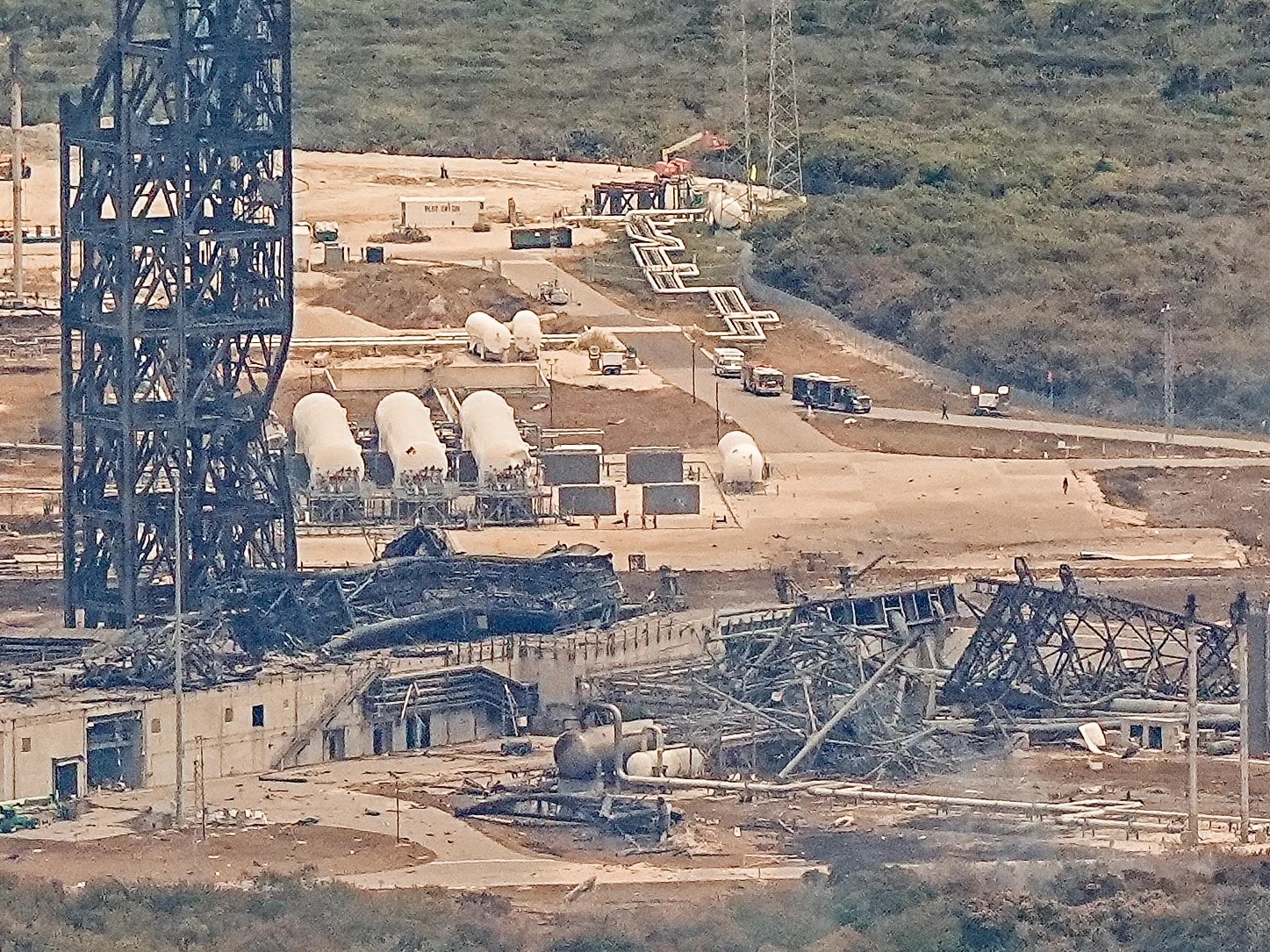
Aerial photos of the damage to Blue Origin's after a New Glenn rocket exploded during a tanking test
"But also, as a person who's lived here since 1988, I know that there's high moments and low moments in the space industry. I remember living through the Challenger and, later, the Columbia disasters," Haridopolos said.
"What we are optimistic about is that they can solve this problem more quickly. This is why we have multiple vehicles being built that can actually land on the moon," he said.
No injuries were reported from the New Glenn explosion, and Brevard County Emergency Management officials announced there was no threat to the general public. Blue Origin released minimal new information Friday, May 30, the day after the blast. No updates were released on the scope of damages at Launch Complex 36.
The explosion was so significant that Blue Origin and Brevard emergency officials said debris may wash ashore for weeks. If beachgoers encounter rocket debris, they were warned "do not touch or approach it for your safety."
NASA officials were counting on a New Glenn — and Launch Complex 36, the rocket's lone liftoff point — to propel Blue Origin's uncrewed Blue Moon Mark 1 lunar lander to the moon's surface as early as fall to start development of a U.S. moon base.
Thursday's explosion and subsequent damages cast doubt on that plan. Blue Origin is also developing the larger Blue Moon Mark 2 crewed lander for potential on-orbit testing during NASA's Artemis III mission, which is scheduled for mid-2027.
Haridopolos, an Indian Harbour Beach Republican who chairs the House Subcommittee on Space and Aeronautics, said he looks forward to hosting a hearing about the fiery anomaly with Blue Origin officials and NASA Administrator Jared Isaacman. Haridopolos said he wants to hear why the incident took place — and "what they've done to remedy the problem so it never happens again."
"These are dramatic challenges. And space is difficult. And it's the reason we need to have the best and brightest here. It's the reason why we're investing here," Haridopolos said, referencing America's space race with China as a national security issue.
Space Force security perimeter kept people from harm's way
Col. Brian Chatman, who commands Space Launch Delta 45, addressed the massive Blue Origin explosion Friday during panel remarks at Accelerate Brevard’s annual State of Space event at the Kennedy Space Center Visitors Complex.
After analyzing the quantity of fuel in the New Glenn rocket, Chatman said Space Force personnel established a BDA — or blast damage area “keep-out zone” — and set up perimeter roadblocks to keep people away from the rocket before the static-fire test.
The thunderous explosion occurred about 9 p.m. Thursday. By 9:25 p.m., Chatman said military officials confirmed all personnel in the area were accounted for.
In partnership with Blue Origin, Space Force personnel used drones overnight to monitor where brush fires were burning. Firefighting personnel reported to the scene after daybreak. And range operators helped SpaceX crews launch a Falcon 9 rocket on a Starlink mission at 8:57 a.m. Friday from Launch Complex 40, roughly 6½ miles north of the New Glenn explosion site.
“Less than 12 hours (later), off the same range where we had an anomaly, we had a launch,” Chatman said, garnering a round of applause from the ballroom crowd.
Terry McCaffrey is a retired U.S. Air Force colonel who serves as director of the FloridaCommerce Office of Military and Defense. He told the audience the Blue Origin explosion reminded him of the fragility of the space industry. He said his old classmate was Richard Scobee, whose father, Dick, was killed aboard NASA's space shuttle Challengeras mission commander during the 1986 disaster.
“The truth is, it’s a dangerous business. And it’s still being figured out, to some extent," McCaffrey said.
Lynda Weatherman is president and CEO of the Economic Development Commission of Florida's Space Coast. During panel discussion, she said Brevard County's space-industry ecosystem features cutting-edge technology that isn't seen elsewhere in the world.
“It’s still exploratory. And things are going to happen in this community. And we faced them in the past — we’ll face them again. This is a challenge for all of us,” Weatherman said.
Quelle: Florida Today