
5.05.2026
On ‘Star Wars day’, researchers more than double the number of potential known ‘circumbinary’ planets like the fictional Tatooine, home to Luke Skywalker
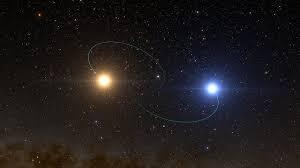
Astronomers have discovered 27 new potential planets that orbit two stars, like the fictional desert planet Tatooine from the Star Wars universe.
To date, only about 18 circumbinary planets – which orbit around two stars – had been identified in the universe. More than 6,000 planets have been discovered that orbit single stars, like Earth does around the sun.
In a timely publication for 4 May, also known as Star Wars Day, scientists have identified nearly 30 more candidate planets, whose distances range from 650 to 18,000 light years away from Earth.
“There are many things in astronomy that aren’t very tangible,” said Associate Prof Ben Montet of the University of New South Wales (UNSW), the study’s senior author. But thanks to the famous Tatooine sunset scene in the first Star Wars film, “everyone has a picture of what a circumbinary planet looks like and what would it mean to stand on a planet with two suns”.
More than half of the stars in the universe exist in binary or multiple star systems.
Scientists previously identified circumbinary planets via their transits: when these planets pass in front of a star, Montet said, “it casts a shadow on the star’s surface, we see a dip in brightness of the star … and we can infer there’s something going around it”.
But this only happens when the planet and its star perfectly align with our line of sight from Earth. “We’re missing lots of systems, potentially,” Montet said.
“Planets are hard to find. It’s like trying to see a candle right next to a big street light.”
The researchers instead used a method known as “apsidal precession”, searching for a wobble between stars that orbit around and eclipse each other.
“If we monitor the exact timing of these eclipses … that can tell us that there’s something else going on in the system,” said Margo Thornton, the study’s lead author and a PhD candidate at UNSW.
After eliminating other factors such as the rotation and gravitational pull of the two stars, the team identified 36 star systems out of 1,590 whose behaviour could only be explained by a third body.
For “27 of those objects, it is possible that they are planet mass”, Thornton said. More research into their spectra – the light they emit – was needed to formally confirm them as circumbinary planets, she said. “It’s just a matter of: what is the mass of it? Is it a planet? Is it a brown dwarf? Is it a star?”
The team discovered the potential planets – which likely range from Neptune-sized to ten times heavier than Jupiter – using data from Nasa’s Transiting Exoplanet Survey Satellite, a planet-hunting space telescope that launched in 2018.
Dr Sara Webb, an astrophysicist at the Swinburne University of Technology who was not involved in the research, said the team’s “very clever techniques” could be used to find more planet candidates in the future.
Circumbinary planets would likely have “very extreme environments” unlike anything in our solar system, Webb said. “[But] a planet like Tatooine could potentially exist where there is that sweet spot between its orbit of the two stars – where it’s not too hot and it’s not too cold.
“When the original Star Wars was released, we didn’t know that there were exoplanets [planets outside our solar system] at all.”
“A lot of things that are predicted in art and in artistic concepts of what the universe might be, we tend to find it … in science as well.”
The research was published in the Monthly Notices of the Royal Astronomical Society.
Quelle: The Guardian
+++
New Star Wars-like planet candidates with two suns discovered
A team of astronomers led by UNSW Sydney have piloted a new method to find planets – and in the process, found 27 potential new worlds in double star systems.
There’s so little we know about circumbinary planets – planets that orbit two stars instead of one – that they can feel like the stuff of fantasy.
And for good reason: to date, we’ve only confirmed the existence of 18 circumbinary planets, compared to the more than 6000 planets we know about in single star systems.
Even the most widely-known circumbinary planet is, quite literally, fiction: the desert planet Tatooine from Star Wars, aka the birthplace of Anakin Skywalker.
But a study led by UNSW has now detected 27 potential circumbinary planets in one sweep, using a new planet-finding method that broadens the typical type of planets we can find.
The findings are published today in the Monthly Notices of the Royal Astronomical Society, just in time for May the 4th, Star Wars Day.
“Most of our current knowledge on planets is biased, based on how we’ve looked for them,” says Ms Margo Thornton, lead author of the study, astronomer and PhD candidate at UNSW. “We’ve mostly found the easiest ones to detect.
“This new method could help us uncover a large population of hidden planets, especially those that don’t line up perfectly from our line of sight. It could help reveal what the true population of planets in our universe might look like.”
The planet-finding method, called apsidal precession, has been used to characterise binary stars before, but not in a large-scale search for planets.
It involves monitoring how the binary stars’ orbit of one other – made visible by their stellar eclipses – change over long periods of time.
If there’s a variation in their (normally predictable) eclipse schedule that can’t be explained by general relativity or stellar interactions, it means a third body could be influencing the stars’ orbits – and that body could be a planet.
The findings were made using data from NASA’s Transiting Exoplanet Survey Satellite (TESS), a space telescope launched in 2018 with the mission to search for exoplanets.
Almost all planets have been discovered by the ‘transit’ method, which is when a planet crosses in front of its star, creating a mini-eclipse.
This eclipse causes a dip in the starlight signal sent to Earth, suggesting there might be a planet orbiting there.
But the transit method restricts us to only discovering planets that cross between Earth and their star. If a planet orbits its star (or stars, in this instance) at an irregular orbit, or an orbit that isn’t in our direct line of sight, it can slip under our radar.
“We’re missing a huge part of the architecture for these systems,” says A/Prof. Montet.
The new method helps astronomers detect planets like these that we might have otherwise missed – helping to build our knowledge of what type of environments can support planet development.
“With this method so far, we have 27 strong planet candidates in environments completely unlike our own solar system,” says Ms Thornton, who made these findings just one year into her PhD.
“By learning more about different types of planets, we can better understand how planets form and evolve, especially in these complex environments with two stars.”
The planets are called ‘candidates’ for now as the team need to confirm, or deny, their planet status using an additional observation method.
Ms Thornton has started work on this process and hopes to have a follow-up paper ready within the next year.
Quelle: UNSW SYDNEY