
28.02.2026
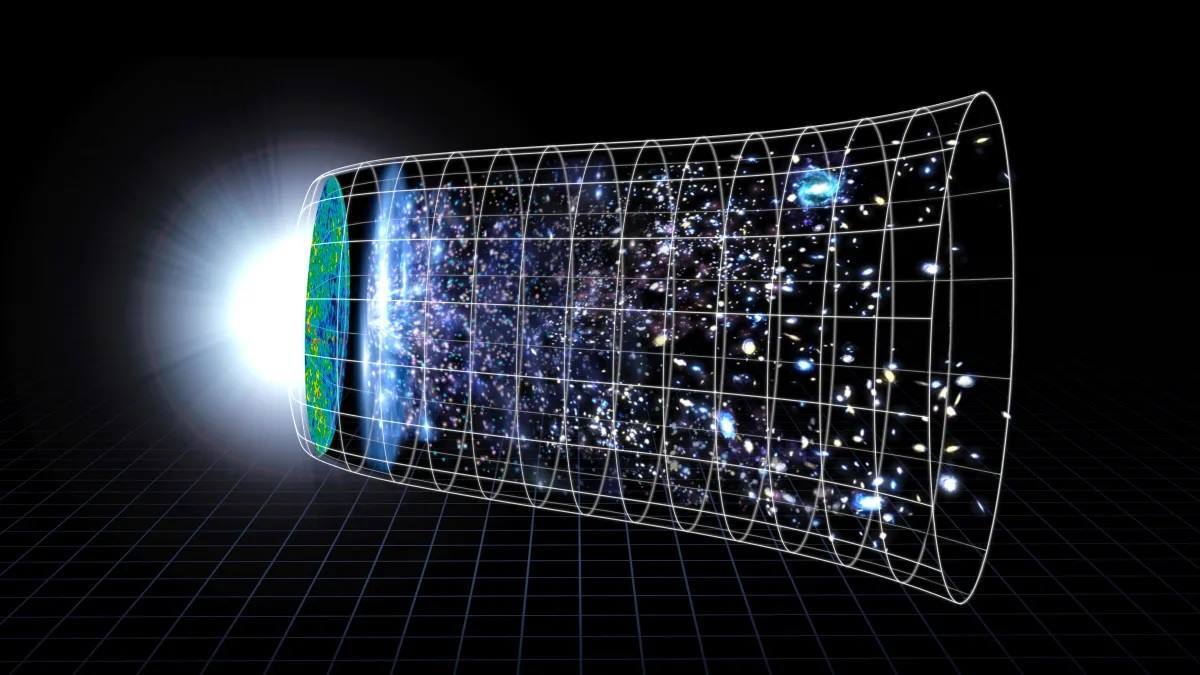
Illustration representing the evolution of the universe over 13.77 billion years. Credit: NASA / Illustrator: Britt Griswold (Maslow Media Group)
Physicists have developed a new way to measure the Hubble constant – the rate of expansion of the universe – using gravitational waves, and it could help settle cosmology’s longstanding disagreements.
Ever since US astronomer Edwin Hubble confirmed in 1929 that there are other galaxies outside the Milky Way and they are moving away from us, cosmologists have known that the universe is expanding.
The fact that the universe is expanding led to the bold claim that, running the clock back, the universe should have a beginning rather than having always existed. This led to the “Big Bang” theory.
The rate of the expansion has been tricky to calculate, however.
Different observational methods used to measure the Hubble constant have yielded different results – something which should not happen given the approaches are based on the same physics. This discrepancy between the measured values of the Hubble constant is called the “Hubble tension” and resolving the tension is one of the ‘Holy Grails’ of modern cosmology.
Current methods to measure the constant fall into 2 main categories.
One is based on the “local” or “late” universe. So-called “standard candles” – such as Type Ia supernovae or Cepheids – have known brightnesses and can therefore be used to calculate the distances to nearby galaxies.
The other approach is based on measurements of the cosmic microwave background – residual radiation which dates to just 380,000 years after the Big Bang.
Late and early universe approaches don’t agree on the value of the Hubble constant.
The third method being proposed is described in a paper which has been accepted for publication in Physical Review Letters. The full text of the article is available on the arXiv preprint server. It is based on gravitational waves (sometimes called the “siren method”) which, until recently, could not be measured accurately enough to pinpoint the distance to the objects creating the waves.
Gravitational waves are tiny ripples in the fabric of spacetime. They are usually too subtle to be detected, but massively disruptive events like the merger of extremely dense objects like black holes or neutron stars have been routinely spotted since the first confirmed gravitational wave observation in 2015.
The researchers argue that measurements of gravitational waves can now be improved enough to measure the Hubble constant.
“This result is very significant – it's important to obtain an independent measurement of the Hubble constant to resolve the current Hubble tension,” says senior author Nicolás Yunes, a professor at the University of Illinois Urbana-Champaign in the US. “Our method is an innovative way to enhance the accuracy of Hubble constant inferences using gravitational waves.”
“Because we are observing individual black hole collisions, we can determine the rates of those collisions happening across the universe,” explains first author Bryce Cousins, a graduate student at Illinois. “Based on those rates, we expect there to be a lot more events that we can't observe, which is called the gravitational-wave background.”
The team argues that lower values of the Hubble constant leads to a higher density of object collisions.
They used gravitational wave data from around the world to confirm that the lack of observations from the gravitational-wave background suggest a higher Hubble constant (or faster expansion of the universe).
More sensitive gravitational wave detectors will improve this method even further.
“This should pave the way for applying this method in the future as we continue to increase the sensitivity, better constrain the gravitational-wave background, and maybe even detect it,” says Cousins.
“By including that information, we expect to get better cosmological results and be closer to resolving the Hubble tension.”
Quelle: CONNECTSCI