
31.01.2026
The comet broke into pieces after making a close approach around the sun in October 2025.
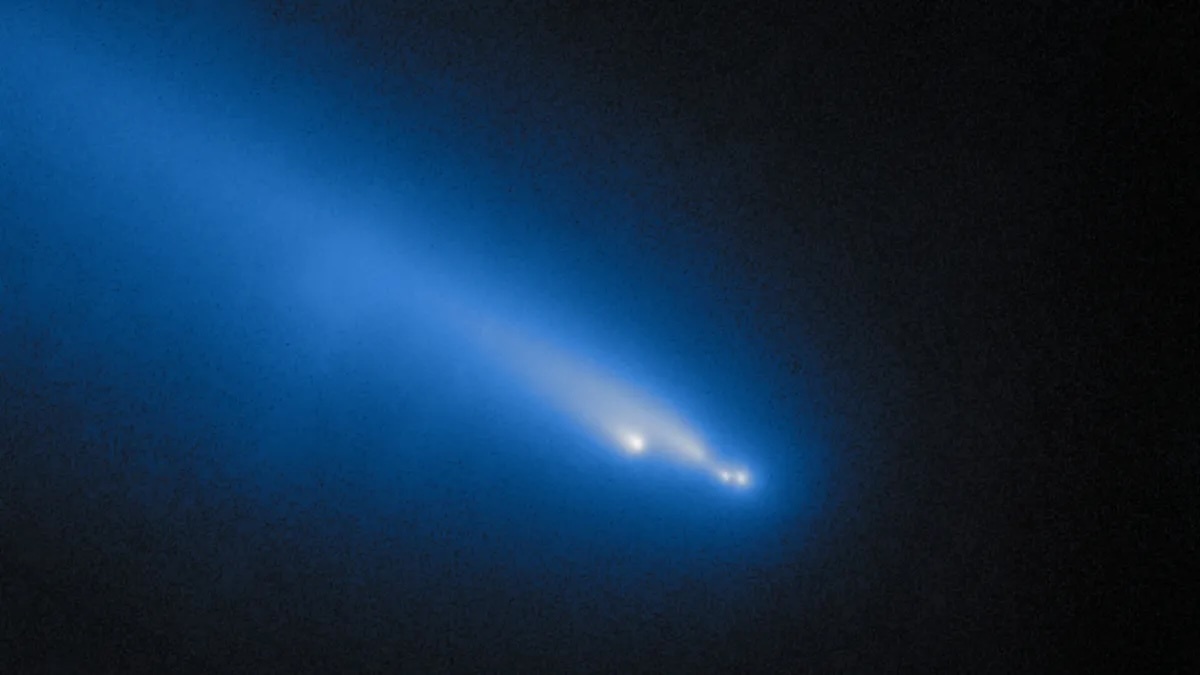
Two images by the Gemini North telescope in Hawaii show Comet C/2025 K1 (ATLAS) breaking apart. AT left is a view on Nov. 11, 2025 and at right, another image from Dec. 6, 2025. (Image credit: International Gemini Observatory/NOIRLab/NSF/AURA/B. Bolin; Image Processing: J. Miller & M. Rodriguez (International Gemini Observatory/NSF NOIRLab), T.A. Rector (University of Alaska Anchorage/NSF NOIRLab), M. Zamani (NSF NOIRLab); Acknowledgments: PI: Bryce Bolin (Eureka Scientific))
A comet was caught falling apart on camera, using a powerful telescope in Hawaii.
Comet C/2025 K1 (ATLAS) crumbled in high-resolution footage captured by the Gemini North telescope atop Mauna Kea in Hawaii. Glowing pieces of the cometare visible in the 8.1-meter diameter optical/infrared telescope, which is part of a twin pair of telescopes at the International Gemini Observatory.
New imagery of the comet released Thursday (Jan. 29) shows pieces tumbling apart in separate pictures obtained Nov. 11 and Dec. 6. The National Science Foundation-funded work complements a number of other observations by professionals and amateurs late last year.
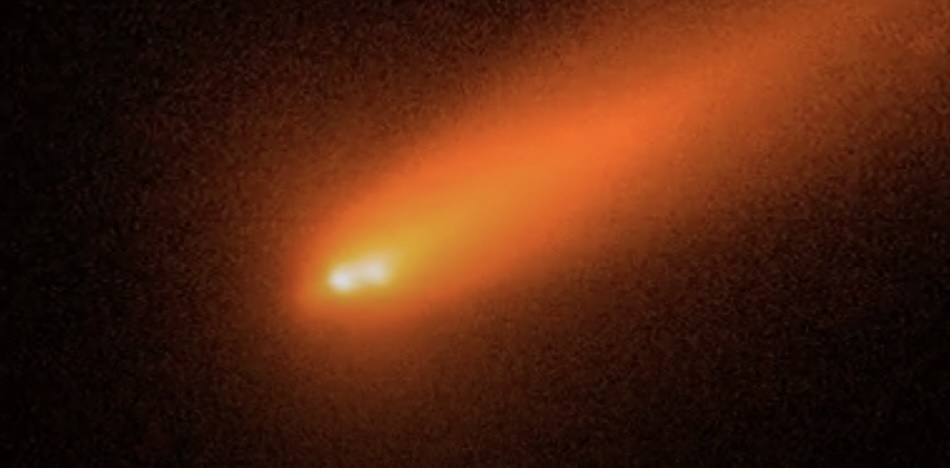
The comet, which was a loosely held collection of ice and dust, swooped around the sun in October and made its closest approach on Oct. 8. The strong solar gravity and the pressure of the solar wind, or constant stream of particles streaming off our sun, fragmented the comet into several chunks.
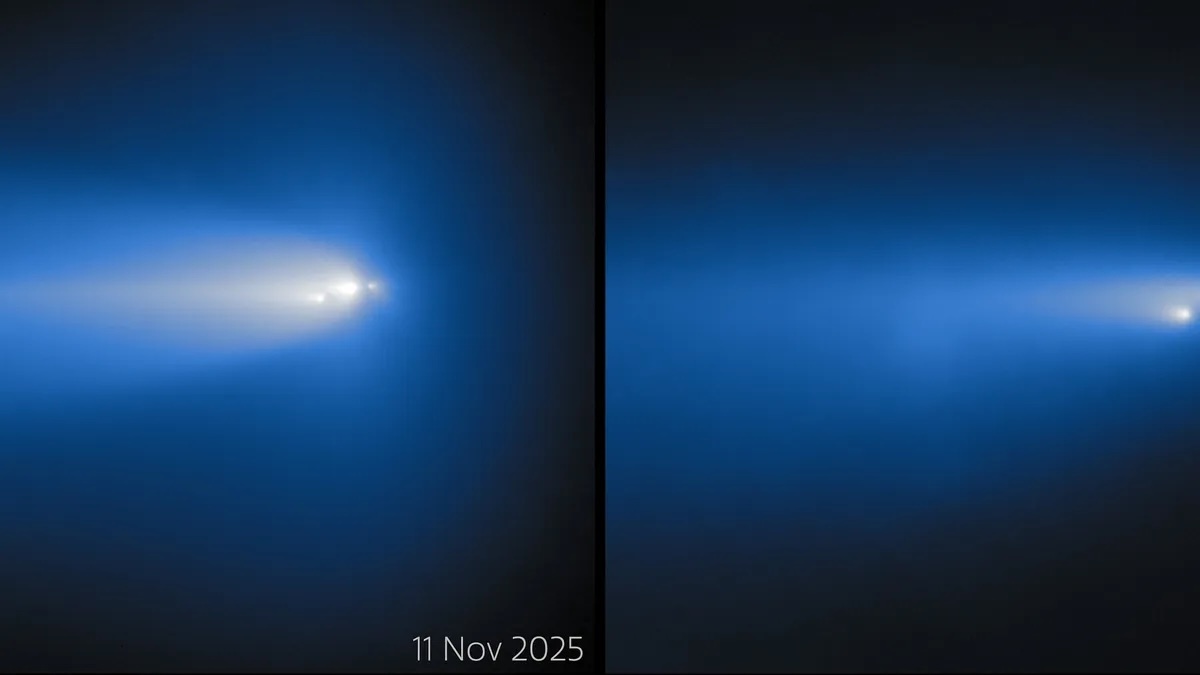
Two images of Comet C/2025 K1 falling apart. (Image credit: International Gemini Observatory/NOIRLab/NSF/AURA/B. BolinImage Processing: J. Miller & M. Rodriguez (International Gemini Observatory/NSF NOIRLab), T.A. Rector (University of Alaska Anchorage/NSF NOIRLab), M. Zamani (NSF NOIRLab))
For example, astronomer Gianluca Masi, of the Virtual Telescope Project in Italy, imaged the breaking-apart comet in early November using a Celestron C14 Schmidt-Cassegrain telescope on a Paramount ME robotic mount. The images appeared to show "three fragments of the original nucleus and possibly a fourth one," Masi wrote in a statement accompanying the images.
Astronomers at the Asiago Observatory in Italy also previously showed the comet in two fragments, separated by roughly 1,200 miles (2,000 km), on Nov. 11. They used a 1.82-meter Copernicus telescope to achieve the work.
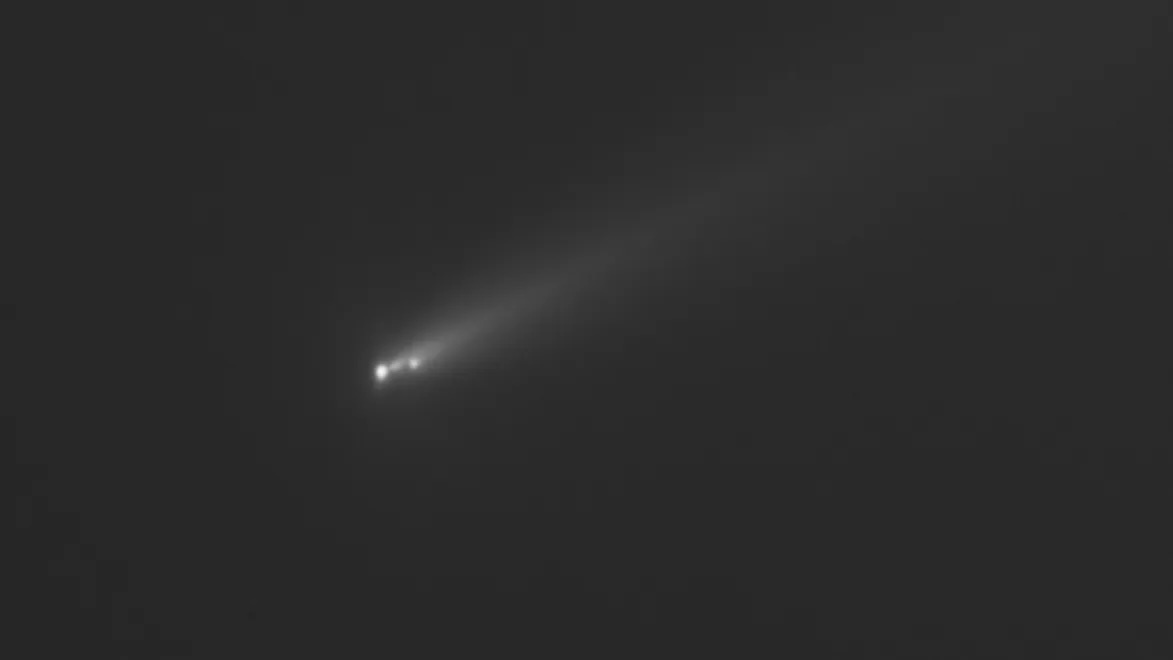
An image of C/2025 K1 (ATLAS) captured by Gianluca Masi of the Virtual Telescope Project. (Image credit: Gianluca Masi, Virtual Telescope Project)
C/2025 K1 (ATLAS), as the name implies, was found in May 2025 using the Asteroid Terrestrial-impact Last Alert System. It is a solar system comet that likely was formed in the Oort Cloud, which is a large group of icy bodies past the orbit of Neptune. There may be billions of comets like C/2025 K1 (ATLAS) there, which may orbit the sun at a distance for eons until a gravitational "kick" sends them towards the inner solar system.
Quelle: SC