Supernova from the dawn of the universe captured by James Webb Space Telescope
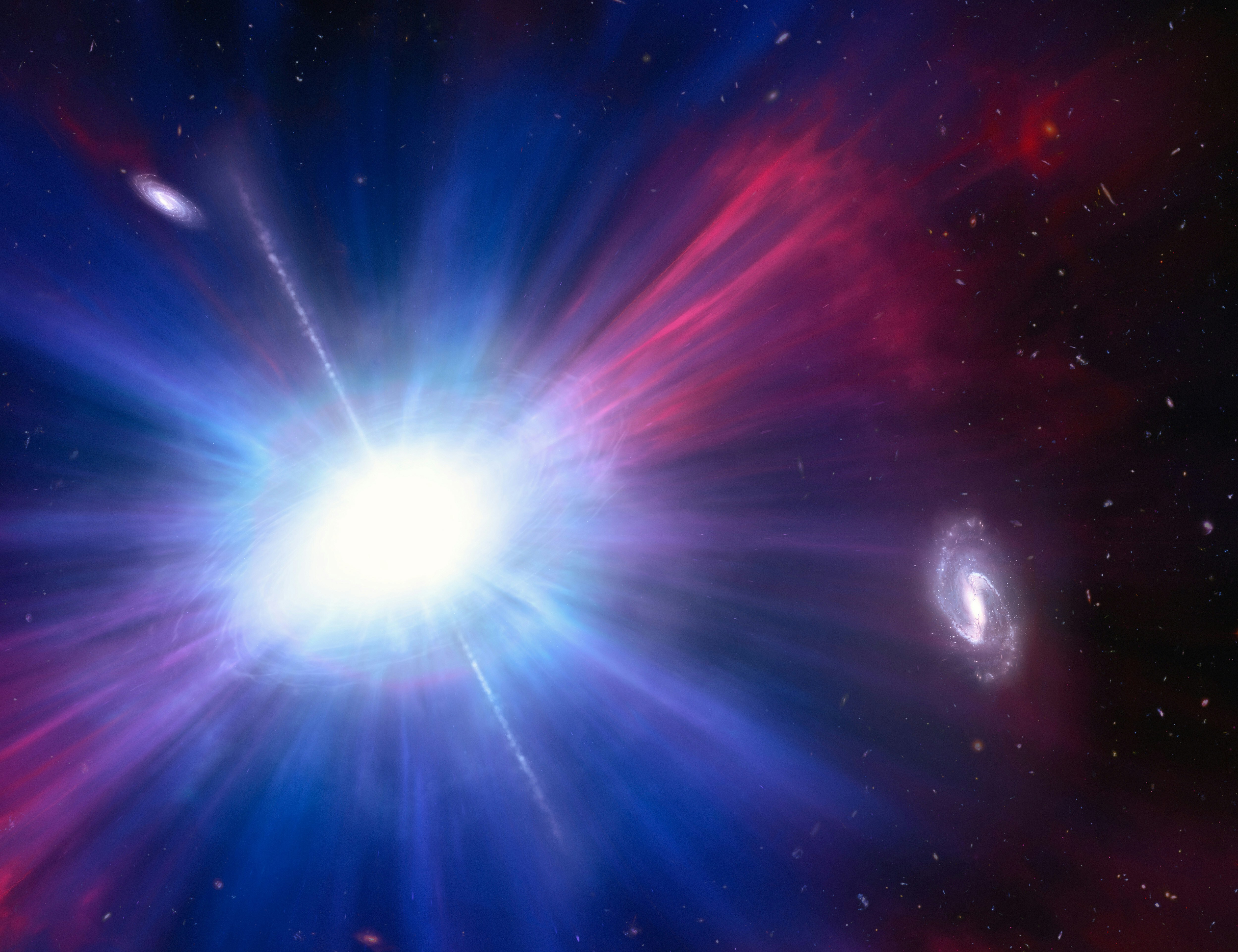
Luminous Fast Blue Optical Transient (Artist's Concept) Caption: This is an artist's concept of one of brightest explosions ever seen in space. Credits: Artwork - NASA, ESA, NSF's NOIRLab, Mark Garlick , Mahdi Zamani
An international team of astronomers has achieved a first in probing the early universe, using the James Webb Space Telescope (JWST), detecting a supernova – the explosive death of a massive star – at an unprecedented cosmic distance.
The explosion, designatedSN in GRB 250314A, occurred when the universe was only about730 million years old, placing it deep in the era of reionisation. This remarkable discovery provides a direct look at the final moments of a massive star from a time when the first stars and galaxies were just beginning to form.
The event, which has been reported on in the recently published academic paper ‘(opens in a new window)JWST reveals a supernova following a gamma-ray burst at z≃7.3,’ (Astronomy & Astrophysics,704, December 2025),was initially flagged by a bright burst of high-energy radiation, known as a long-duration Gamma-Ray Burst (GRB), detected by the space-based multi-band astronomical Variable Objects Monitor (SVOM) on March 14, 2025. Follow-up observations with the European Southern Observatory’s Very Large Telescope (ESO/VLT) confirmed the extreme distance.
The key finding came from targeted observations with JWST's Near-Infrared Camera (NIRCAM) approximately 110 days after the burst. Scientists were able to separate the light of the explosion from its faint, underlying host galaxy.
Co-author, and astrophysicist at UCD School of Physics,(opens in a new window)Dr Antonio Martin-Carrillosaid: “The key observation, or smoking gun, that connects the death of massive stars with gamma-ray bursts is the discovery of a supernova emerging at the same sky location. Almost every supernova ever studied has been relatively nearby to us,with just a handful of exceptions to date.When we confirmed the age of this one,we saw a unique opportunity to probe how the Universe was there and what type of stars existed and died back then.
“Using models based on the population of supernovae associated with GRBs in our local universe, we made some predictions of what the emission should be and used it to proposed a new observation with the James Webb Space Telescope. To our surprise, our model worked remarkably well and the observed supernova seems to match really well the death of stars that we see regularly. We were also able to get a glimpse of the galaxy that hosted this dying star.”
The data indicate that the distant supernova is surprisingly similar in brightness and spectral properties to the prototype GRB-associated supernova,SN 1998bw, which exploded in the local universe.
This similarity suggests that the massive star that collapsed to create GRB 250314A was not significantly different from the progenitors of GRBs observed locally, despite the vastly different physical conditions (such as lower metallicity) in the early universe. The observations also ruled out a much more luminous event, such as a Superluminous Supernova (SLSN).
The findings challenge the assumption that the stars of the early universe, formed under extremely low-metallicity conditions, would lead to markedly different, perhaps brighter or bluer, stellar explosions than those seen today.
While this discovery provides a powerful anchor point for understanding stellar evolution in the early universe, it also opens new questions about the observed uniformity.
The research team plans to secure a second epoch of JWST observations in the next one to two years. By that time, the supernova light is expected to have faded significantly (by over two magnitudes), allowing the team to completely characterise the properties of the faint host galaxy and confirm the supernova's contribution.
Quelle: University College Dublin
+++
NASA’s Webb telescope finds bizarre atmosphere on a lemon-shaped exoplanet
Faraway planet defies our understanding of planet formation, say UChicago scientists
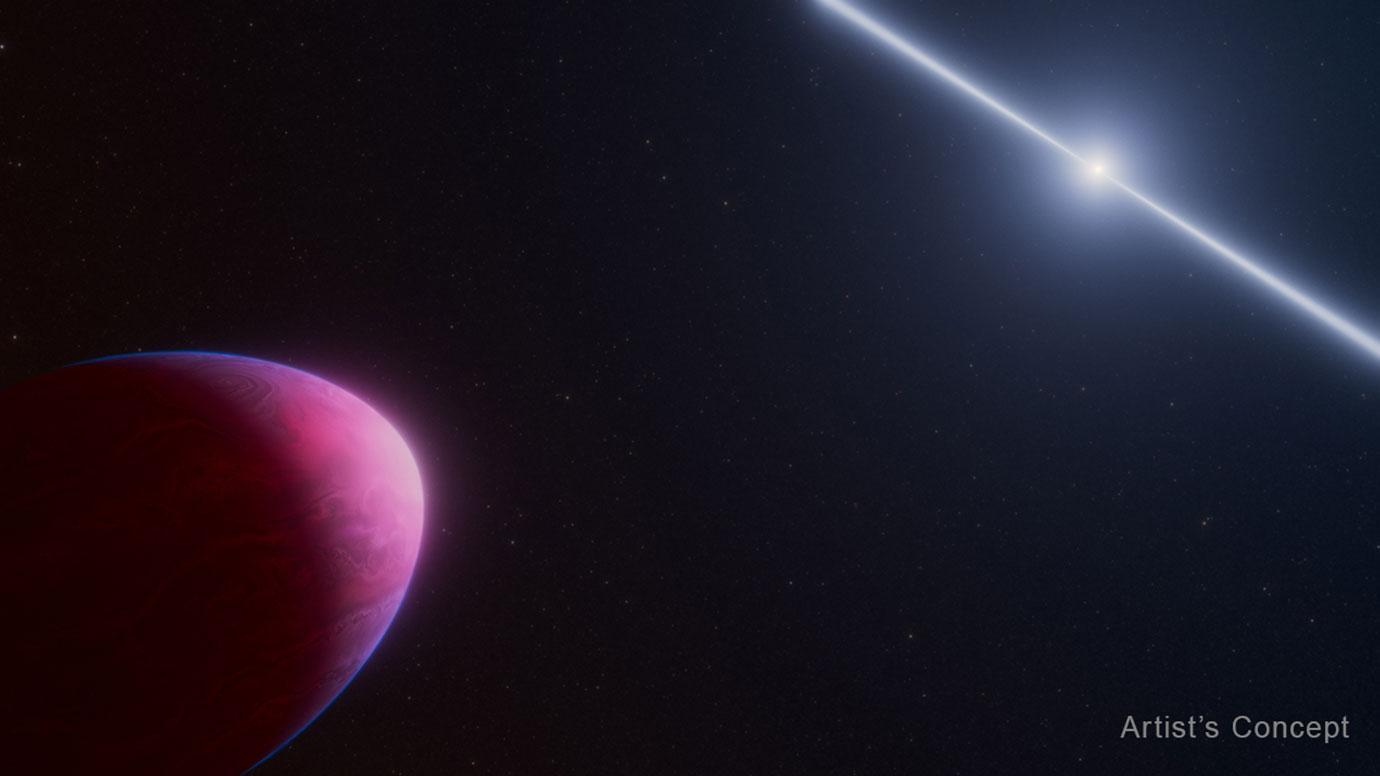
A strange planet (left) orbits a rapidly spinning neutron star called a pulsar (right). This artist's illustration shows that gravitational forces from the much heavier pulsar are pulling the world into the shape of a lemon. This planet, studied with NASA’s James Webb Space Telescope, appears to have an exotic atmosphere unlike any ever seen before.Image courtesy of NASA, ESA, CSA, Ralf Crawford (STScI)
Scientists using NASA’s James Webb Space Telescope have observed an entirely new type of exoplanet whose atmospheric composition challenges our understanding of how this type of planet forms.
This bizarre, lemon-shaped body, possibly containing diamonds at its core, blurs the line between planets and stars.
Officially named PSR J2322-2650b, this object has an exotic helium-and-carbon-dominated atmosphere unlike any ever seen before. It has a mass about the same as Jupiter, but soot clouds float through the air—and deep within the planet, these carbon clouds can condense and form diamonds. It orbits a rapidly spinning neutron star.
How the planet came to be is a mystery.
This animation shows an exoplanet orbiting a distant pulsar - a rapidly rotating neutron star that sends off strong radio pulses every few milliseconds. The planet, which orbits about 1 million miles away from the pulsar, is stretched into a lemon shape by the pulsar’s strong gravitational tides.Animation courtesy of NASA, ESA, CSA, Ralf Crawford (STScI)
“The planet orbits a star that's completely bizarre — the mass of the Sun, but the size of a city,” explained the University of Chicago’s Michael Zhang, the principal investigator on this study, which is accepted for publication in The Astrophysical Journal Letters. “This is a new type of planet atmosphere that nobody has ever seen before.”
“This was an absolute surprise,” said team member Peter Gao of the Carnegie Earth and Planets Laboratory in Washington, D.C. “I remember after we got the data down, our collective reaction was ‘What the heck is this?’”
A bizarre pair
The new planet, PSR J2322-2650b, is orbiting a rapidly spinning neutron star, also known as a pulsar.
This star emits beams of electromagnetic radiation from its magnetic poles at regular intervals just milliseconds apart. But the star is emitting mostly gamma rays and other high-energy particles, which are invisible to the Webb telescope’s infrared vision.
This means scientists can study the planet in intricate detail across its whole orbit—normally an extremely difficult task, because stars usually far outshine their planets.
“This system is unique because we are able to view the planet illuminated by its host star, but not see the host star at all,” explained Maya Beleznay, a graduate student at Stanford University who worked on modelling the shape of the planet and the geometry of its orbit. “So we get a really pristine spectrum. And we can better study this system in more detail than normal exoplanets.”
Taking stock of the planet, the team was surprised.
“Instead of finding the normal molecules we expect to see on an exoplanet—like water, methane and carbon dioxide—we saw molecular carbon, specifically C3 and C2,” said Zhang.
At the core of the planet, subjected to intense pressure, it’s possible this carbon could be squeezed into diamonds.
But to the scientists, the larger question is how such a planet could have formed at all.
“It's very hard to imagine how you get this extremely carbon-enriched composition,” said Zhang. “It seems to rule out every known formation mechanism.”
How the planet came to be is a mystery.
‘A puzzle to go after’
PSR J2322-2650b is extraordinary close to its star, just 1 million miles away. In contrast, the Earth’s distance from the Sun is about 100 million miles.
Because of its extremely tight orbit, the exoplanet’s entire year—the time it takes to go around its star—is just 7.8 hours.
Applying models to the planet’s brightness variations over its orbit, the team finds that immense gravitational forces from the much heavier pulsar are pulling the Jupiter-mass planet into a lemon shape.
Together, the star and exoplanet may be considered a “black widow” system. Black widows are a rare type of system where a rapidly spinning pulsar is paired with a small, low-mass companion. In the past, material from the companion would have streamed onto the pulsar, causing it to spin faster over time, which powers a strong wind. That wind and radiation then bombard and evaporate the smaller and less massive star.
Like the spider for which it is named, the pulsar slowly consumes its unfortunate partner.
But in this case, the tiny companion is officially considered an exoplanet by the International Astronomical Union, not a star.
An artist's illustration of what exoplanet PSR J2322-2650b might look like. Because of its extremely tight orbit, the planet’s entire year—the time it takes to go around the pulsar—is just 7.8 hours.Illustration courtesy of NASA, ESA, CSA, Ralf Crawford (STScI)
“Did this thing form like a normal planet? No, because the composition is entirely different,” said Zhang. “Did it form by stripping the outside of a star, like ‘normal’ black widow systems are formed? Probably not, because nuclear physics does not make pure carbon.”
Team member Roger Romani, of Stanford and the Kavli Institute for Particle Astrophysics and Cosmology Institute, is one of the world’s preeminent experts on black widow systems. He proposes one evocative phenomenon that could occur in the unique atmosphere.
“As the companion cools down, the mixture of carbon and oxygen in the interior starts to crystallize,” Romani theorized. “Pure carbon crystals float to the top and get mixed into the helium, and that's what we see. But then something has to happen to keep the oxygen and nitrogen away. And that's where there's controversy.”
“But it's nice to not know everything,” said Romani. “I'm looking forward to learning more about the weirdness of this atmosphere. It's great to have a puzzle to go after.”
With its infrared vision and exquisite sensitivity, this is a discovery only the Webb telescopecould make. Its perch a million miles from Earth and its huge sunshield keeps the instruments very cold, which is necessary for conducting these observations.
“It's very hard to imagine how you get this extremely carbon-enriched composition. It seems to rule out every known formation mechanism.”
—Michael Zhang
“On the Earth, lots of things are hot, and that heat really interferes with the observations because it's another source of photons that you have to deal with,” explained Zhang. “It's absolutely not feasible from the ground.”
Other UChicago scientists on the study included Prof. Jacob Bean, graduate student Brandon Park Coy and Rafael Luque, who was then a postdoctoral researcher at UChicago and is now with the Instituto de Astrofísica de Andalucía in Spain.
Quelle: University of Chicago
----
Update: 8.01.2026
.
Scientists Identify ‘Astronomy’s Platypus’ with NASA’s Webb Telescope
After combing through NASA’s James Webb Space Telescope’s archive of sweeping extragalactic cosmic fields, a small team of astronomers at the University of Missouri says they have identified a sample of galaxies that have a previously unseen combination of features. Principal investigator Haojing Yan compares the discovery to an infamous oddball in another branch of science: biology’s taxonomy-defying platypus.
“It seems that we’ve identified a population of galaxies that we can’t categorize, they are so odd. On the one hand they are extremely tiny and compact, like a point source, yet we do not see the characteristics of a quasar, an active supermassive black hole, which is what most distant point sources are,” said Yan.
The research was presented in a press conference at the 247th meeting of the American Astronomical Society in Phoenix.
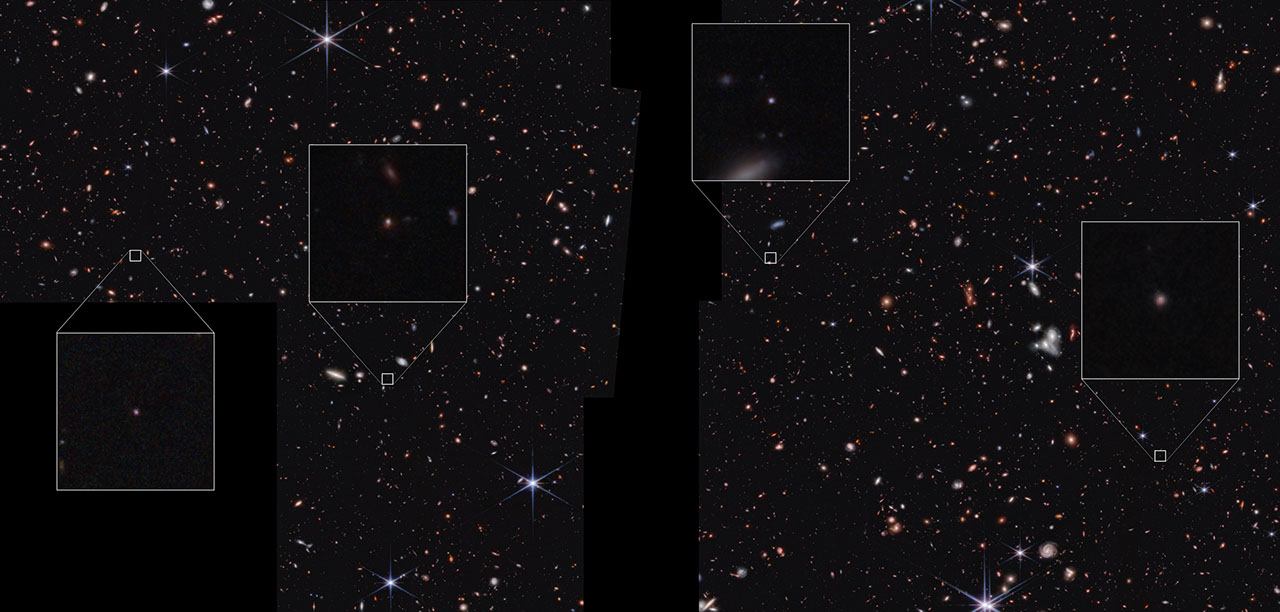
Image A: Galaxies in CEERS Field (NIRCam image)
Four of the nine galaxies in the newly identified “platypus” sample were discovered in NASA’s James Webb Space Telescope’s Cosmic Evolution Early Release Science Survey (CEERS). One key feature that makes them distinct is their point-like appearance, even to a telescope that can capture as much detail as Webb.
Image: NASA, ESA, CSA, Steve Finkelstein (UT Austin); Image Processing: Alyssa Pagan (STScI)
“I looked at these characteristics and thought, this is like looking at a platypus. You think that these things should not exist together, but there it is right in front of you, and it’s undeniable,” Yan said.
The team whittled down a sample of 2,000 sources across several Webb surveys to identify nine point-like sources that existed 12 to 12.6 billion years ago (compared to the universe’s age of 13.8 billion years). Spectral data gives astronomers more information than they can get from an image alone, and for these nine sources it doesn’t fit existing definitions. They are too far away to be stars in our own galaxy, and too faint to be quasars, which are so brilliant that they outshine their host galaxies. Though the spectra resemble the less distant “green pea” galaxiesdiscovered in 2009, the galaxies in this sample are much more compact.
“Like spectra, the detailed genetic code of a platypus provides additional information that shows just how unusual the animal is, sharing genetic features with birds, reptiles, and mammals,” said Yan. “Together, Webb’s imaging and spectra are telling us that these galaxies have an unexpected combination of features.”
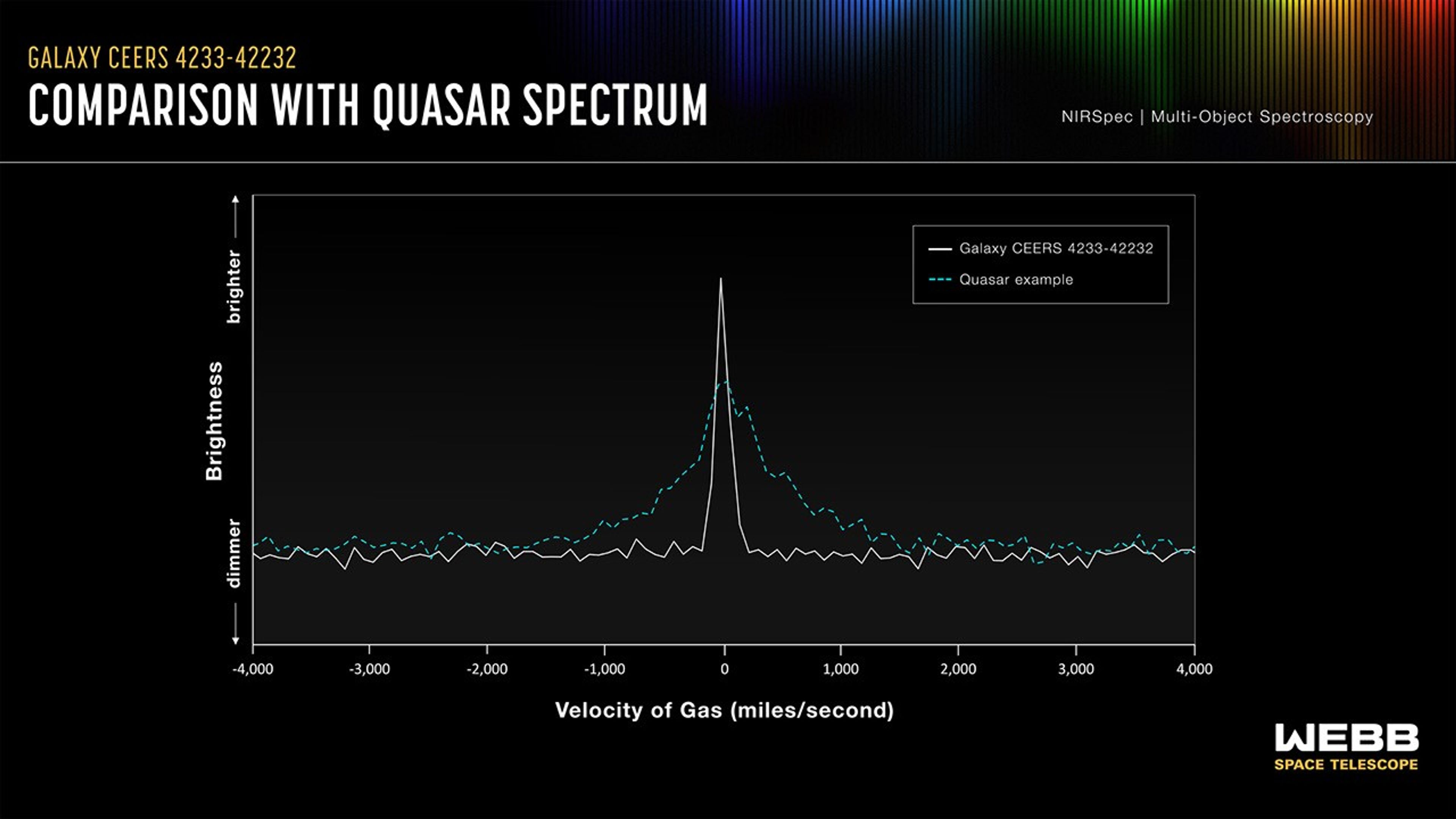
Yan explained that for typical quasars, the peaks in their characteristic spectral emission lines look like hills, with a broad base, indicating the high velocity of gas swirling around their supermassive black hole. Instead, the peaks for the “platypus population” are narrow and sharp, indicating slower gas movement.
While there are narrow-line galaxies that host active supermassive black holes, they do not have the point-like feature of the sample Yan’s team has identified.
Image B: Galaxy CEERS 4233-42232: Comparison With Quasar Spectrum
This graphic illustrates the pronounced narrow peak of the spectra that caught researchers’ attention in a small sample of galaxies, represented here by galaxy CEERS 4233-42232. Typically, distant point-like light sources are quasars, but quasar spectra have a much broader shape.
Illustration: NASA, ESA, CSA, Joseph Olmsted (STScI)
Has Yan’s team discovered a missing link in the cosmos? Once the team determined that the objects didn’t fit the definition of a quasar, graduate student researcher Bangzheng Sun analyzed the data to see if there were signatures of star-forming galaxies.
“From the low-resolution spectra we have, we can’t rule out the possibility that these nine objects are star-forming galaxies. That data fits,” said Sun. “The strange thing in that case is that the galaxies are so tiny and compact, even though Webb has the resolving power to show us a lot of detail at this distance.”
One proposal the team suggests is that Webb, as promised, is revealing earlier stages of galaxy formation and evolution than we have ever been able to see before. It is generally accepted across the astronomy community that large, massive galaxies like our own Milky Way grew by many smaller galaxies merging together. But, Yan asks, what comes before small galaxies?
“I think this new research is presenting us with the question, how does the process of galaxy formation first begin? Can such small, building-block galaxies be formed in a quiet way, before chaotic mergers begin, as their point-like appearance suggests?” Yan said.
To begin answering that question, as well as to determine more about the nature of their odd platypuses, the team says they need a much larger sample than nine to analyze, and with higher-resolution spectra.
“We cast a wide net, and we found a few examples of something incredible. These nine objects weren’t the focus; they were just in the background of broad Webb surveys,” said Yan. “Now it’s time to think about the implications of that, and how we can use Webb’s capabilities to learn more.”
The James Webb Space Telescope is the world’s premier space science observatory. Webb is solving mysteries in our solar system, looking beyond to distant worlds around other stars, and probing the mysterious structures and origins of our universe and our place in it. Webb is an international program led by NASA with its partners, ESA (European Space Agency) and CSA (Canadian Space Agency).
Quelle: NASA
----
Update: 16.01.2026
.
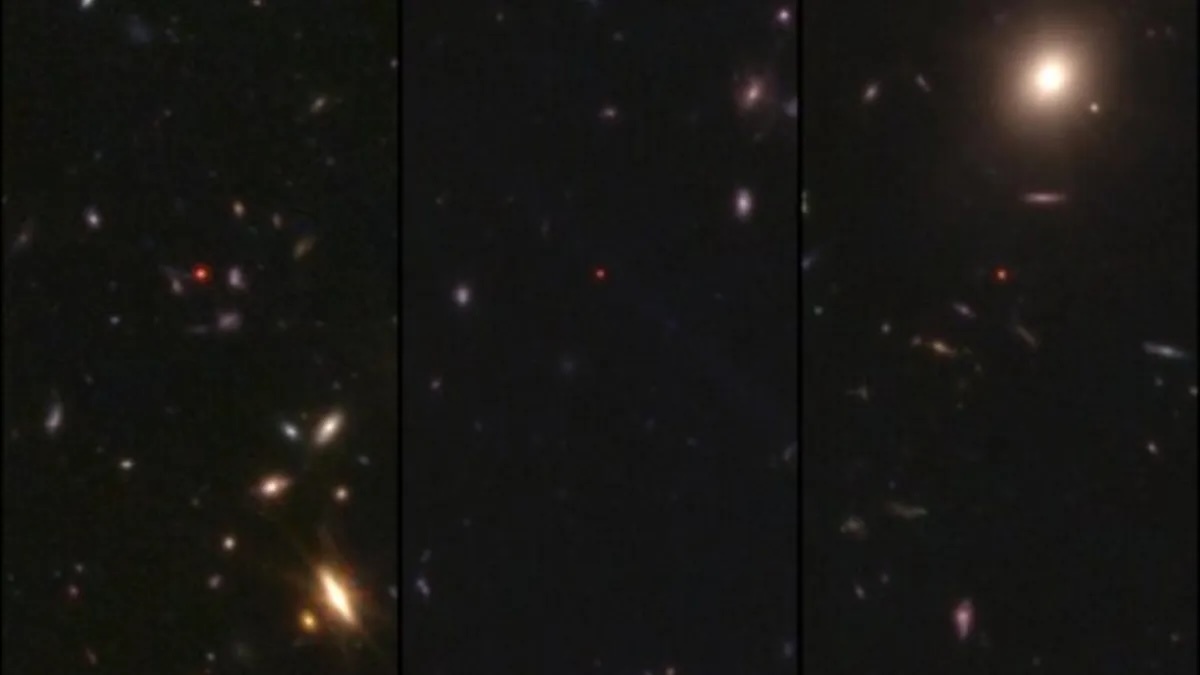
James Webb Space Telescope's mysterious 'little red dots' may be black holes in disguise
"If they were purely made up of stars, they would be the densest galaxies in the universe."
Ancient galaxies colloquially known as "little red dots" have proven a mystery ever since astronomers discovered them three years ago. Now, a new study finds the strange features of little red dots might be explained by supermassive black holes in disguise during their youth.
With the help of NASA's $10 billion James Webb Space Telescope (JWST), astronomers first discovered the mysterious specks of light known as little red dots at the end of 2022. They only existed for a short time in the cosmos, first appearing in the universe less than 1 billion years after the Big Bang and almost completely disappearing after 2 billion years, explained study lead author Vadim Rusakov at the University of Manchester in England. (The universe is currently about 13.8 billion years old.)
The discovery ignited a fierce debate among scientists over the identity of the little red dots. One possible explanation for these ancient bright spots was that they were extraordinarily star-rich galaxies. Another possibility was that little red dots hosted supermassive black holes — light in the galaxies may have emerged from gas that became super-hot as it rushed toward the enormous gravitational pull of these black holes.
The James Webb Space Telescope's little red dot discoveries continue to capture scientists' attention.(Image credit: adim Rusakov/CEERS/PRIMER)
A key problem with these possible explanations, however, was that both proposed objects were both too massive to have formed so early in the history of the universe. In addition, supermassive black holes should emit X-rays and radio waves, and scientists have detected neither from little red dots.
In the new study, researchers investigated 12 ancient galaxies to get a better sense of the nature of little red dots. The earliest of these galaxies existed when the universe was only about 840 million years old.
Their analysis suggested that little red dots "are simply too luminous and too compact to be explained by a large number of stars," Rusakov told Space.com. "If they were purely made up of stars, they would be the densest galaxies in the universe."
Instead, the research team's model suggested the most luminous sources of light they examined were as bright as more than 250 billion suns but also less than a third of a light-year across. This is much smaller than a galaxy — the distance from our sun to its nearest neighbor, Proxima Centauri, is about 4.25 light-years. The compact sizes of these incredibly bright spots within little red dots suggest they must be supermassive black holes.
The spectrum of radiation emitted from the little red dots suggested that before the JWST detected these rays of light, they got scattered off electrons in dense clouds of ionized gas in the centers of the little red dots. Such cocoons would trap most of the radiation generated near black holes.
"These objects turned out to be supermassive black holes despite missing almost all typical indications of massive black holes," Rusakov said. "They have an almost perfect disguise that removes X-ray and radio emission."
By analyzing the light from the little red dots, the scientists calculated the speed of the light-emitting gas within most of the dots as being about 670,000 miles per hour (1.08 million kilometers per hour). Assuming this gas was orbiting the black holes at the centers of these little red dots, they could deduce the black holes were likely about 100,000 to 10 million times the mass of the sun. This is about 100 times less than previous estimates suggested, and is closer to what researchers would expect from young super-massive black holes early in the history of the cosmos.
"Our results imply, most importantly, that for the first time we are seeing supermassive black holes early in their lifetimes, possibly early enough to understand how they were born—either by continuously growing from smaller black holes or by starting big, as intermediate-mass black holes that formed from collapsing streams of gas," Rusakov said.
Future research may shed light on how these supermassive black holes were born. "If we are lucky, little red dots may still preserve clues from the time when they were formed — whether it’s the gas chemistry or some useful physical property of the black holes and their cocoons that can help to differentiate between different theories," Rusakov said. "This is one of the biggest remaining questions in astrophysics and it seems that we are closer than ever to being able to answer it."
The scientists detailed their findings in the Jan. 15 issue of the journal Nature.