
20.08.2025
NASA Begins Processing Artemis III Moon Rocket at Kennedy
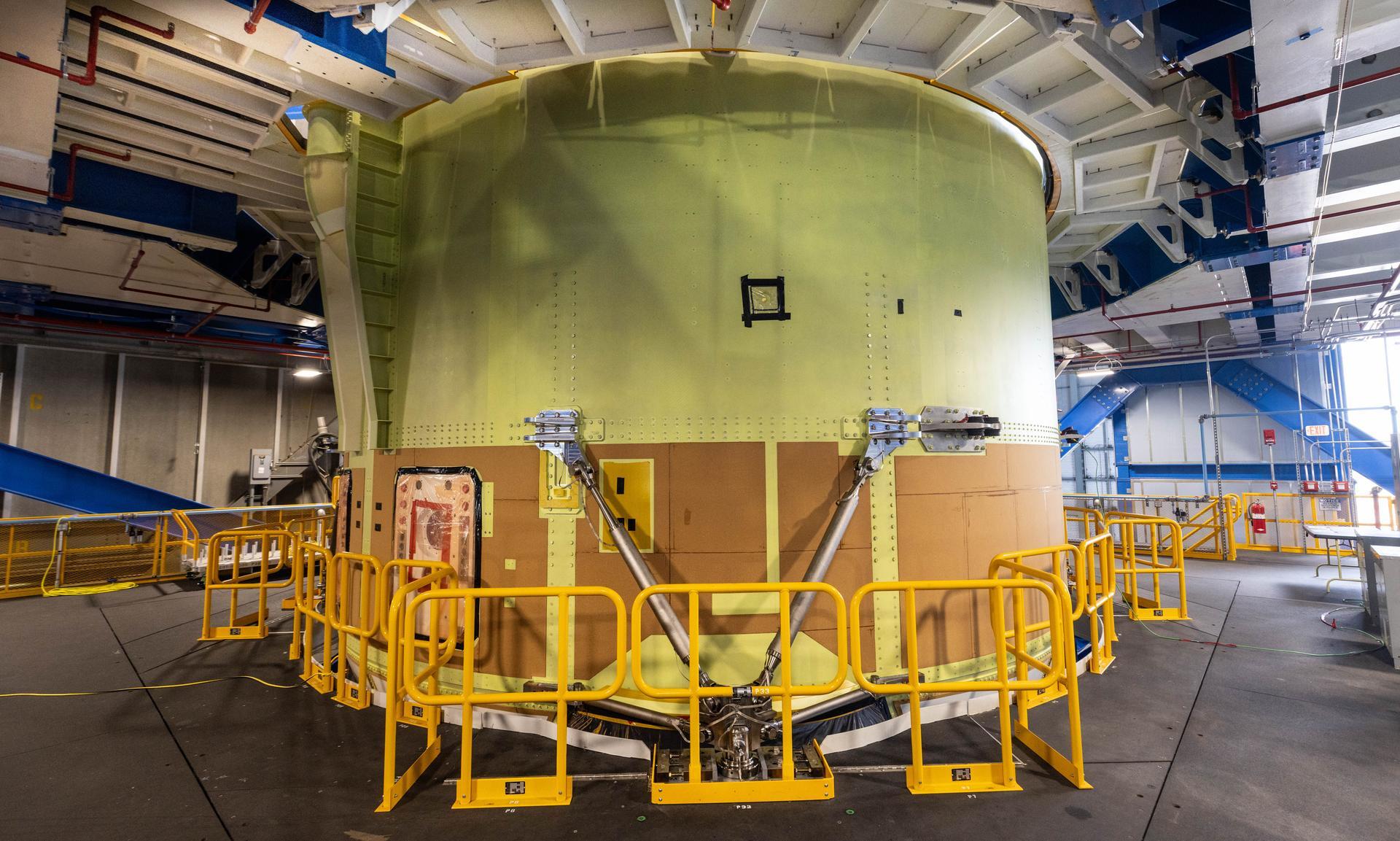
Buildup of NASA’s SLS (Space Launch System) rocket for the Artemis III lunar mission has started at the agency’s Kennedy Space Center in Florida, even as NASA prepares for the launch of the Artemis II mission, the second Artemis mission in NASA’s efforts to l return humans to the Moon and eventually land on Mars.
The Artemis III SLS engine section and boat-tail – which protects the engines during launch – moved from the Space Systems Processing Facility at NASA Kennedy to the mammoth Vehicle Assembly Building (VAB) in late July, just a few feet from where the Artemis II SLS is mostly stacked and undergoing integrated testing and checkouts.
In early 2026, NASA will launch Artemis II, the first crewed flight of the SLS rocket and Orion spacecraft, on an approximately 10-day journey around the Moon. This will be followed by the Artemis III lunar landing mission in 2027, the first ever to the lunar South Pole region, which will launch an SLS with a crew of four aboard an Orion spacecraft to rendezvous with the Starship Human Landing System. These missions set the stage for NASA to land the first American on the Martian surface.
Teams lifted the engine section onto a stand and mated the boat-tail to the bottom. They installed a canopy on top of the engine section to allow the segment to be air conditioned, preventing moisture build-up and contamination.
Teams then lifted the completed assembly into High Bay 2 in the VAB where it will complete integration and check-out testing until the arrival of the rest of the Artemis III SLS core stage components to complete stage integration, targeted for Spring 2026.
Called the top four-fifths, the remaining elements of the core stage – the liquid hydrogen tank, liquid oxygen tank, intertank, and forward skirt – are at NASA’s Michoud Assembly Facility in New Orleans undergoing processing and integration. The four core stage RS-25 engines are scheduled to ship from NASA’s Stennis Space Center in Bay St. Louis, Mississippi, in early 2026 for integration into the engine section.
The engine section is one of the most complex parts of the rocket, containing the four RS-25 engines and related ducts, valves, electronics, and more than 18 miles of cabling that connect to the core stage propellant tanks and rocket.
The move is part of a change to the SLS production process. The Artemis I and Artemis II SLS core stages were manufactured entirely at NASA Michoud and transferred to NASA Kennedy to be integrated with the SLS solid boosters, upper stage, and the Orion crew spacecraft. Beginning with the Artemis III hardware, NASA moved engine section internal outfitting and integration with the top of the core stage to NASA Kennedy to streamline the manufacturing process and enable simultaneous production operations of two core stages.
Quelle: NASA
----
Update: 30.10.2025
.
Blue Origin details lunar exploration progress amid Artemis 3 contract shakeup
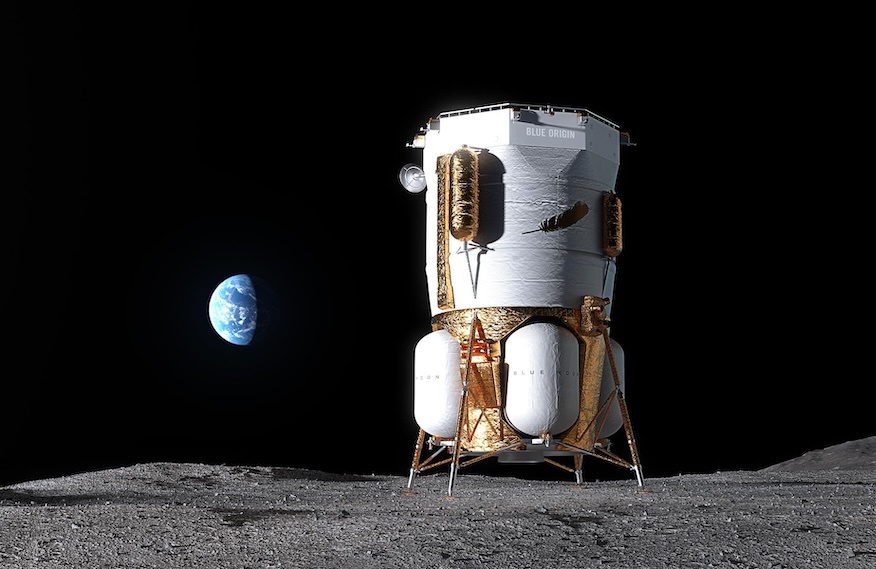
An artist’s rendering of Blue Origin’s Blue Moon Mark 1 lunar lander on the surface of the Moon. Graphic: Blue Origin
Correction Oct. 29: Fixed reference to the engines on the Lunar Transporter from BE-4 to BE-7.
Blue Origin is still several years off from its currently contracted mission to bring astronauts to the Moon’s South Pole on the Artemis 5 mission. But it has a number of spacecraft in development with at least one set to fly to the lunar surface as soon as potentially later this year.
The company is also developing plans that could expedite the Artemis 3 mission, which will be the first human landing on the Moon as part of NASA’s Artemis program.
Jacqueline Cortese, Blue Origin’s Senior Director of Civil Space, represented the company during a Tuesday panel at the American Astronautical Society’s 2025 von Braun Space Exploration Symposium. Dubbed “Artemis 3 and Beyond: Establishing a Permanent Lunar Presence,” Cortese was there to discuss Blue Origin’s plans for both astronaut and cargo flights to the Moon.
She said that Blue Origin’s first mission to the Moon will be an uncrewed Blue Moon Mark 1 lander is going through final stacking in Florida. The 8.1-meter-tall cargo lander will help with ongoing development of their crewed lander, named Blue Moon Mk. 2, which is 15.3 meters tall.
Both are powered by Blue Origin’s BE-7 engines, which are being tested on stands in Alabama, Texas and Washington. Company CEO Dave Limp shared a 17-minute-long video of one hot fire test in Texas meant to simulate the Apogee Raise Maneuver for the Blue Moon Mk. 1 lander.
“A big milestone for you to look out for online is that Mk. 1 is three modules that are being stacked as we speak: aft, forward and mid. And once it is stacked in its finished configuration, we will be barging it over to NASA Johnson Space Center Chamber A to do a full up thermal vac campaign,” Cortese said. “So when you see that on its boat, you will know that big things are happening.”
Both versions of the lander are powered by a combination of liquid hydrogen and liquid oxygen. A key difference though is that Mk.1 can be launched to the Moon with a single launch of Blue Origin’s New Glenn rocket while Mk. 2 requires orbital refueling.
Cortese said the stacking work for the first Blue Moon Mk.1 lander is happening at a dedicated production plant for the spacecraft located at Port Canaveral, which is south of Cape Canaveral Space Force Station in Florida. She said Blue Origin is ramping up a production line for the Blue Moon Mk. 1 landers, stating that the aft section for the second of these vehicles is currently in structural testing.
“That first Mk. 1 is intentionally not carrying 3,000 kilograms of payload because it’s a demo flight, right? It is sensored. So many instruments, so many sensors, PSI, instrumentation with NASA, etc., but that vehicle itself is intended to grow into a production line,” Cortese said.
The first of these landers will carry NASA’s SCALPSS (Stereo Cameras for Lunar-Plume Surface Studies) and LRA (Laser Retroreflective Array) payloads onboard. Cortese teased that it would launch “in the next couple of weeks,” but didn’t offer further details on the timeline.
During the 2025 International Astronautical Congress in Australia, Pat Remias, Blue Origin’s Vice President of Space Systems Development said the company intends to recover the first stage booster flying on the upcoming EscaPADE mission for NASA (planned to launch in early November) and then reuse it for the first flight of a Blue Moon Mk. 1 lander.
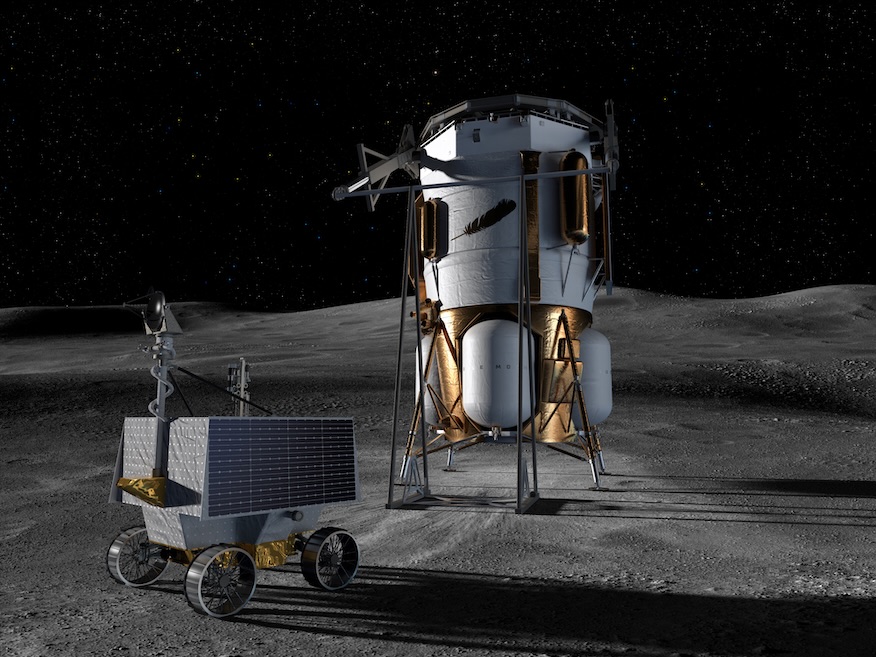
Last month, NASA tapped the Blue Moon Mk. 1 as the vehicle that will deliver its VIPER (Volatiles Investigating Polar Exploration Rover) mission to the Moon’s South Pole as part of the agency’s CLPS (Commercial Lunar Payload Services) task order. This new contract is valued at $190 million and it will be the second flight of a Blue Moon Mk. 1 lander.
“We’re very excited for that one, not just as a test bed for what we’re doing on HLS (Human Landing System program), but as its future for logistics infrastructure and big permanence on the Moon,” Cortese said.
Returning humans to the Moon
While Blue Origin is preparing to send these cargo landers to the Moon, the far more challenging endeavor is creating a safe passage for astronauts to travel to and from the lunar surface. In May 2023, NASA awarded Blue Origin a firm-fixed price contract valued at $3.4 billion to develop a crewed lander for the Artemis 5 mission, which was scheduled for 2029 at the time.
The contract calls for at least one uncrewed landing demonstration of a Blue Moon Mk.2 lander before the vehicle can host NASA’s astronauts as part of the Human Landing System (HLS) program.
For the Artemis 5 mission, Blue Origin will use the Blue Moon Mk. 2 lander, which will require the use of their Lunar Transporter for in-space cryogenic propellant transfer. Work has been underway for some time to prepare systems to store propellant at the necessary temperatures to mitigate or prevent boil off.
“Blue Origin has been working to mature our cryo cooling capabilities over the last several years and we’re now holding, with proto-flight hardware, 90 and 20 Kelvin in lab environments and we have some big, upcoming milestones for that,” Cortese said. “We worked with NASA super hard this summer on this test campaign.”
Additionally, the Blue Origin Utility Transfer Mechanism was recently tested inside the TS300 thermal vacuum chamber at NASA’s Marshall Space Flight Center in Huntsville, Alabama. Cortese said the Lunar Transporter will using similar propellant tanks to those flown on the company’s New Glenn rocket.
Like both of the landers, the Lunar Transporter will also use seven BE-7 engines as its main propulsion system. Both the Lunar Transporter and the Blue Moon Mk. 2 are being built at the Lunar Plant 1 building at Blue Origin’s Rocket Park campus in Florida.
While these spacecraft are coming together, Cortese said Blue Origin is also working closely with NASA on the habitation area of the Blue Moon Mk. 2, which will house two astronauts during their mission down to the lunar surface and back up to the Gateway, a space station being developed by NASA and other international partners.
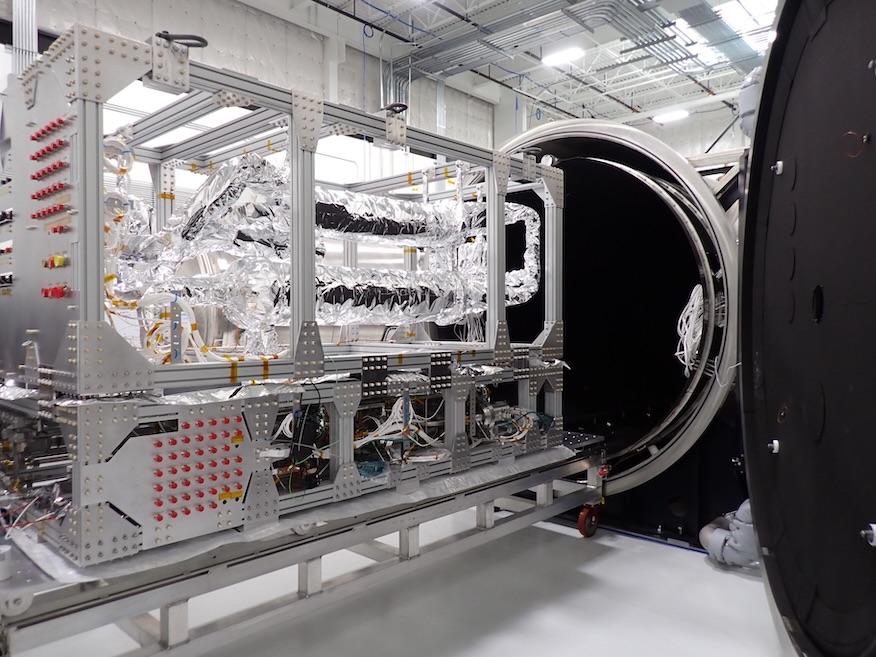
“We’ve definitely decided to insource a lot of the ECLSS (environmental control and life support system) and environmental components,” Cortese said. “I think that supply chain is an area where we wanted to have a lot of robustness and redundancy.
“I think what we were seeing was some down range supply chain issues in the ECLSS area, so we are working to vertically integrate a number of those areas. We’ve made some great progress on that.”
Cortese added that there are some “awesome synergies” between their work for HLS and their bid for a successor to the International Space Station, which Blue Origin and its partners dubbed, Orbital Reef.
Lunar dust up
Looming over the “Artemis 3 and Beyond” panel was the fate of that mission itself. In the midst of the ongoing government shutdown —- which also prevented NASA employees from participating in this week’s conference -— NASA Acting Administrator Sean Duffy said he would be reopening the contract for the Artemis 3 mission because SpaceX is behind in its HLS work.
The company founded by billionaire Elon Musk is developing a variant of its Starship rocket that will be capable of taking crew down to the surface. It was granted a $2.89 billion contract for the Artemis 3 mission in April 2021 and a separate $1.15 billion contract for an Artemis 4 landing.
SpaceX completed 11 integrated test flights of its Starship-Super Heavy rocket and is preparing to transition to the third major version of the launch vehicle. However, the company was expected to have completed its in-space propellant transfer demo by mid-2025 and that operation now not expected until sometime in early- to mid-2026 at the earliest.
Through its most recent public update, NASA set the Artemis 3 launch for mid-2027, but many expect that this date won’t bear out.

“SpaceX had the contract for Artemis 3. By the way, I love SpaceX. They’re an amazing company. The problem is they’re behind. They pushed their timelines out and we’re in a race against China,” Duffy said in an Oct. 20 appearance on CNBC’s Squawk Box show.
“The President and I want to get to the Moon in this President’s term. So, I’m going to open up the contract. I’m going to let other space companies compete with SpaceX, like Blue Origin,” Duffy added. “And whatever one can get us there first, to the Moon, we’re gonna take. And if SpaceX is behind and Blue Origin can do it before them, good on Blue Origin.”
This led to Musk berating Duffy on X, formerly Twitter, with allegations about Duffy’s perceived competence to run NASA while simultaneously serving as the Secretary of Transportation.
Asked during the panel what work it was doing to capitalize on this new opportunity, Cortese played it close to the vest.
“Since it’s definitely a competitive environment, I probably won’t say too much about it, but we did just kick off that work with NASA. We’re super excited about it. We have a lot of ideas,” Cortese said.
“I will say it this way. Especially with Mk. 1 and some of our preceding work we’re doing, we have what we think are some good ideas about maybe a more incremental approach that could be taken advantage of for an acceleration-type scenario, which is ultimately still on that end path to sustainability, but is perhaps more incremental in near term.”
Aarti Matthews, Director of Starship Crew and Cargo Programs at SpaceX, was listed as one of the participants of Tuesday’s panel, but was missing from the final line up.
Quelle: SN
----
Update: 19.11.2025
.
SpaceX Starship timeline delays astronaut moon landing for NASA's Artemis 3 mission to 2028: Report
At this rate, Starship will not be ready in time for NASA's schedule.
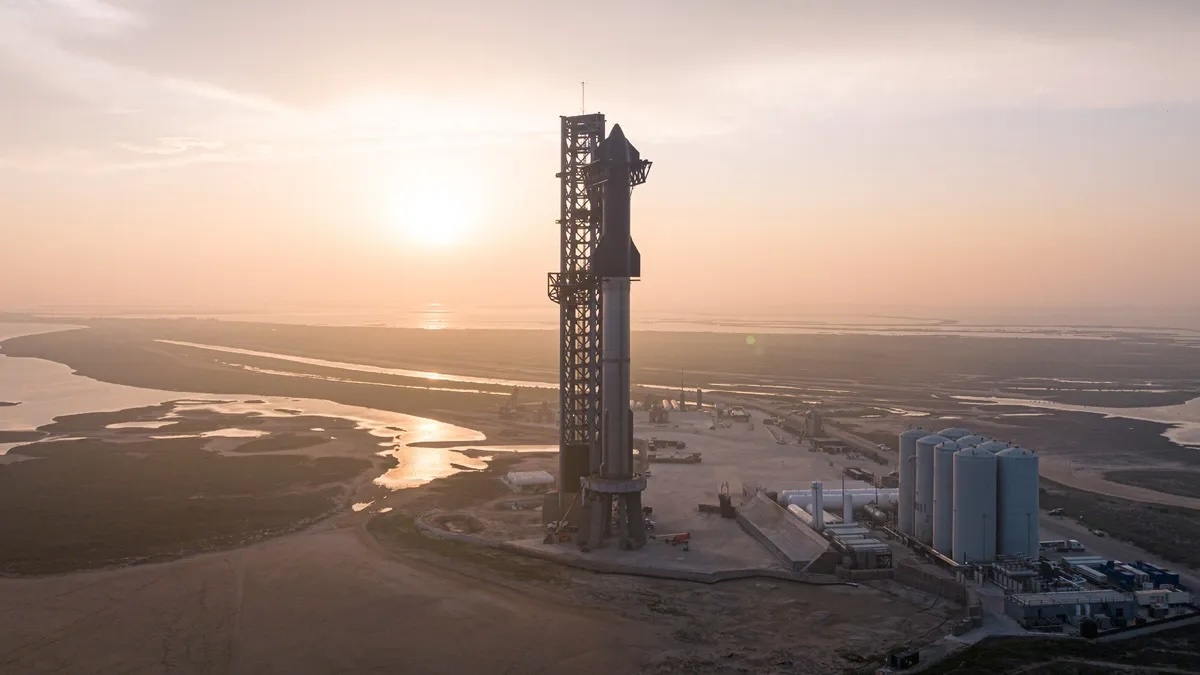
SpaceX's Starship spacecraft on the launchpad. (Image credit: SpaceX
NASA may have no choice but to postpone the launch of its next mission to land astronauts on the moon by more than a year.
Growing pains for SpaceX's massive Starship rocket over the past year have stunted the timeline for the still-developing launch vehicle and spacecraft, which is contracted to land astronauts on the lunar surface as a part of NASA's Artemis 3 mission. The space agency is targeting 2027 for that launch, but SpaceX's own timeline seems to contradict that, reinforcing concerns previously voiced by NASA officials over Starship's readiness.
According to an internal SpaceX document obtained by Politico, the company is targeting June 2026 for the first orbital refueling demonstration between Starship vehicles, and an uncrewed lunar landing in June 2027. If Starship manages to breeze through those qualification tests and stick to its current timeline, SpaceX estimates the earliest first attempt to complete a crewed mission to the surface of the moon could take place in September 2028. SpaceX has not yet conferred these dates to NASA, according to Politico, but plans to include them as part of an "integrated master schedule" it will provide in December. The company acknowledges their timeline falls outside their original NASA contract, and hopes to determine new contract deadlines in coordination with the space agency, the report says.
Artemis 3's predecessor, Artemis 2, could launch as soon as February 2026 based on current NASA timelines. That mission will launch astronauts around the moon, but doesn't include a lunar landing. Artemis 1 launched an uncrewed mission to lunar orbit in November 2022, so a delay of Artemis 3 to 2028 will set an average cadence longer than two years between Artemis program missions. By comparison, between 1968 and 1972, NASA's Apollo program launched one of its 11 missions about every 4.5 months.
But the internal SpaceX document obtained by Politico shows the company's timeline for Starship no longer aligns with NASA's. Starship entered the test flight phase of its development in 2023 with the first integrated launch of its Ship upper stage with its Super Heavy booster. In its first two years, the vehicle has reached some significant milestones, including the return and recovery of a Super Heavy booster using its launch tower's "Mechazilla" chopstick-like arms to catch the rocket out of mid air.
This year, however, has been a different story. Of Starship's five launches of 2025, the first three were not considered successful. Each resulted in the loss of the Ship upper stage either in space or during reentry. Starship's latter two launches of the year represented complete turn-arounds for the "Block 2" version of the vehicle, and managed to successfully demonstrate some of the spacecraft's critical capabilities.
SpaceX is designing Starship for complete reusability — something never yet accomplished for an orbital launch vehicle. The company has perfected reflight refurbishment with its smaller Falcon 9 rocket booster, and while SpaceX has completed 500 launches and counting of its previously-flown boosters, the rocket's second stage still remains a one-time-use vehicle.
With Starship, SpaceX is aiming for reusability of the entire system. The company has already demonstrated two Super Heavy reflights, and completed successful soft-touchdowns in the ocean with Ship during Starship's Aug. 26 and Oct. 13 test launches. Starship can carry considerably heavier payloads compared to the company's smaller Falcon 9 rocket, and SpaceX hopes to position Starship as humanity's spacecraft to Mars. Company CEO Elon Musk has voiced his hope that Starship will deliver up to 1 million people to the Red Planet in the next 20 years. Before it can do that, however, Starship needs to land NASA astronauts on the moon, and it has several more milestones to reach before the space agency puts its personnel onboard.
While Starship has found some slightly firmer footing on its path to operational qualification, SpaceX still has to prove some of the vehicle's most critical capabilities, including orbital cryogenic fuel transfer between vehicles and an uncrewed lunar landing. To complete its responsibilities for Artemis 3, SpaceX estimates the Starship lunar lander will need up to be refueled in space 12 times to pack away enough propellant to land on the moon and launch back to lunar orbit. Once there, it will rendezvous with NASA's Orion spacecraft, which will ferry Artemis 3 astronauts back to Earth.
So, while terrestrial landing and reusability are crucial for SpaceX's Starship design, they aren't critical for NASA's mission to the moon. Still, the space agency may be at the mercy of SpaceX's design trajectory.
Quelle: SC
----
Update: 9.04.2026
.
Experience the Rollout of SLS Hardware for Artemis III
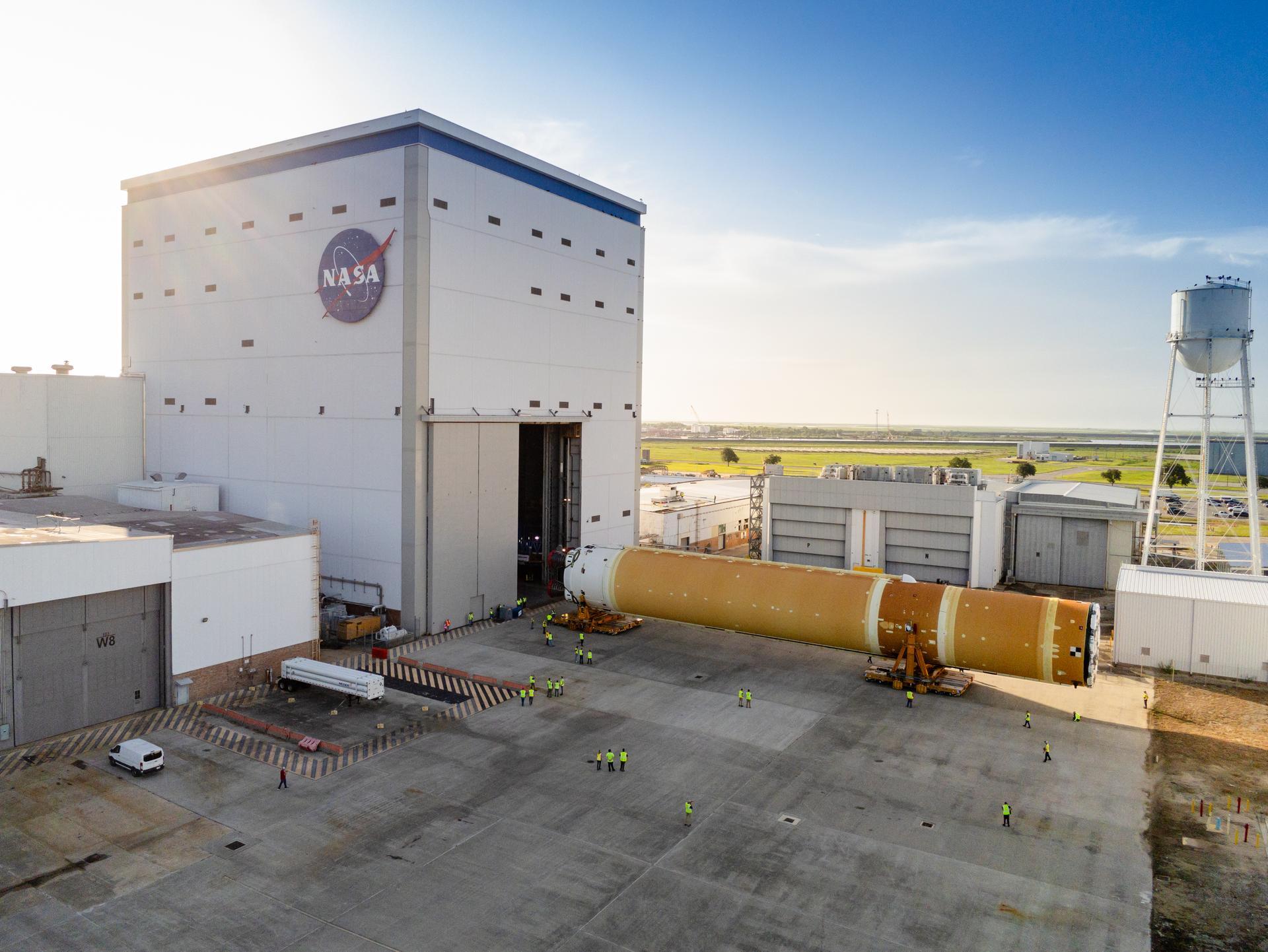
Digital creators and social media users are invited to register to attend the rollout of the third SLS (Space Launch System) core stage as it is prepped to head from NASA’s Michoud Assembly Facility to NASA’s Kennedy Space Center.
Are you passionate about social media and communications? Do you love to create content for an audience? Are you a fan of new, unique experiences? If you said yes, this NASA Social event is for you! This is your opportunity to be on the front lines as NASA continues to lay the groundwork for future deep space exploration.
The NASA Social event will be a one-day event as soon as mid to late April pending the launch of Artemis II. A maximum of 20 digital creators will be selected to attend this event and will be given access similar to news media.
NASA Social participants will have the opportunity to:
- Tour NASA’s Michoud Assembly Facility
- Learn directly from subject matter experts
- Meet fellow digital creators and social media users
- Spend time with members of NASA’s social media team
- View the rollout of the SLS core stage for Artemis III
NASA Social registration for the hardware rollout opens on this page on Tuesday, April 7, and the deadline to apply is noon EDT on Friday, April 10. All applications will be considered on a case-by-case basis.
Do I need to have a social media account to register?
Yes. This event is designed for people who:
- Actively use multiple social networking platforms and tools to disseminate information to a unique audience.
- Regularly produce new content that features multimedia elements.
- Have the potential to reach a large number of people using digital platforms.
- Reach a unique audience, separate and distinctive from traditional news media and/or NASA audiences.
- Must have an established history of posting content on social media platforms.
- Have previous postings that are highly visible, respected, and widely recognized.
Users are encouraged to follow @NASAArtemis for Artemis updates on X, Facebook, and Instagram. Updates and information about the event will be shared on X via @NASA_Events.
How do I register?
Registration for this event opens April 7 and closes at noon EDT on April 10. Registration is for one person only (you) and is non-transferable. Each individual wishing to attend must register separately. Each application will be considered on a case-by-case basis.
Can I register if I am not a U.S. citizen?
No, this event is open to only U.S citizens
When will I know if I am selected?
After registrations have been received and processed, an email with confirmation information and additional instructions will be sent to those selected. We expect to send the first notifications on Monday, April 13.
What are NASA Social credentials?
All NASA social applications will be considered on a case-by-case basis. Those chosen must prove through the registration process they meet specific engagement criteria.
What are the registration requirements?
Registration indicates your intent to travel to NASA Michoud and attend the one-day event in person. You are responsible for your own expenses for travel, accommodation, food, and other amenities.
The schedule of events and special guest appearances are subject to change without notice. NASA is not responsible for loss or damage incurred as a result of attending. NASA, moreover, is not responsible for loss or damage incurred if the event is canceled with limited or no notice. Please plan accordingly.
Michoud is a government facility. Those who are selected may need to complete additional steps to receive clearance to enter the secure areas.
IMPORTANT: Those without proper identification cannot be admitted.
For United States Citizens:
You will be required to present a REAL ID compliant identification or valid U.S. passport PLUS one of the following:
Acceptable documents to accompany federal or state identification:
- U.S. Passport
- Unexpired Employment Authorization Card (Form I-688A)
- Unexpired Employment Authorization Document issued by DHS that contains a photograph (Form I-688B)
- Driver’s license or ID card issued by a state or outlying possession of the United States provided it contains a photograph or information such as name, date of birth, gender, height, eye color, and address
- ID card issued by federal, state or local government agencies or entities, provided it contains a photograph or information such as name, date of birth, gender, height, eye color and address
- School ID card with a photograph
- Voter’s Registration Card
- Military Dependent’s ID Card
- U.S. Military card or draft record
- U.S. Coast Guard Merchant Mariner Card
- Native American Tribal Document
- U.S. Social Security Card issued by the Social Security Administration (other than a card stating it is not valid for employment)
- Original or Certified copy of birth certificate issued by a state, county, municipal authority or outlying possessions of the United States bearing an official seal
- U.S. Citizen ID Card (Form I-197)
- ID Card for use of Resident Citizens of the United States (Form I-179)
- Unexpired employment authorization document issued by DHS (other than those listed previously)
For Legal Resident Aliens:
- Same items required of U. S. Citizens, and:
- Permanent Resident Card or Alien Registration Receipt Card with photograph (Form I-551)
- Unexpired Temporary Resident Card (Form I-688)
- Certification of Birth Abroad issued by the Department of State (Form FS-545 or Form DS-1350)
The REAL ID Act was passed by Congress in 2005 to establish minimum security standards for state-issued driver’s licenses and identification cards.
All registrants must be at least 18 years old.
What if the rollout date changes?
Many different factors can cause a scheduled date change. NASA may adjust the date of the NASA Social accordingly to coincide with a new target rollout date, and will notify registrants of any changes via email.
If the event is postponed, attendees will be invited to attend at a later date. If the rollout is postponed beyond 72 hours, the NASA Social event may be canceled.
NASA Social attendees are responsible for any additional costs they incur related to any launch delay. We strongly encourage participants to make travel arrangements that are refundable and/or flexible.
What if I cannot come to Michoud Assembly Facility?
If you cannot come to NASA Michoud and attend in person, you should not register for the NASA Social. Join the conversation by following @NASAArtemis on X, Facebook, and Instagram,
If you cannot make this NASA Social, don’t worry; NASA is planning many other NASA Social events in the near future at various locations! Check for updates on NASA Socials.
Quelle: NASA