
3.04.2026
Analysis of gravitational waves supports theory that some stars explode without leaving behind black holes
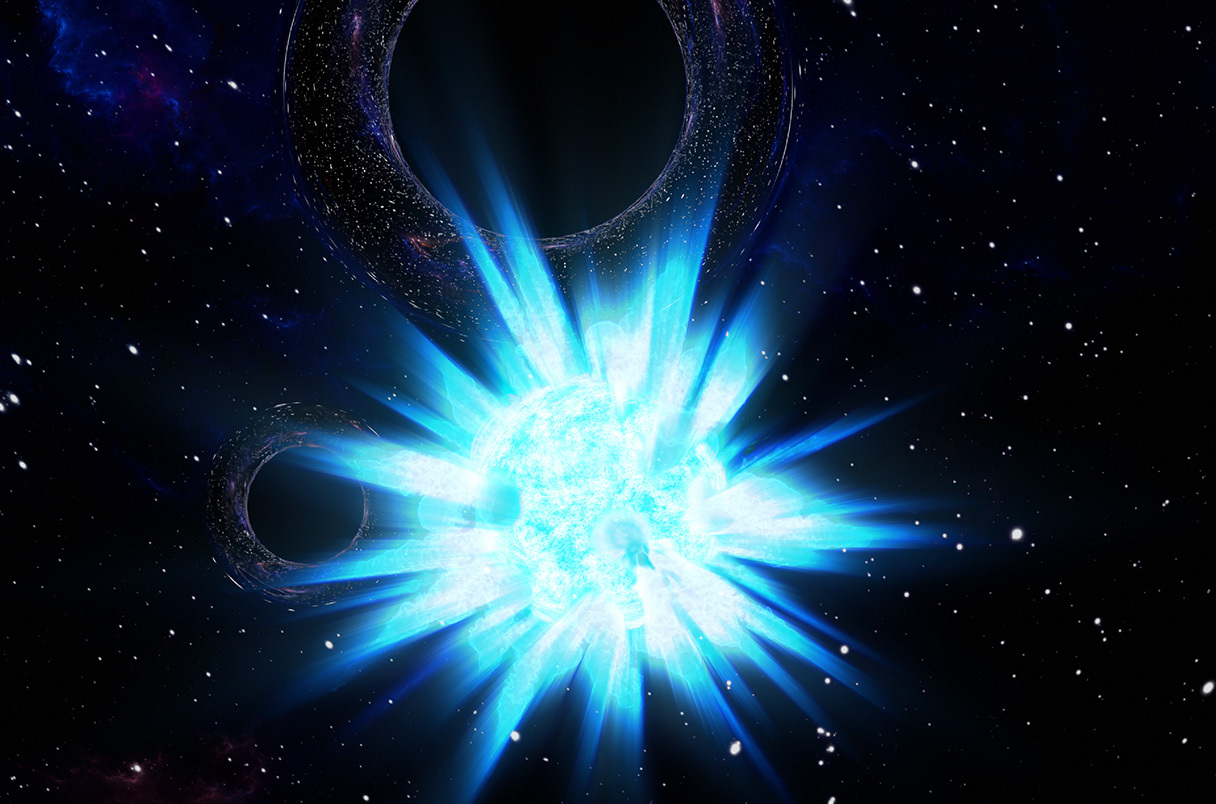
Gravitational waves given off by distant black hole binaries, such as the one in the background of this artist’s conception, suggest that some stars are too big to form black holes at all—and instead explode as pair instability supernovae.CARL KNOX/OZGRAV, SWINBURNE UNIVERSITY OF TECHNOLOGY
How do you prove that in the unimaginably vast universe, certain objects don’t exist? That’s a question that has plagued scientists studying gravitational waves—ripples in spacetime set off when two massive objects such as black holes swirl together and merge. For decades, theorists have thought that, ironically, stars in a certain very heavy mass range simply cannot collapse to form black holes. But gravitational wave astronomers had spotted no evidence of such a “mass gap”—until now.
“What they’re seeing is pretty much in line with what we predicted,” says Stanford Woosley, a theoretical astrophysicist at the University of California, Santa Cruz (UCSC) who predicted roughly the observed mass range in the early 2000s using theoretical models. “I’m personally very gratified to see it.”
When a massive star runs out of fuel, it collapses to an infinitesimal point and leaves behind only its incredibly intense gravitational fields—a black hole. But in the 1960s, physicists first theorized that especially massive stars could die another way, by exploding with such ferocity that they completely rip themselves apart, scatter their matter everywhere, and leave behind nothing, not even a black hole.
That’s because the largest stars can avoid internal collapse because of the sheer pressure generated by the light inside them. If a star gets hot enough, the particles that make up this light, called photons, start to spontaneously convert into pairs of electrons and positrons, which reduces the pressure supporting the star. Eventually, gravity briefly overwhelms the pressure, compressing the star’s core until it ignites and explodes into a luminous supernova.
Astronomers believe this phenomenon, called pair instability, is what happens to stars in the “forbidden range” when they die. “They don’t leave behind a black hole,” says University of Toronto astrophysicist Maya Fishbach, who co-authored the new paper. “Instead, the entire star just explodes and leaves nothing behind at all.” That prediction led to a decades-long mystery: How big must stars be to self-destruct when they die?
Since 2015, scientists have had the potential to address that problem observationally. Instruments like the Laser Interferometric Gravitational-Wave Observatory (LIGO), which has stations in Louisiana and Washington state, and the Virgo interferometer in Italy, have been able to detect the incredibly faint gravitational waves set off when two black holes swirl together and merge. Over the past decade, LIGO and Virgo have spotted hundreds of such black-hole mergers, inferring from the ripples the masses and spins of the merging black holes. So, in principle, researchers need only look to see whether there is a big gap in the spectrum of masses of black holes.
There’s one big catch, however. As LIGO and Virgo’s own observations show, two smaller black holes can merge to form a bigger one, and the heavier “second-generation” black holes produced by such mergers could fill in this so-called upper mass gap. (There may also be a lower mass gap caused by stars too small to make black holes.) Just looking at the masses of all the black holes observed shows no obvious gap.
To get around this problem, Fishbach and colleagues had to dig deeper. They examined 153 mergers involving heavy black holes. Crucially, they ignored the mass of the heavier black hole in each merging pair and instead focused on the mass of the lighter one, as it was more likely to be a first-generation black hole produced by a collapsing star. Sure enough, they found a range of masses—starting at about 44 times the mass of the Sun—at which stars don’t form black holes, as they report today in Nature.
Although the researchers did see some black holes nearing 90 solar masses, spin measurements of those black holes are faster than predicted, suggesting that they formed from a previous merger of two smaller black holes.
“The story that the authors provide has no real flaws in it and is consistent with everything that we know,” says Ryan Foley, an astronomer at UCSC. Djuna Croon, an astroparticle physicist at Durham University who was not involved with the new work, says the range of masses this paper provides “is an incredibly interesting prediction at the interface of particle physics, nuclear physics, stellar evolution, and gravitational wave astronomy.”
Fishbach hopes to use future observations to more precisely measure the boundaries of the mass gap, which will shed more light on the fundamental physics inside stars. But she also notes it’s impossible to know for certain how forbidden the “forbidden range” truly is. “Can we really say that massive stars absolutely never make these black holes?” she asks. “The universe is a really big place—and there might be some really weird stars out there.”
Quelle: AAAS