
17.03.2026
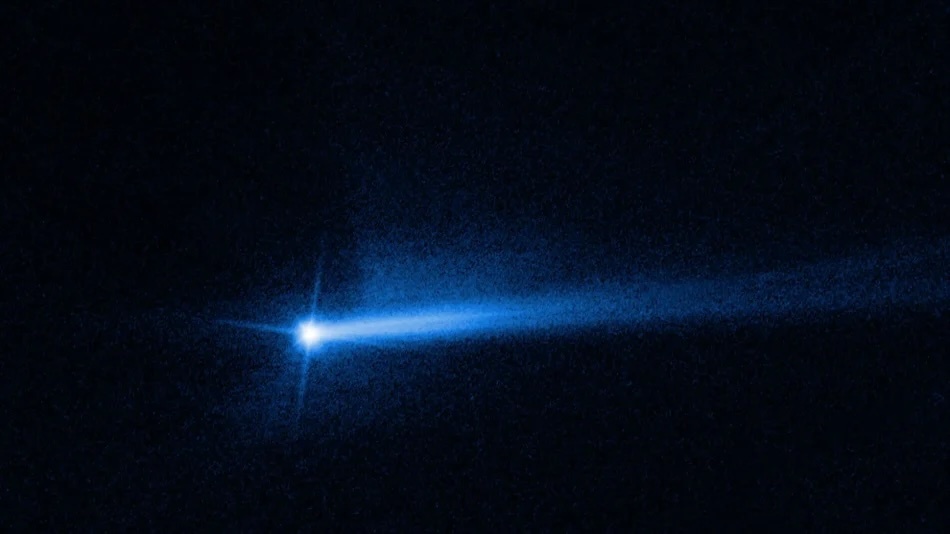
Credit: NASA, ESA, Jian-Yang Li (PSI), Joe Depasquale (STScI)
In a major milestone, humanity has measurably changed a natural body’s orbit around the Sun. In September 2022, the DART (Double Asteroid Redirection Test) spacecraft smashed into Dimorphos, the tiny moonlet of a larger asteroid named Didymos, at 6.6 kilometers (4 miles) per second.
The impact changed the asteroids’ orbit around each other — or technically around their shared center of mass — and altered their trajectory. This successful test proved that a kinetic impactor could deflect a potentially Earthbound space rock.
A Viable Planetary Defense Method
Before impact, the 170-meter-wide (560-foot-wide) Dimorphos completed one loop around the 805-meter-wide (half-a-mile-wide) Didymos every 11 hours and 55 minutes. The DART impact shortened that orbit by 33 minutes and 15 seconds.
It also changed the binary system’s orbit around the Sun by 0.15 seconds. That may not sound like much, but that’s the point: a tiny deflection applied early enough could alter an asteroid’s path, turning a cosmic catastrophe into a swing-and-a-miss.
And, despite the fact that DART weighed only 550 kilograms (1,200 pounds) and its target Dimorphos is about 5 billion kilograms (11 billion pounds), the impact changed the moonlet’s shape from a mostly symmetrical spheroid to an “oblong watermelon.” Or, in more abstruse terms, a triaxial ellipsoid.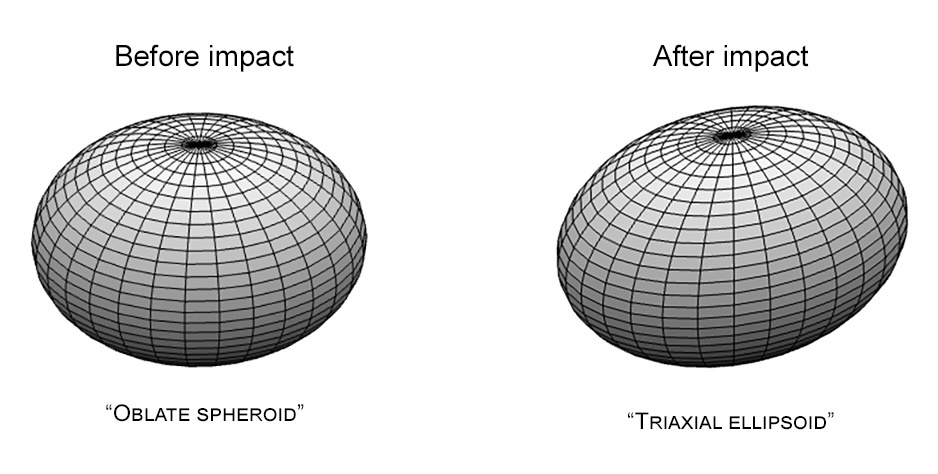
Credit: NASA/JPL-Caltech
As described in a recent paper published in Science Advances, researchers measured the binary asteroid’s shifted orbit through a technique called occultation. Occultation occurs when a celestial object passes in front of a background star and temporarily block that star’s light. By analyzing this change in starlight, scientists can measure of an object’s speed, shape, and position with extreme precision.
Unsurprisingly, it’s a challenging task. “This work is highly weather dependent and often requires travel to remote regions with no guarantee of success. This result would not have been possible without the dedication of dozens of volunteer occultation observers around the world,” explains study co-lead Steve Chesley, a senior research scientist at JPL.
Accordingly, a global volunteer astronomer community braved the elements and the distance to record 22 occultations that occurred between October 2022 and March 2025. “When combined with years of existing ground-based observations, these stellar occultation observations became key in helping us calculate how DART had changed Didymos’ orbit,” says Chesley.
Earth’s New Anti-Asteroid Strategy
We need to do three things to avert an asteroid-assisted apocalypse. First, find near-Earth asteroids, though most that are larger than 140 meters (460 feet) remain worryingly undetected. Fortunately, NASA’s Near-Earth Object (NEO) Survey mission, set to launch no earlier than 2027, is the first space telescope designed for planetary defence.
After detection, step two requires assessing a space rock’s threat level. Step three is to find a way to smash into said space rock. Luckily, DART provided an already successful blueprint.
Additionally, knowing the composition of an asteroid is essential. The DART mission allowed astronomers to ascertain that Dimorphos is a “rubble pile” asteroid, formed from the rocky debris expelled from its rapidly spinning sibling Didymos. Similarly, DART helped researchers conclude that if Earth is accosted by a binary asteroid, we must only nudge the little one.
More information is upcoming. The European Space Agency’s (ESA) Hera mission will rendezvous with the asteroid pair in late 2026 to gather additional data on the effectiveness of the impact. As Roberto Armellin of the Auckland Space Institute says, “These measurements will help turn this historic experiment into a reliable planetary defence technique.
Quelle: Orbital Today