
9.03.2026
The nebula was formed when a star went supernova 5,000 light-years from Earth.
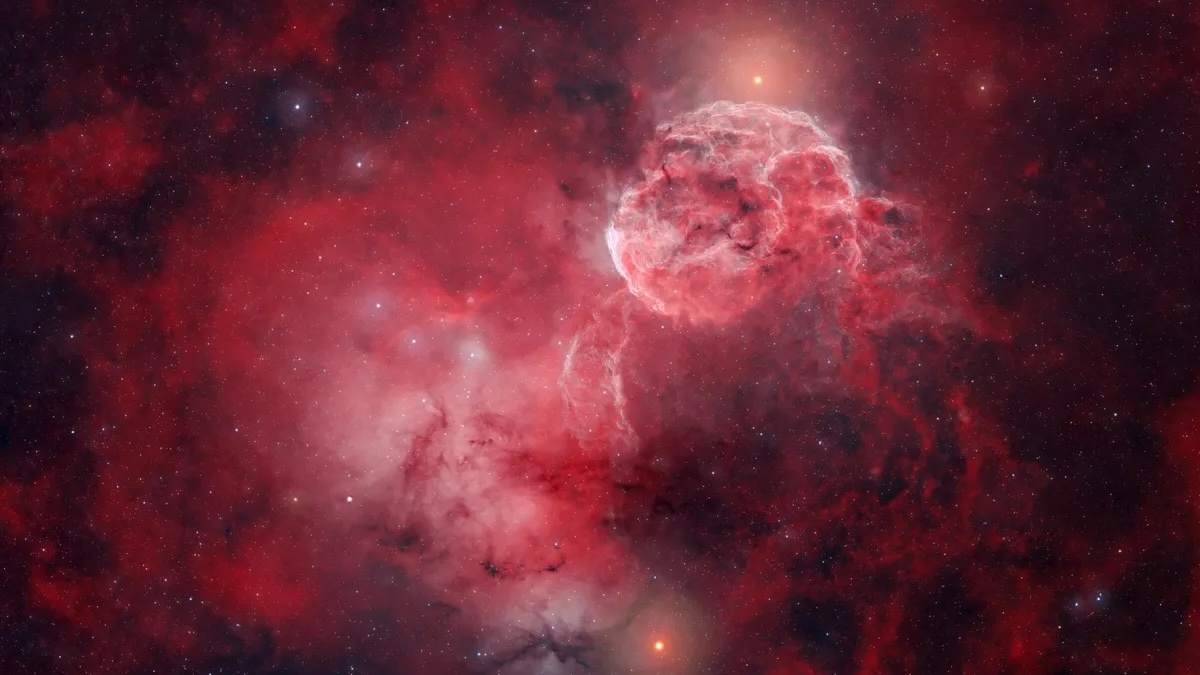
The Jellyfish Nebula shines in the constellation Gemini. (Image credit: Ogetay Kayali)
Astrophotographer Ogetay Kayali has captured a nebula resembling a jellyfish — or possibly a brain, depending on your perspective — shining 5,000 light-years from Earth near the bright star Propus, which represents one foot of a mythological twin represented in the constellation Gemini.
The nebula IC 443 is, in reality, a vast supernova remnant composed of stellar debris cast off in the cataclysmic death of an enormous star. The stellar body that spawned the remnant lingers on as a fast-spinning neutron star, or pulsar, which was detected in observations made by NASA's Chandra Space Telescopeback in 2015.
Kayali's nebula view highlights the expanding structure of IC 443's luminous shell, which is visible to the upper right of the image, glowing alongside dense filaments of interstellar dust and gas punctuated by the multicolored light of stars in the foreground and background of the nebula. "This image captures the intricate shock fronts where stellar debris collides with surrounding interstellar gas, causing hydrogen to glow in deep crimson while faint filaments trace the blast wave's turbulent history," Kayali told Space.com in an email.
The distinctive appearance of IC 443's shell-like structure has led to it being nicknamed the "Jellyfish Nebula," owing to its resemblance to the aquatic creature — though, through clever capture, processing and angling, Kayali opted to highlight the nebula's similarity to a human brain in his composition.
"Ironically, jellyfish do not have a brain!" Kayali said. "Rather than isolating the bright shell alone, I framed the wider environment to reveal how the remnant interacts with its surroundings, emphasizing the contrast between emission structures and darker molecular clouds."
Kayali captured the nebula scene over the course of 17 hours as it glowed in the skies above Texas using his William Optics Redcat 51 III WFID telescope paired with a ZWO ASI2600MM astronomy camera and H-alpha filter.
Want to capture spectacular images of the night sky for yourself? Then be sure to check out our guide to the best cameras and lenses for astrophotography, along with our roundup of the best telescopes for exploring the night sky!
Quelle: Space.com