
24.02.2026

NASA to Rollback Artemis II Rocket, Spacecraft
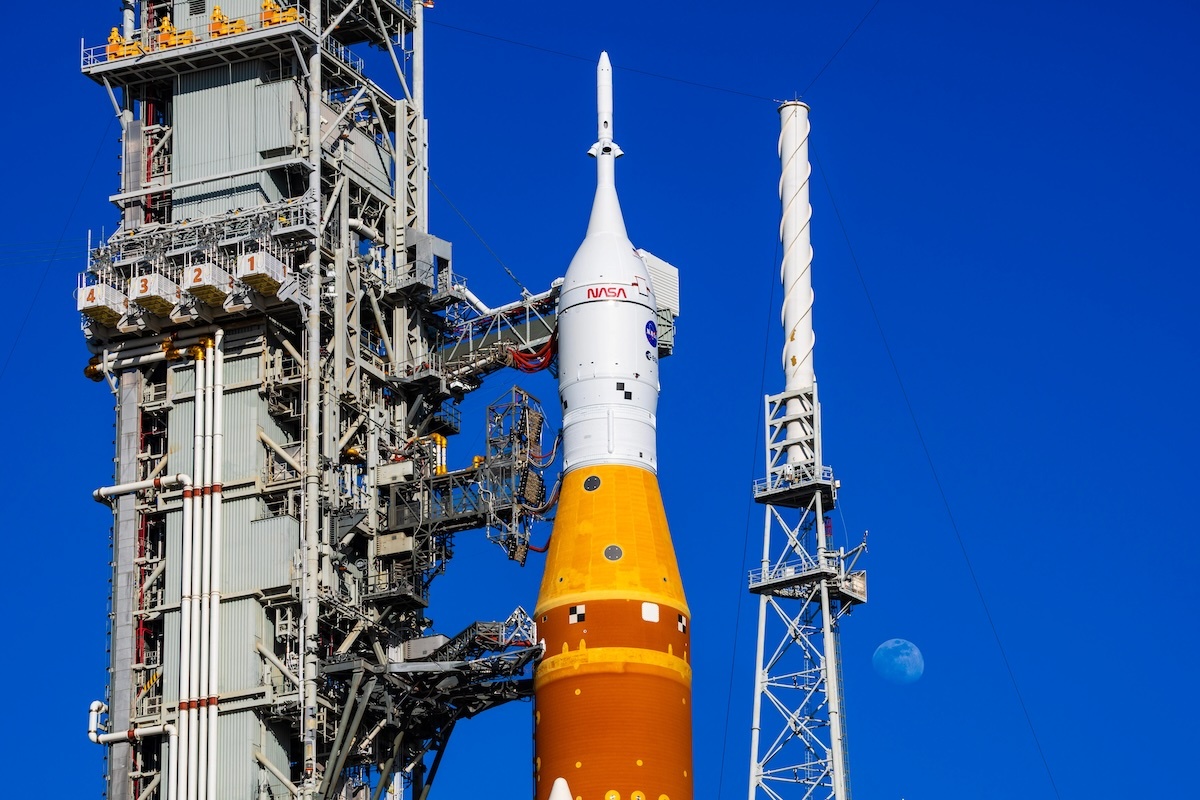
Weather pending, NASA will roll the SLS (Space Launch System) rocket and Orion spacecraft for Artemis II off the launch pad at the agency’s Kennedy Space Center in Florida as soon as Tuesday, Feb. 24.
Engineers are continuing to prepare for the move after encountering an issue with the flow of helium to the rocket’s upper stage.
On Feb. 21, managers decided to remove recently installed platforms before high winds descend on the Space Coast, which poised teams for rollback while discussions about the issue were ongoing. Returning to the Vehicle Assembly Building at Kennedy is required to determine the cause of the issue and fix it.
Teams are reviewing the exact time to begin the approximately 4 mile, multi-hour trek.
The quick work to begin preparations for rolling the rocket and spacecraft back to the VAB potentially preserves the April launch window, pending the outcome of data findings, repair efforts, and how the schedule comes to fruition in the coming days and weeks.
The Artemis II crew members were released from quarantine the evening of Feb. 21 and remain in Houston.
NASA will hold a media event in the coming days to discuss rollback, and plans for the Artemis II test flight.
Quelle: NASA
----
Update: 26.02.2026
.
First Motion Set for Artemis II Rollback
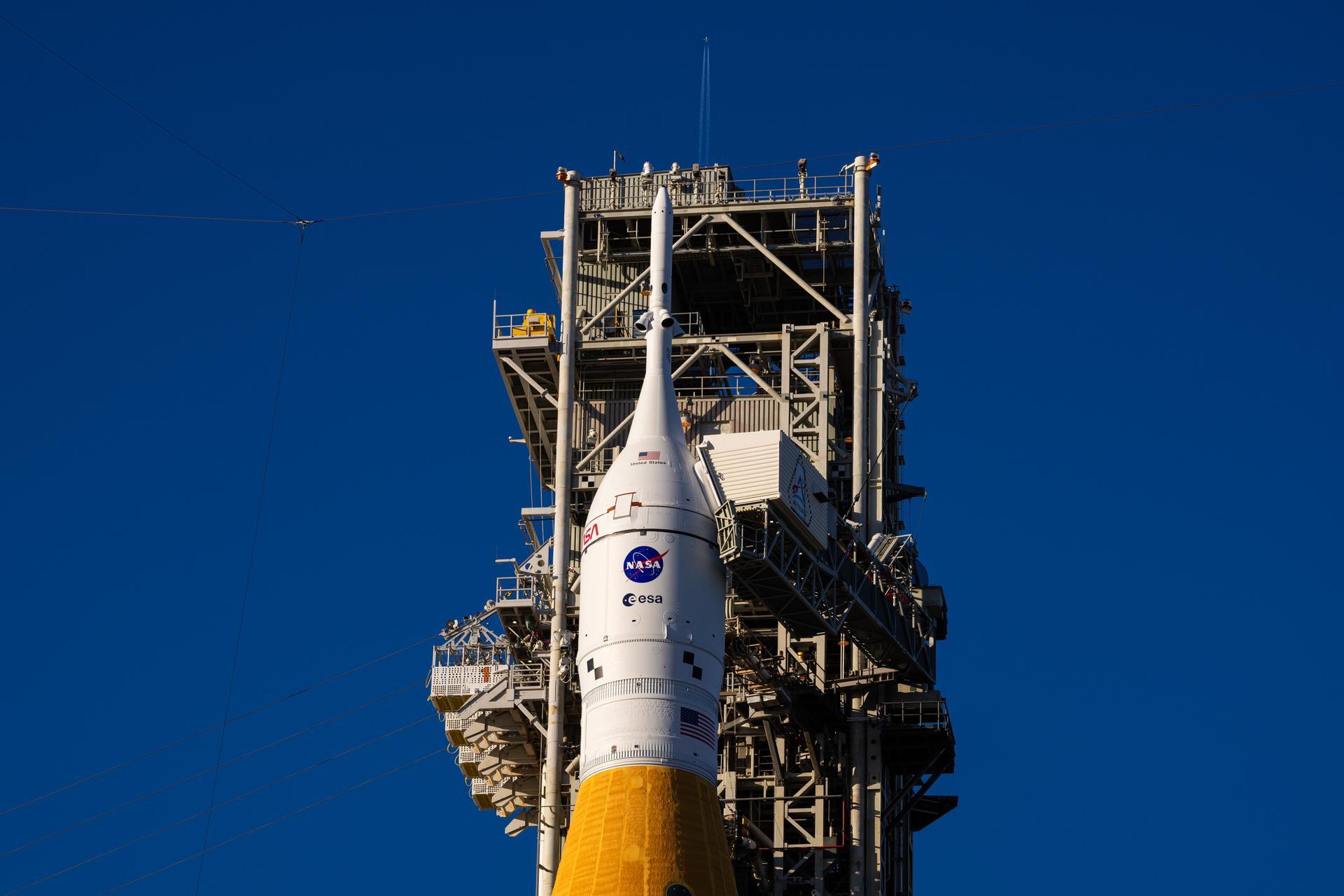
NASA is targeting approximately 9 a.m. EST, Wednesday, Feb. 25, to begin rolling the SLS (Space Launch System) rocket and Orion spacecraft for Artemis II off the launch pad and back to the Vehicle Assembly Building (VAB) at the agency’s Kennedy Space Center in Florida. Teams will continue to monitor winds and temperatures in advance of the roll.
The approximately 4-mile trek is expected to take up to 12 hours. Once back in the VAB, teams will immediately begin work to install platforms to access the area of the helium flow issue. Teams also will take advantage of the time in the VAB to replace batteries in the flight termination system and retest it, and replace additional batteries in the upper stage.
Quelle: NASA
----
Update: 5.03.2026
.
NASA Artemis II moon rocket repairs underway, April launch possible
After a helium flow issue temporarily grounded the Artemis II SLS rocket, NASA announced they'd found the root cause of the problem that delayed the return-to-the-moon mission — a dislodged seal that led to an obstruction.
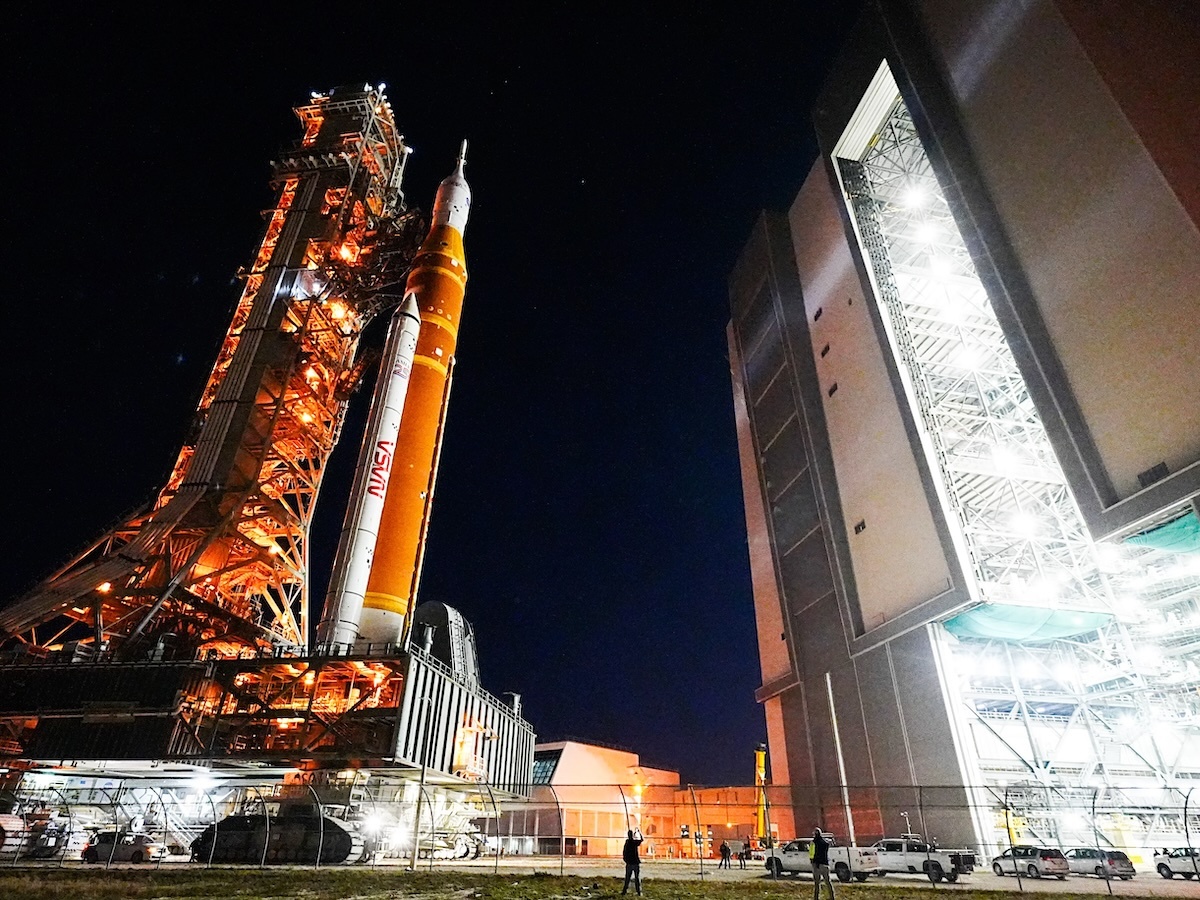
Repairs are underway inside the Vehicle Assembly Building, and the massive orange-and-white moon rocket is expected to be rolled back to the Kennedy Space Center launch pad later this month.
The long-awaited Artemis II mission, which will send astronauts around the moon for the first time in more than 50 years, is set for no earlier than April 1.
The helium flow problem was discovered after a successful wet dress rehearsal in February; that's when teams fuel the rocket and bring it through most of the countdown. While teams worked to transition SLS to launch configuration after the fueling test, an interruption to the flow of helium in the SLS rocket's upper stage was found.
“Engineers determined a seal in the quick disconnect, through which helium flows from the ground systems to the rocket, was obstructing the pathway,” a March 3 NASA blog post said. “The team removed the quick disconnect, reassembled the system, and began validating the repairs to the upper stage by running a reduced flow rate of helium through the mechanism to ensure the issue was resolved. Engineers are assessing what allowed the seal to become dislodged to prevent the issue from recurring.”
While the rocket is inside the VAB, teams are performing other maintenance to the rocket, which originally rolled to the launch pad in mid-January.
“They are activating a new set of flight termination system batteries ahead of end-to-end retesting of the system and also are replacing the flight batteries on the upper stage, core stage, and solid rocket boosters, and charging the Orion launch abort system batteries,” the NASA blog said. “Work to replace a seal on the core stage liquid oxygen line feed system began March 2. Once complete, teams will reassemble the oxygen tail service mast umbilical plate and perform various integrity tests to ensure the seal interface is tight.”
Isaacman announces 'NASA Force' as agency aims to speed up Artemis missions
The ongoing delays to the NASA’s Artemis program prompted NASA's new chief to call for changes that would lead to a quicker turnaround time between missions.
On March 3, NASA Administrator Jared Isaacman announced the creation of NASA Force, which aims to bring talented people directly into NASA instead of relying on vendors. This will be done by utilizing U.S. Office of Personnel Management, the head human resources department for the federal government.
“Today, we’re launching NASA Force with @USOPM,” Isaacman posted to X (formerly Twitter). “Returning to the Moon requires restoring core competencies in our civil servant workforce.”
Isaacman said that the new program would bring in top talent for two-year terms and would feature workers with aerospace, software and systems expertise, as well as skilled technical workers.
“This will strengthen in-house engineering excellence, close skill gaps, and deepen partnerships with industry. We’re investing in our people to deepen America’s leadership in space,” Isaacman wrote.
The Artemis II SLS rocket has suffered numerous problems, leading to delays in the planned launch.
“We've got a lot of really talented folks that have been working hard on the Artemis II campaign, and whether they're going to want to stick around for three more years after this mission is complete, is a question mark,” Isaacman said, in noting that Artemis missions needed to fly more frequently. “This is just not the right pathway forward.”
The proposed changes include modifications to the complex rocket configuration, setting ambitious new objectives, increasing the pace of manufacturing and reducing time between flights.
Artemis III, which was set to be the moon landing, will now be an Earth orbit mission testing one or both of the planned landers in 2027. Artemis IV is now set to be the moon landing and is currently targeting no earlier than 2028.
Quelle: Florida Today
----
Update: 8.03.2026
.
Track NASA’s Artemis II Mission in Real Time
As NASA invites the public to follow the Artemis II mission as a crew of four astronauts venture around the Moon inside the agency’s Orion spacecraft, people around the world can pinpoint Orion during its journey using the Artemis Real-time Orbit Website (AROW).
During the approximately 10-day mission, NASA will test how the spacecraft’s systems operate as designed with crew aboard in the deep space environment. Using AROW, anyone with internet access can track where Orion and the crew are, including their distance from Earth, distance from the Moon, mission duration, and more. Access to AROW is available on:
- NASA’s website (www.nasa.gov/trackartemis)
- The NASA app (www.nasa.gov/nasa-app)
Using AROW, the public can visualize data that is collected by sensors on Orion and then sent to the Mission Control Center at NASA’s Johnson Space Center in Houston during its flight. It will provide constant information using this real-time data beginning about one minute after liftoff through Orion’s atmospheric reentry to Earth at the end of the mission.
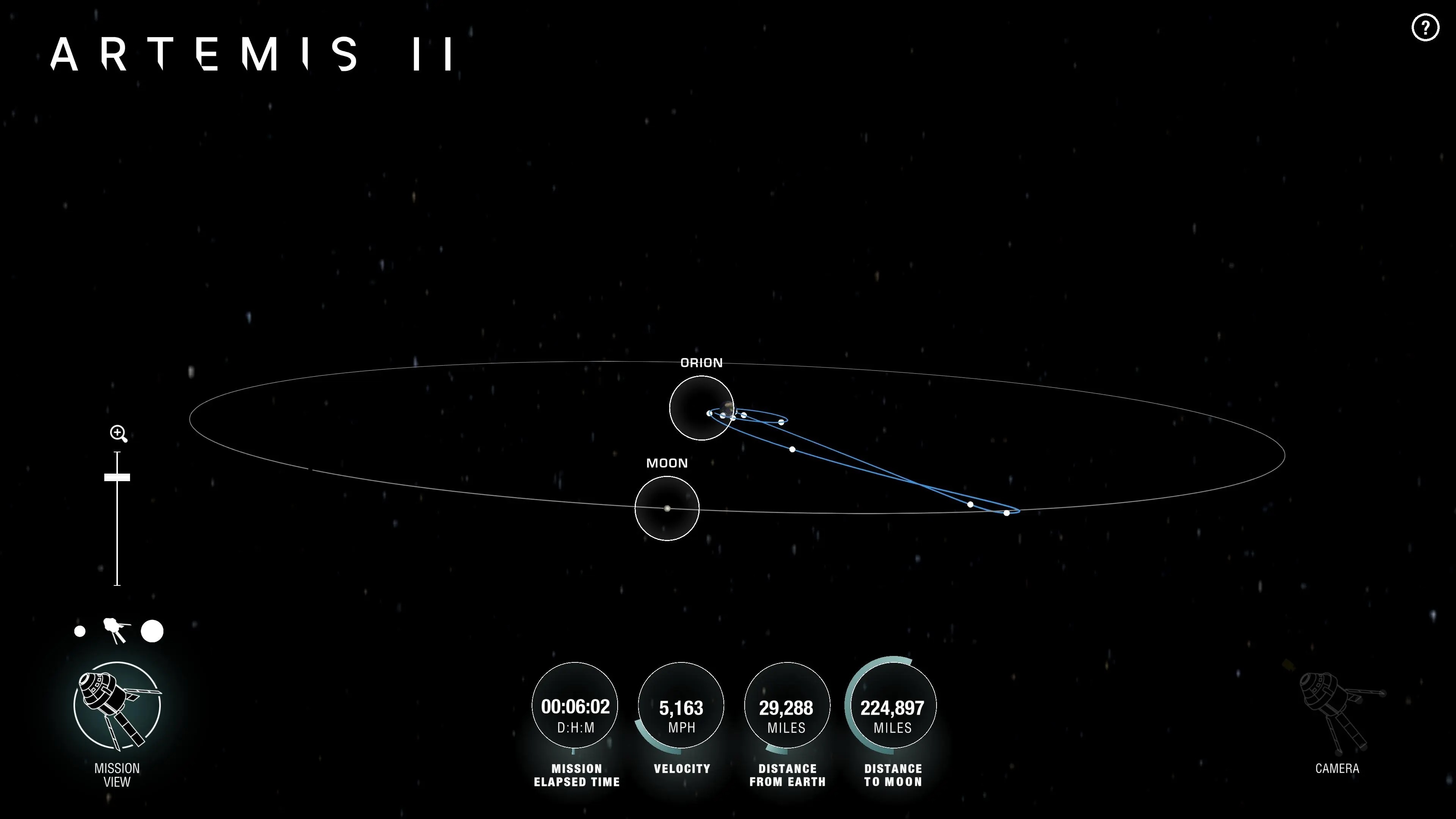
Online, users can follow AROW to see where Orion and the crew are in relation to the Earth and the Moon and follow Orion’s path during the mission. Users can view key mission milestones and characteristics on the Moon, including information about landing sites from the Apollo program.
The mobile app includes similar features to the website, with the addition of augmented reality tracker. After a brief calibration sequence, on-screen indicators will direct users where to move their phone to see where Orion currently is relative to their position on Earth. Mobile app tracking will be available once Orion separates from the rocket’s upper stage, approximately three hours into the mission.
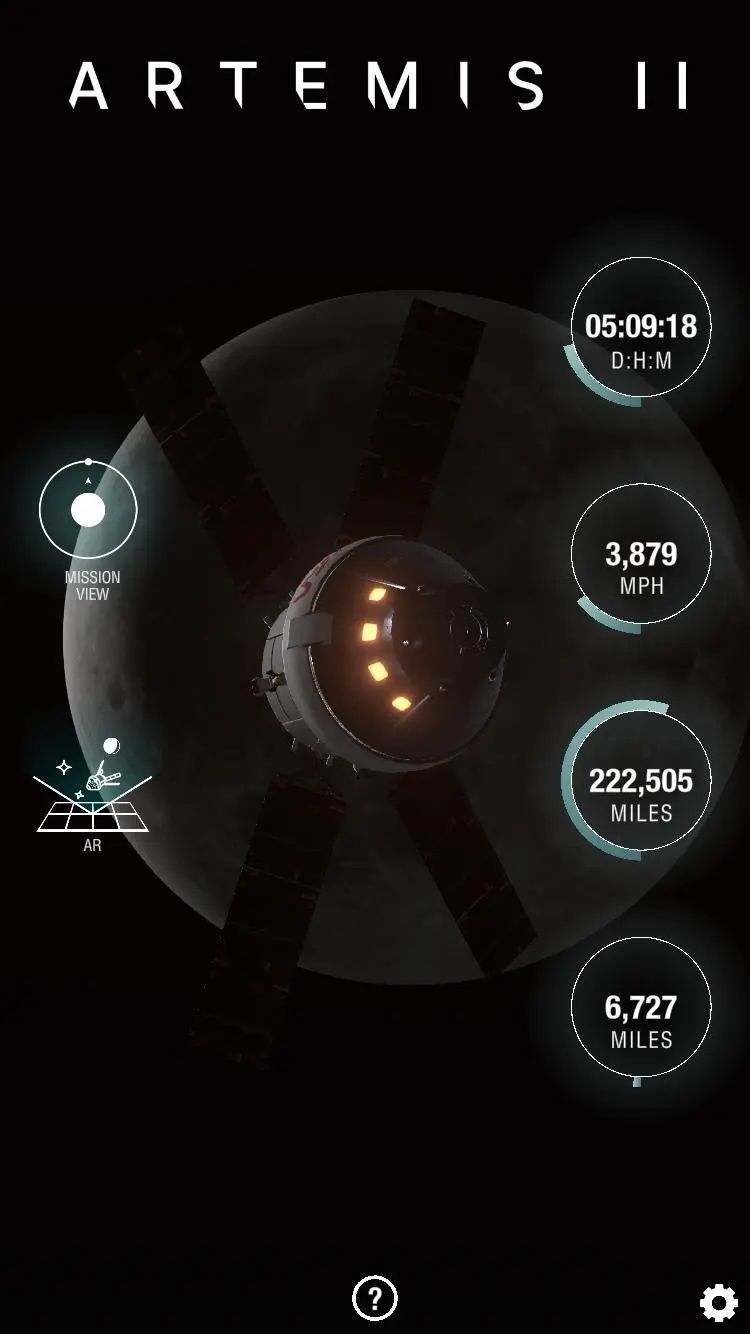
State vectors, or data that describes precisely where Orion is located and how it moves, also will be provided by AROW, following a proximity operations demonstration to evaluate the manual handling qualities of Orion.
These vectors can be used for data lovers, artists, and creatives to make their own tracking app or data visualization. Also available for download will be trajectory data from the flight, called an ephemeris, found at the bottom of this page, after the mission begins. The ephemeris data can be used to track Orion with your own spaceflight software application or telescope, or to create projects such as a physics model, animation, visualization, or tracking application.
Artemis II, the agency’s first crewed mission in the Artemis campaign, is a key step in NASA’s path toward establishing a long-term presence at the Moon and confirming the systems needed to support future lunar surface exploration and paving the way for the first crewed mission to Mars.
Quelle: NASA
----
Update: 11.03.2026
.
NASA to Share Artemis II Flight Readiness Review Update
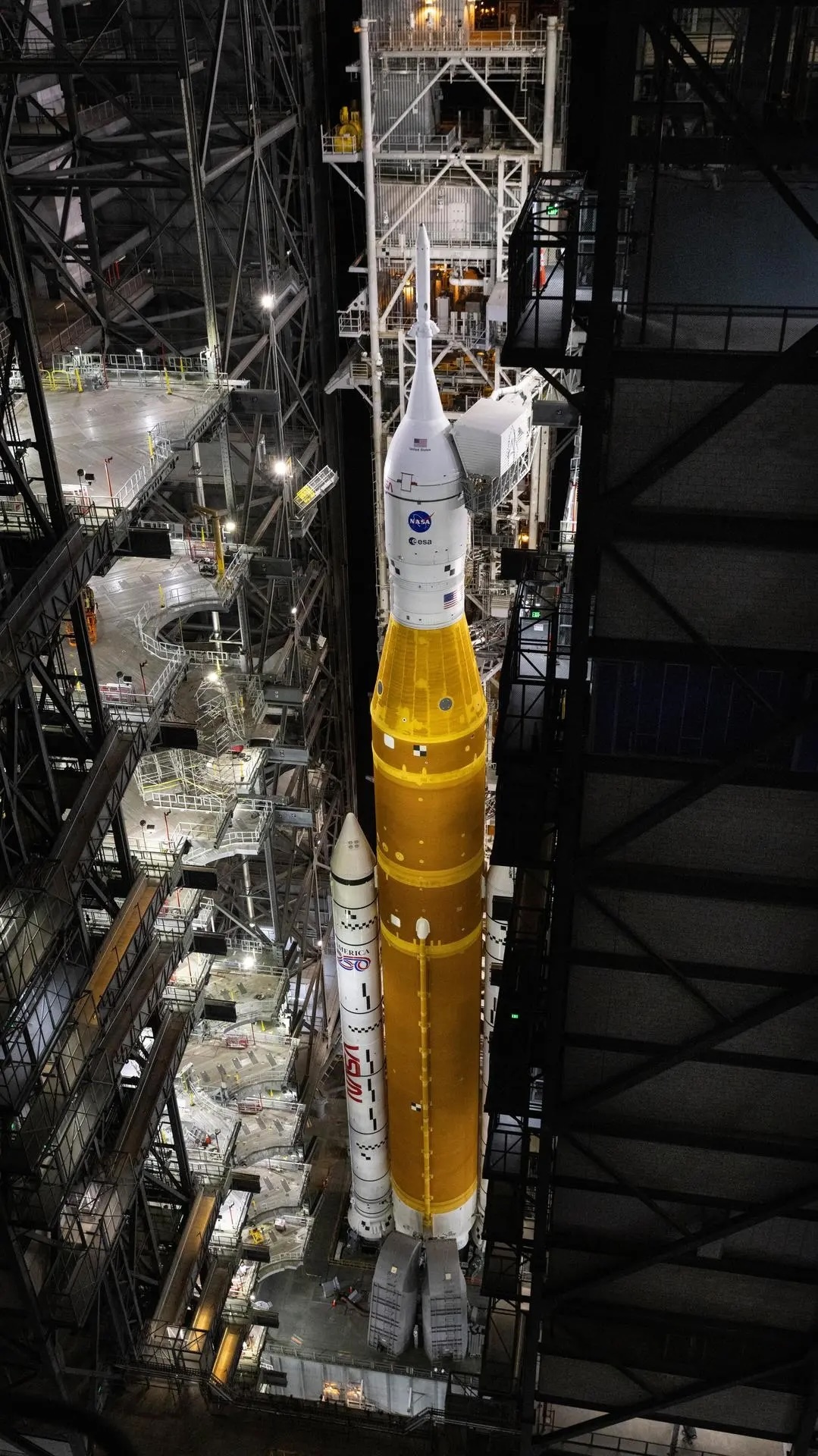
NASA will host a news conference at 3 p.m. EDT, Thursday, March 12, to highlight progress toward the Artemis II crewed mission around the Moon. The media briefing will take place from the agency’s Kennedy Space Center in Florida after the conclusion of an Artemis II Flight Readiness Review.
The news conference will stream live on the agency’s YouTube channel. Learn how to stream NASA content through a variety of online platforms, including social media, as available.
NASA participants include:
- Lori Glaze, acting associate administrator, Exploration Systems Development Mission Directorate
- John Honeycutt, chair, Artemis II Mission Management Team
- Shawn Quinn, manager, Exploration Ground Systems Program
- Norm Knight, director, Flight Operations Directorate
This event is open in-person for media previously credentialed at NASA Kennedy for the Artemis II launch. To participate virtually, media must RSVP for call details no later than 30 minutes prior to the start of the event to the newsroom at NASA Kennedy: ksc-newsroom@mail.nasa.gov. NASA’s media credentialing policy is online.
NASA is continuing work on the SLS (Space Launch System) rocket and Orion spacecraft in NASA Kennedy’s Vehicle Assembly Building before a second rollout to the launch pad later this month ahead of a potential launch in April.
As part of Golden Age of innovation and exploration, NASA will send Artemis astronauts on increasingly difficult missions to explore more of the Moon for scientific discovery, economic benefits, and to build on our foundation for the first crewed missions to Mars.
Quelle: NASA
----
Update: 14.03.2026
.
Artemis II Flight Readiness Polls Go to Proceed Toward April Launch
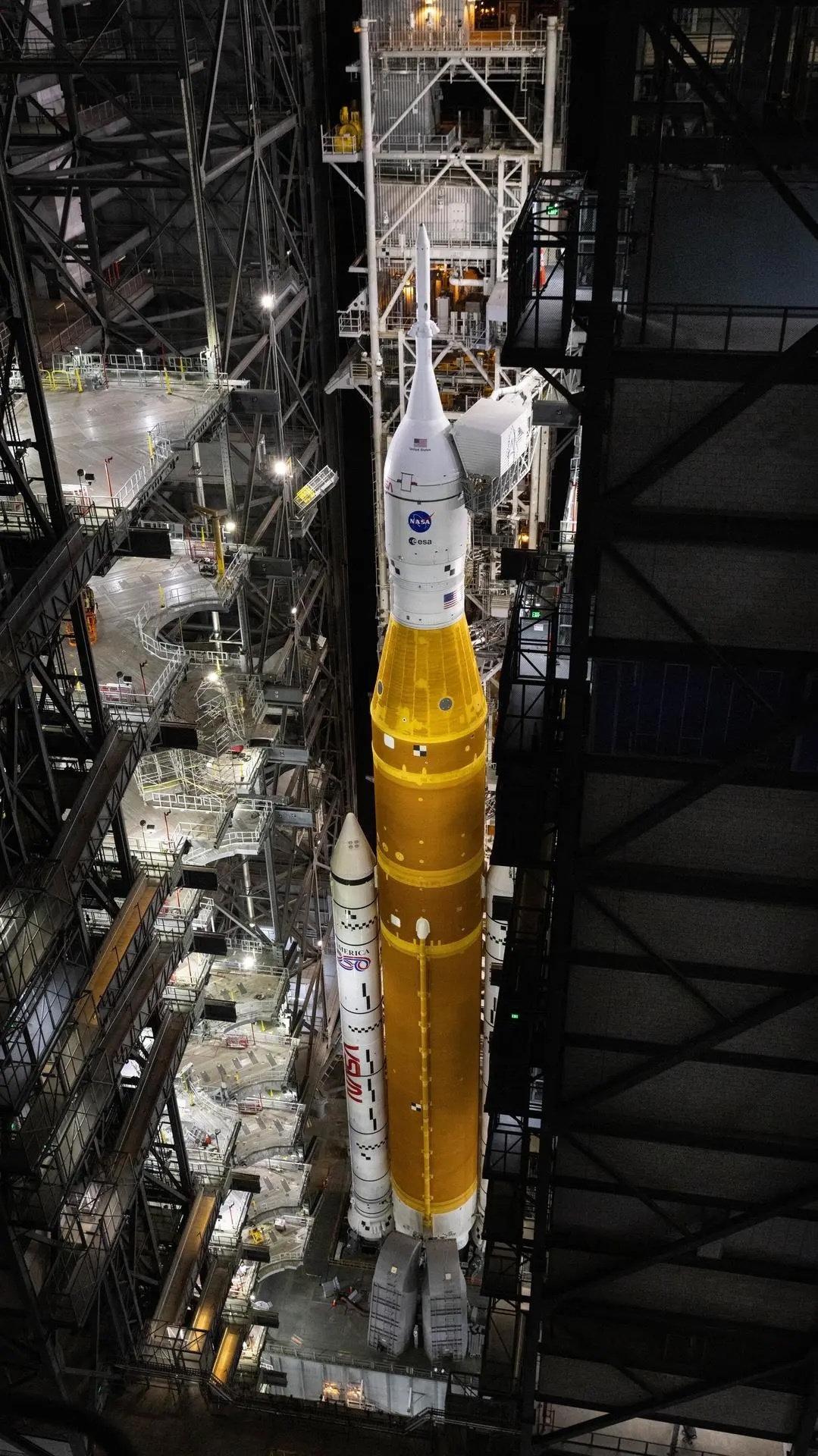
NASA completed the agency’s Artemis II Flight Readiness Review on Thursday, March 12, and polled “go” to proceed toward launch. NASA is targeting Thursday, March 19, to roll the SLS (Space Launch System) rocket and Orion spacecraft to launch pad 39B in advance of a launch attempt Wednesday, April 1, pending close out of remaining open work.
Agency leaders provided updates about the outcome of the readiness review in a news conference.
View an updated calendar of April launch opportunities.
Quelle: NASA
----
Update: 16.03.2026
.
NASA manager Giles describes his role in moving Artemis to pad 39B
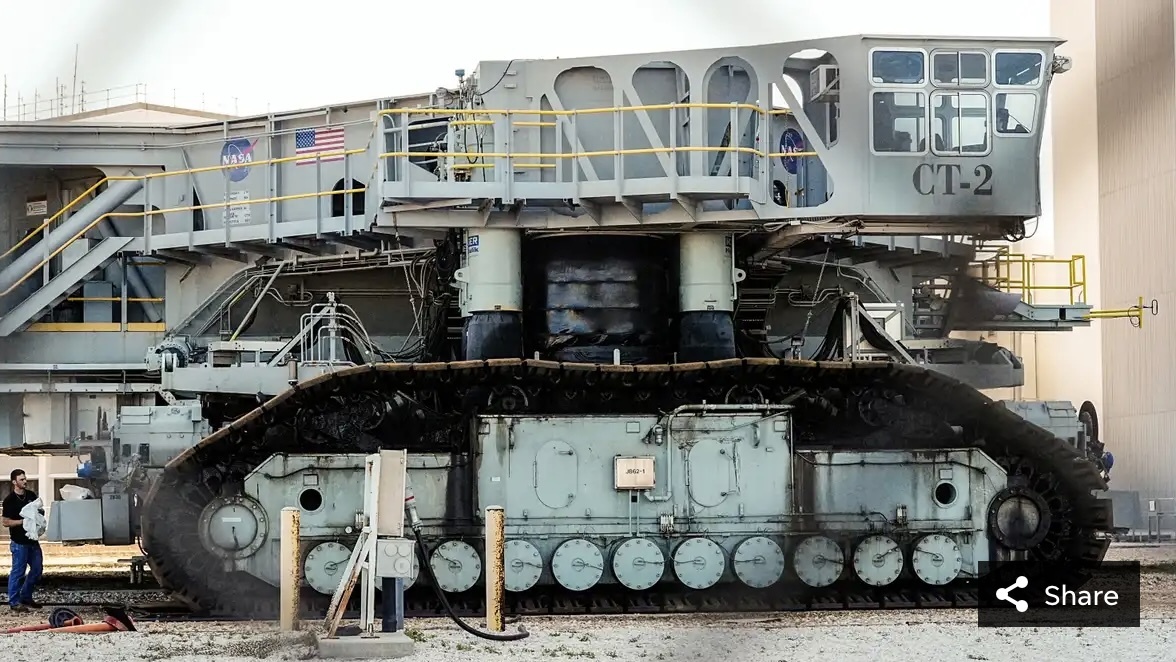
Like a massive mechanical Atlas bearing the weight of the world on its shoulders, NASA’s Crawler-Transporter 2 will soon slowly scoot the Artemis II rocket and mobile launch tower back to the pad so American astronauts can return to the moon.
Built on the scale of a Godzilla movie, CT-2’s top deck spans an area bigger than a Major League Baseball diamond. The goliath machine creeps along at a leisurely 0.82 mph while transporting NASA’s huge, 322-foot-tall Space Launch System moon rocket.
And its four monstrous, thirsty engines devour one gallon of diesel fuel for every 32 feet of travel. Talk about poor mileage — that works out to roughly 165 gallons per mile.
“I call it a combination of a locomotive, a ship and a piece of mining equipment — kind of all those pieces put together in one,” said John Giles, engineering operations manager for NASA’s crawler-transporters.
“It’s an engineer’s dream. Because you have mechanical systems, electrical systems, electronics, hydraulics. There’s always something to do, always something to work on,” Giles said.
Dwarfing a convoy of human-scale vehicles and roughly 35 logistics personnel and security officers on Jan. 17, CT-2 muscled the mighty Artemis II rocket, Orion spacecraft and launch tower along the 4.2-mile trek from Kennedy Space Center's Vehicle Assembly Building to pad 39B.
But during pre-launch testing, faulty components prevented helium from flowing to the rocket's upper stage following NASA's wet dress rehearsal. So the immense eight-tracked crawler rolled the rocket back inside the VAB for repairs on Feb. 25. That creeping return journey took from 9:38 a.m. to about 8 p.m. to complete.
With the rocket issues now resolved, NASA announced that the Artemis II rocket will roll back to pad 39B on March 19, setting up for a possible launch of the four astronauts as early as April 1.
'Greatest piece of equipment in the world'
NASA's crawlers are so enormous that, when they were added to the National Register of Historic Places in 2000, officials added an unusual stipulation. They were listed as structures, not objects.
During a March 2023 ceremony at KSC, Guinness World Records presented NASA personnel a certificate declaring CT-2 as “the heaviest self-powered vehicle.” Top speed while loaded: 1 mph.
“I think this is the greatest piece of equipment in the world. The way it moves, the way it acts, the way we need to repair it. The stress that comes with it, knowing we’re the biggest single-point failure in our return-to-the-moon program,” Giles said, standing near CT-2 as it silently parked in the shadow of the VAB.
“When you’re rolling with a vehicle on board, that’s stressful. You’re carrying an expensive piece of equipment there. And you want to carry it as smoothly as possible, as quickly as possible. So that’s when it’s kind of all-hands-on-deck, all-business,” he said.
NASA’s one-of-a-kind crawler is a Space Race relic that was engineered to move powerhouse Saturn V rockets during the Apollo days. CT-2 and its counterpart, Crawler-Transporter 1, were built by Marion Power Shovel Co. in Marion, Ohio, and assembled and tested at the Cape from 1963-65.
Both crawlers became operational by early 1966. On Aug. 26, 1967, a crawler scooted the first Saturn V to the pad for the uncrewed Apollo 4 mission.
Sometimes called "mighty tortoises," the crawlers — which were originally nicknamed Hans and Franz — continued moving mobile launch towers and spacecraft at KSC throughout the space shuttle era, which wrapped up in 2011.
Giles said CR-2 features an automated hydraulic leveling system that maintains its top deck elevation within a two-inch range. Huge vertical cylinders — four at each corner of the crawler — jack up or down making real-time leveling adjustments.
Crews upgraded CT-2 during the mid-2010s to handle SLS heavy-lift rockets, which clock in larger than the Saturn V. Giles said the beefed-up behemoth can now carry 18 million pounds, while CT-1 is limited to its original 12-million-pound capacity and remains parked at the crawler yard on the other side of the VAB.
Today, Giles said the aging CT-2 remains about 90% original from the Apollo era. Logistics personnel track some 70,000 mechanical parts. During the 12-hour Artemis II rollback, he said problems emerged with a grease pump. Technicians replaced that pump with a brand-new, in-stock model — which was 30 years old.
How do you drive a 6.65-million-pound machine?
Based in Virginia, Amentum provides Artemis II engineering, technicians and systems integration under NASA’s Exploration Ground Systems program. Breanne Rohloff, an Amentum mechanical engineer, is the lone woman on the crawler-driving squad.
Rohloff logged one hourlong driving shift, or "stick time," during the Jan. 17 Artemis II rollout. CR-2 sports a pair of drivers' cabs amid its sprawling industrial layout of engine rooms, pump rooms and a control room.
“It’s a very visible culmination in all of this work ... once you see the rocket on the pad and the crawler back down the slope,” Rohloff said.
At the end of their crawlerway journeys, lasers mounted at the VAB and pad 39B help drivers precisely align and position their monumental payloads within a fraction of an inch.
Sam Dove has worked as an Amentum crawler-transporter engineer since 1987. He is one of three certified crawler test conductors, who direct driving operations like a captain of a ship or a NASCAR crew chief. He said CR-2 performed well during the Artemis II rollout and rollback.
“The program rides on our back, on the crawler-transporter. The crawler, it’s such a great machine. Those folks who designed it: They were giants, is what they were. They were geniuses," Dove said.
"What it performs is just amazing — where you can pick up this vehicle and this mobile launcher and carry it down the crawlerway. That’s a specialized task. Crawler and crew make it look easy. And it’s anything but easy," he said.
Quelle: Florida Today
----
Update: 20.03.2026
.
NASA Finalizes Artemis II Rollout, Crew Begins Quarantine
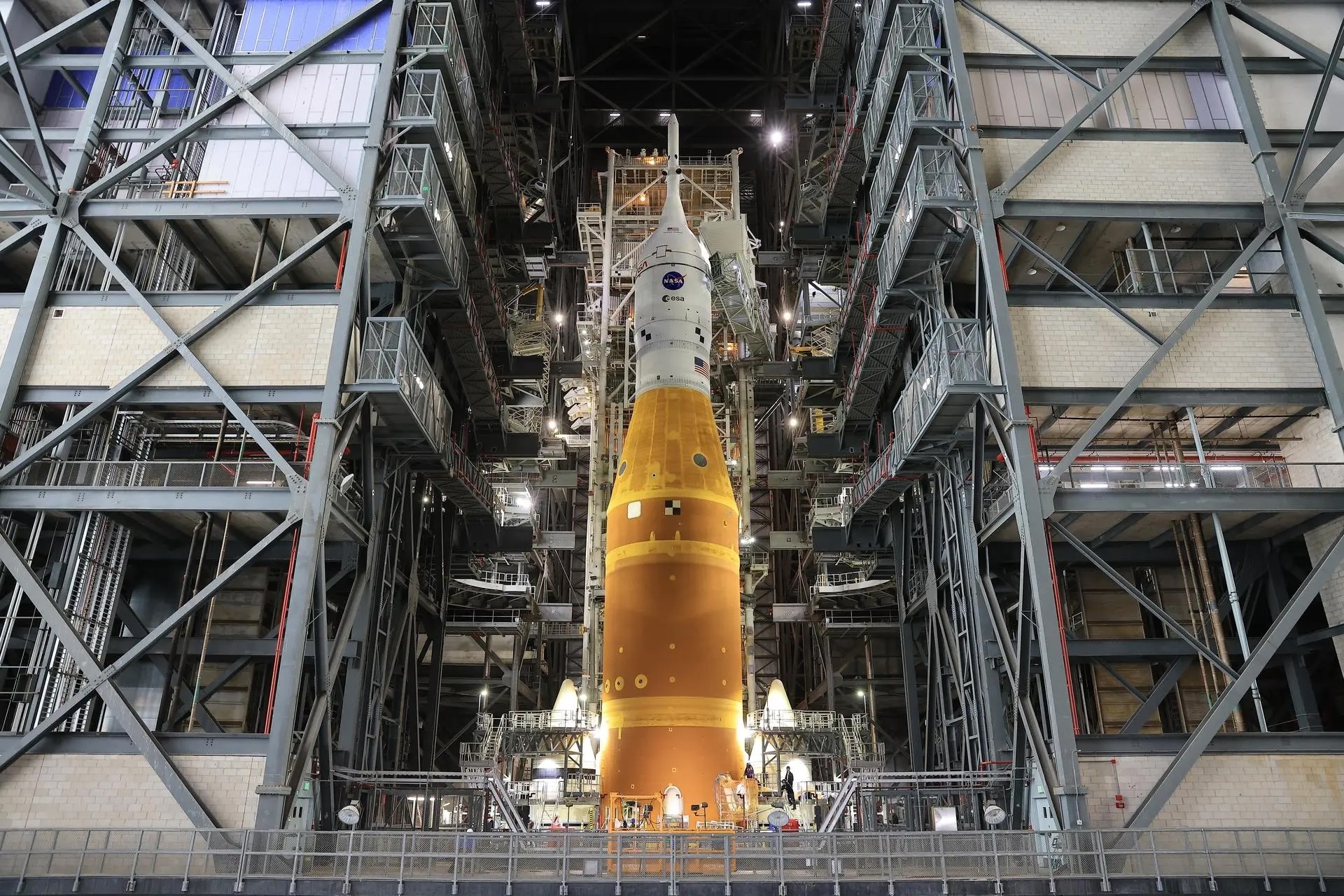
NASA’s Artemis II rocket and its four-person crew are all making progress toward a launch pad meet up in April.
Engineers are targeting 8 p.m. EDT on Thursday, March 19, to start rolling the Artemis II SLS (Space Launch System) rocket and Orion spacecraft to Launch Pad 39B at the agency’s Kennedy Space Center in Florida.
NASA’s crawler-transporter 2 will carry the 11-million-pound stack, including the mobile launcher, at about 1 mph along the four-mile route from Kennedy’s Vehicle Assembly Building to the launch pad. The journey, which can take up to 12 hours, will be streamed on NASA’s You Tube channel.
The time of rollout is subject to change if additional time is needed for technical preparations or weather accommodations.
Meanwhile, the Artemis II crew entered quarantine at 5 p.m. CDT Wednesday in Houston, to ensure they stay healthy leading up to launch. NASA astronauts Reid Wiseman, Victor Glover, and Christina Koch, along with CSA (Canadian Space Agency) astronaut Jeremy Hansen, will limit their exposure to others for the next week in Houston, before flying to Kennedy approximately five days before launch, to continue their quarantine from the astronaut crew quarters there.
Both activities are key milestones on the way to a launch as early as Wednesday, April 1. The early April launch window includes opportunities through Monday, April 6.
Quelle: NASA
----
Update: 22.03.2026
.
NASA’s Artemis II Rocket Arrives at Launch Pad 39B
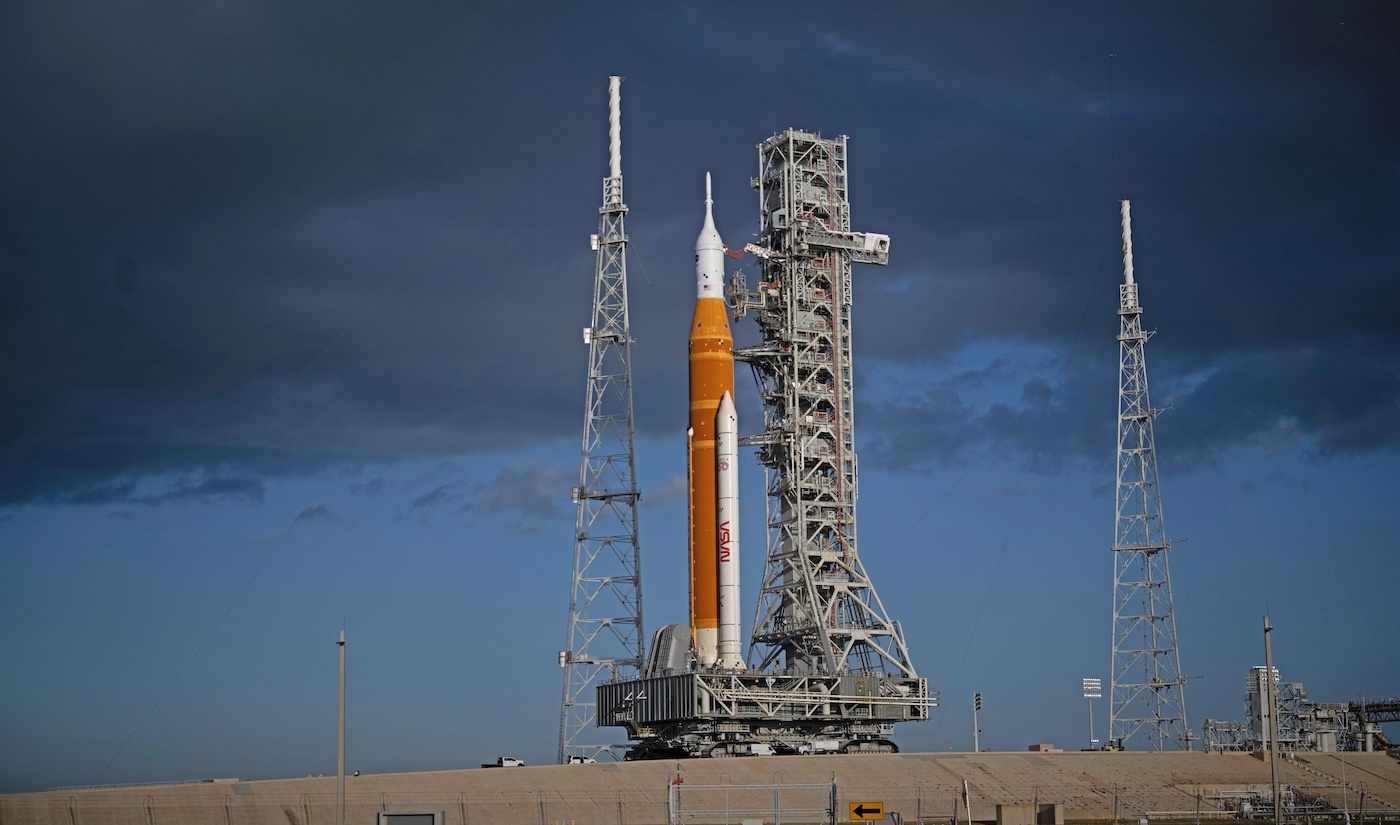
At 11:21 a.m. EDT on Friday, March 20, NASA’s Artemis II SLS (Space Launch System) rocket and Orion spacecraft arrived at Launch Pad 39B after an 11-hour journey from the Vehicle Assembly Building at the agency’s Kennedy Space Center in Florida.
NASA’s crawler-transporter 2 began its 4-mile trek with the integrated SLS and Orion stacked on top of the mobile launcher at 12:20 a.m. EDT. Moving at a maximum speed of just 0.82 mph, the crawler carried the 322-foot-tall Moon rocket and spacecraft slowly and steadily toward the pad.
Now that the rocket is at Pad 39B, NASA teams are gearing up for the final stretch of prelaunch preparations ahead of launch as soon as Wednesday, April 1. The early April launch window includes opportunities through Monday, April 6.
Artemis II Commander Reid Wiseman, Pilot Victor Glover, and Mission Specialist Christina Koch of NASA, along with CSA’s (Canadian Space Agency) Mission Specialist Jeremy Hansen will embark on a 10-day journey around the Moon and back.
As part of a Golden Age of innovation and exploration, Artemis II is another step toward new U.S.-crewed missions to the Moon’s surface, leading to a sustained presence on the Moon that will help the agency prepare to send astronauts to Mars.
Quelle: NASA
----
Update: 27.03.2026
.
NASA Sets Coverage for Artemis II Moon Mission
Editor’s note: NASA will continuously update this Artemis II briefings and mission events page throughout prelaunch, launch, and mission activities.
NASA will provide live coverage of prelaunch, launch, and mission events for the agency’s upcoming Artemis II crewed test flight around the Moon. Launch is targeted for no earlier than 6:24 p.m. EDT Wednesday, April 1, with a two-hour launch window. Additional opportunities for launch run through Monday, April 6.
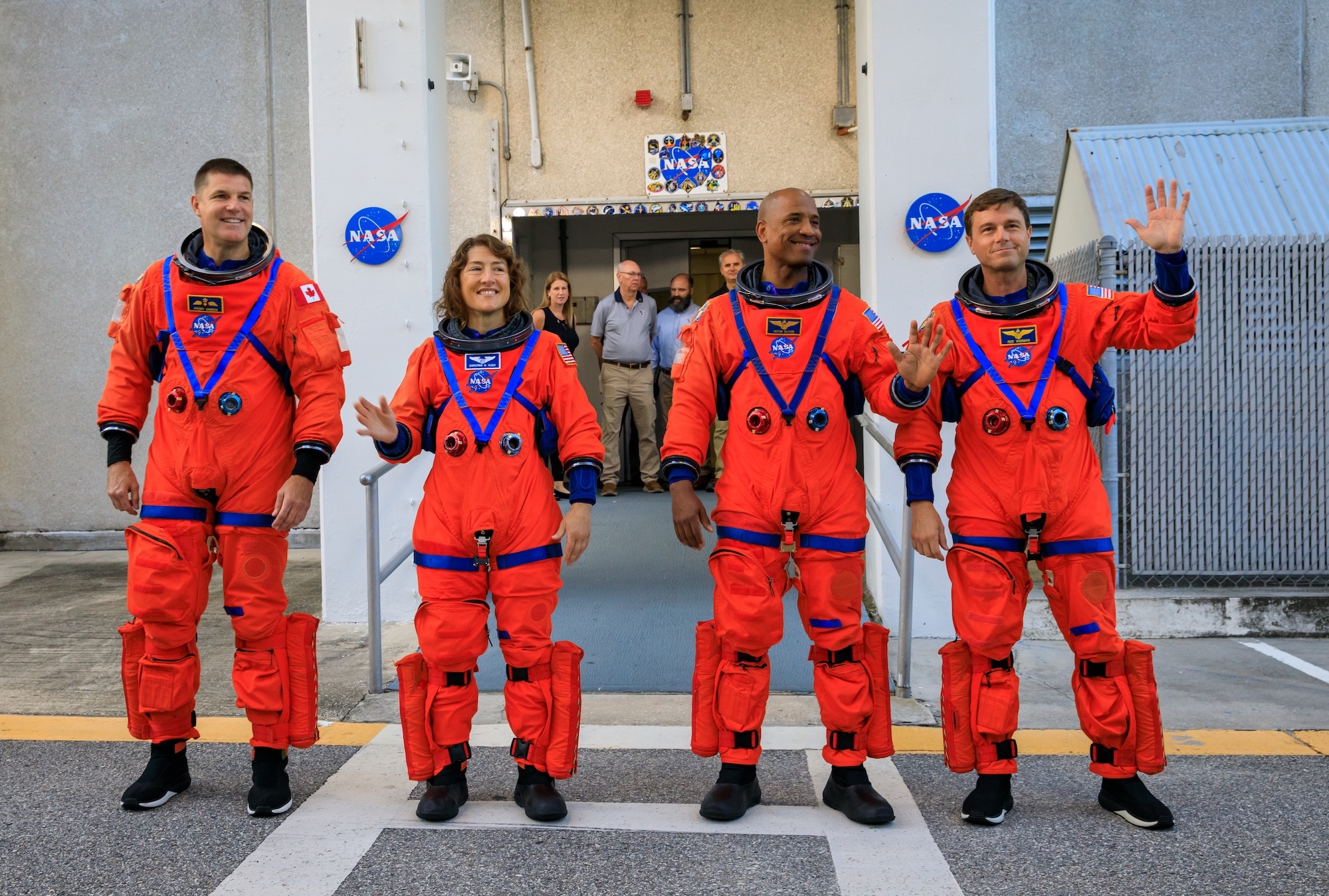
Artemis II is NASA’s first crewed mission under the Artemis program and will launch from the agency’s Kennedy Space Center in Florida. It will send NASA astronauts Reid Wiseman, Victor Glover, Christina Koch, and CSA (Canadian Space Agency) astronaut Jeremy Hansen on an approximately 10-day journey around the Moon. Launching on NASA’s SLS (Space Launch System) rocket, the agency will test the Orion spacecraft’s life support systems for the first time with humans aboard, helping lay the groundwork for future crewed Artemis missions.
Briefings, events, and 24/7 mission coverage will be on the agency’s YouTube channel, and events will each have their own stream closer to their start time.
Watch agency launch, lunar flyby, and splashdown coverage on NASA+ and Amazon Prime. Learn how to watch NASA content through a variety of online platforms, including social media.
For information on obtaining feeds, email the NASA+ programming at team at: nasa-dl-nasaplus-programming@mail.nasa.gov.
The deadline for media accreditation for in-person coverage of launch and mission events has passed. The agency’s media credentialing policy is available online. For questions about media accreditation at NASA Kennedy, please email: ksc-media-accreditat@mail.nasa.gov. For questions about media accreditation at the agency’s Johnson Space Center in Houston, please email: jsccommu@mail.nasa.gov.
A limited number of seats inside the Kennedy auditorium will be available during prelaunch briefings to previously credentialed journalists on a first-come, first-served basis. To participate by telephone, media must RSVP no later than two hours before the start of each briefing to: ksc-newsroom@mail.nasa.gov.
Beginning Thursday, April 2, briefings will occur from NASA Johnson. To participate by telephone in these briefings, media must RSVP no later than two hours before the start of each briefing to the Johnson newsroom at: jsccommu@mail.nasa.gov.
The time of events is subject to change. All events are listed in Eastern Time.
Friday, March 27
2:30 p.m.: The Artemis II crew will arrive at Kennedy and answer questions from credentialed media in attendance. Agency leadership, including NASA Administrator Jared Isaacman, also will attend, along with CSA (Canadian Space Agency) President Lisa Campbell.
Available for questions are:
- Reid Wiseman, commander, NASA astronaut
- Victor Glover, pilot, NASA astronaut,
- Christina Koch, mission specialist, NASA astronaut
- Jeremy Hansen, mission specialist, CSA astronaut
Sunday, March 29
9:30 a.m.: The Artemis II crew members will virtually answer reporters’ questions from their quarantine facility.
2 p.m.: NASA will hold a status update on preparations for launch with the following participants:
- Lori Glaze, acting associate administrator, Exploration Systems Development Mission Directorate
- Shawn Quinn, program manager, Exploration Ground Systems
- Howard Hu, manager, Orion Program
- Chris Cianciola, deputy manager, SLS Program
Monday, March 30
5 p.m.: Following a key mission meeting, NASA will host a news conference to provide a status update on preparations for launch. NASA participants include:
- Associate Administrator Amit Kshatriya
- John Honeycutt, chair, Mission Management Team
- Charlie Blackwell-Thompson, launch director
- Emily Nelson, chief flight director
Tuesday, March 31
1 p.m.: NASA will hold a prelaunch news conference on countdown status with the following participants:
- Launch team representative
- Mark Burger, launch weather officer, 45th Weather Squadron Cape Canaveral Space Force Station
Wednesday, April 1
7:45 a.m.: Coverage of tanking operations to load propellant into the SLS rocket begins, including views of the rocket and audio from a commentator.
12:50 p.m.: NASA+ coverage of launch begins. Coverage continues on YouTube after Orion’s solar array wings deploy in space.
Approximately two-and-a-half hours after launch, NASA will hold a post-launch news conference after the SLS rocket’s upper stage performs a burn to send Orion and its crew to high Earth orbit. The start time is subject to change, based on the exact liftoff time. This postlaunch news conference will include the following participants:
- Administrator Jared Isaacman
- Associate Administrator Amit Kshatriya
- Lori Glaze, acting associate administrator, Exploration Systems Development Mission Directorate
- John Honeycutt, chair, Mission Management Team
- Norm Knight, director, Flight Operations Directorate
Mission Coverage
NASA’s real-time coverage will continue throughout the mission on YouTube. The agency also will provide a separate live stream of views from the Orion spacecraft, as bandwidth allows.
The agency will provide daily mission status briefings from NASA Johnson beginning April 2, except for April 6, due to lunar flyby activities. Times are subject to change based on the exact time of launch and mission operations.
The crew will participate in live conversations throughout the mission, known as downlinks. NASA will provide the exact times of each of these downlink events in the Artemis blog and on this page.
Times below are subject to change based on the exact time of launch and mission operations.
Thursday, April 2
8:30 p.m.: Mission status media briefing after the translunar injection burn to send the crew in Orion toward the Moon.
10:24 p.m.: Live downlink event
Friday, April 3
3:30 p.m.: Mission status briefing
8:44 p.m.: Live downlink event
Saturday, April 4
12:59 a.m.: Live CSA downlink event
4:34 p.m.: Live downlink event
5:15 p.m.: Mission status briefing
Sunday, April 5
12:14 a.m.: Live CSA downlink event
3:30 p.m.: Mission status briefing
Monday, April 6
12:45 p.m.: NASA+ coverage of lunar flyby begins.
1:45 p.m.: For a launch on April 1, the crew is expected to surpass the record for human’s farthest distance from Earth previously set by Apollo 13, at 248,655 miles from Earth.
Additionally, for a launch that day, video during the lunar flyby may be limited while the spacecraft flies through an eclipse. The crew also is expected to temporarily experience a loss of communications with Earth as the Orion flies behind the Moon’s far side.
10:39 p.m.: Live downlink event
Tuesday, April 7
2:29 p.m.: The Artemis II crew will speak with the astronauts aboard the International Space Station in an audio-only conversation.
4 p.m.: Mission status briefing
Wednesday, April 8
3:30 p.m.: Mission status briefing
7:09 p.m.: Live CSA downlink event
Thursday, April 9
3:30 p.m.: Mission status briefing
5:59 p.m.: Crew news conference
7:54 p.m.: Live downlink event
Friday, April 10
6:30 p.m.: NASA+ coverage of the crew’s return to Earth begins
8:06 p.m.: Splashdown in the Pacific Ocean. NASA and U.S. Department of War personnel are expected to assist the crew out of Orion and fly them to a waiting recovery ship.
10:35 p.m.: Post-splashdown news conference at NASA Johnson
Details on the astronauts’ return to Houston will be shared later.
NASA website launch, mission coverage
NASA will provide updates during the launch countdown and throughout mission on the Artemis blog.
Throughout the mission, the latest imagery will be available at: Artemis II Multimedia
To track Orion in space, visit: nasa.gov/trackartemis
Quelle: NASA
----
Update: 28.03.2026
.
NASA Releases Artemis II Moon Mission Launch Countdown
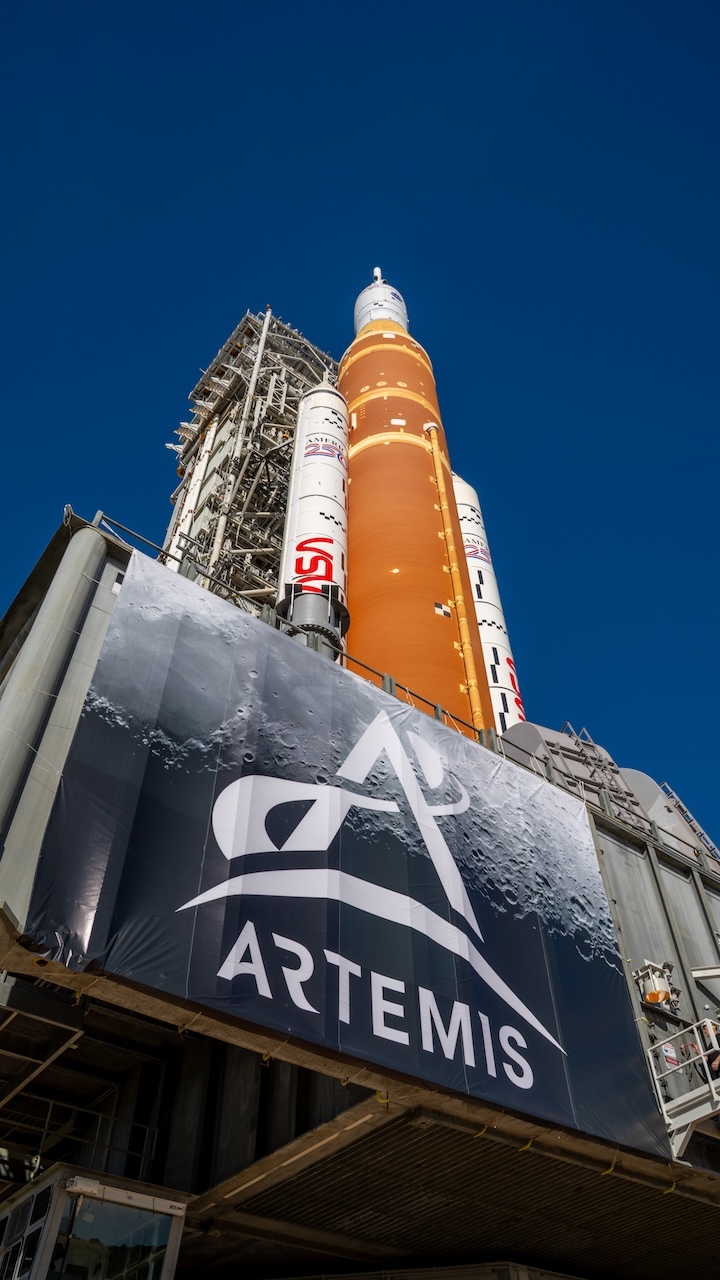
Before NASA sends its astronauts Reid Wiseman, Victor Glover, Christina Koch, and CSA (Canadian Space Agency) astronaut Jeremy Hansen on their Artemis II mission around the Moon, the launch team at NASA’s Kennedy Space Center in Florida and teams across the country will begin counting down about two days before liftoff.
A launch countdown contains “L Minus” and “T Minus” times. The “L minus” indicates how far away liftoff is in hours and minutes. The “T minus” time is a sequence of events built into the launch countdown. Pauses in the countdown, or “holds,” are built in to allow the launch team to target a precise launch window, and to provide a cushion of time for certain tasks and procedures without impacting the overall schedule. During planned holds in the countdown process, the countdown clock is intentionally stopped and the T- time also stops. The L- time, however, continues to advance.
Below are some of the key events that take place at each milestone after the countdown begins.
All times are approximate for when these milestones occur.
L-49 hours 50 minutes and counting
- L-49H50M – Launch team arrives to stations
- L-49H40M – Countdown clock begins
- L-49H40M – L-42H30M: Liquid oxygen (LOX)/Liquid hydrogen (LH2) system
preparations for vehicle loading - L-45H30M – L-44H: Orion spacecraft powered up
- L-42H20M – L-41H: Core stage powered up
- L-42H10M – L-40H30M: Interim cryogenic propulsion stage (ICPS) powered up
- L-39H45M – L-35H30M: Final preparations of the four RS-25 engines
L-35 hours and counting
- L-34H45M – L-34H10M: ICPS is powered down
- L-33H30M – L-29H30M: Charge Orion flight batteries to 100%
- L-31H30M – L-24H30M: Charge core stage flight batteries
- L-20H15M – L-18H45M: ICPS is powered up for launch
L-16 hours and counting
- L-15H30M – L-14H: All non-essential personnel leave Launch Complex 39B
- L-14H15M – L-12H05M: Air-to-gaseous nitrogen (GN2) changeover and rocket
cavity inerting - L-13H15M – L-11H45M: Ground launch sequencer (GLS) activation
L-13 hours and counting
- L-12H35M – L-9H50M: 2-hour 45-minute built in countdown hold begins
- L-10H50M – Launch team decides “go” or “no-go” to begin tanking
- L-10H50M – L-9H35M: Orion cold soak
- L-10H40M – L-10H35M: Core stage LOX transfer line chilldown
- L-10H40M – L-9H55M: Core stage LH2 chilldown
- L-10H25M – L-9H40M: Core stage LOX main propulsion system chilldown
L-10 hours and counting
- L-9H55M – L-9H25M: Core stage LH2 slow fill start
- L-9H50M – Resume T-Clock from T-8H10M
- L-9H40M – L-9H30M: Core stage LOX slow fill
- L-9H30M – L-6H40M: Core stage LOX fast fill
- L-9H25M – L-8H: Core stage LH2 fast fill
- L-9H05M – L-8H30M: ICPS LH2 chilldown
- L-8H30M – L-7H45M: ICPS LH2 fast fill start
- L-8H – L-7H55M: Core stage LH2 topping
- L-7H55M – terminal count: Core stage LH2 replenish
- L-7H45M – L-7H20M: ICPS LH2 vent and relief test
- L-7H20M – L-7H10M: ICPS LH2 tank topping start
- L-7H05M – terminal count: ICPS LH2 replenish
- L-6H40M – L-6H10M: Orion communications system activated (radio frequency to mission control)
- L-6H40M – L-6H05M: Core stage LOX topping
- L-6H40M – L-6H30M: ICPS LOX main propulsion system chilldown
- L-6H30M – L-5H45M: ICPS LOX fast fill
- L-6H10M – Stage pad rescue
- L-6H10M: – Closeout crew assemble
- L-6H05M – terminal count: Core stage LOX replenish
L-6 hours and counting
- L-6H – Flight crew weather brief
- L-5H45M – L-5H30M: ICPS LOX vent and relief test
- L-5H30M – L-5H10M: ICPS LOX topping
- L-5H10M – terminal count: ICPS LOX replenish
- L-5H10M – All stages replenish
- L-5H10M – Start 1-hour 10-minute built in hold
- L-5H10M – L-4H55M: Closeout crew to white room
- L-4H40M – L-4H10M: Flight crew deployment to pad
- L-4H: Flight crew board Orion
- L-3H40M – L-3H10M: Crew module hatch preps and closure
- L-3H10M – L-2H45M: Counterbalance mechanism hatch sealpress decay
checks - L-2H20M – L-1H40M: Crew module hatch service panel install/closeouts
- L-1H40M – L1H30M: Launch abort system (LAS) hatch closure for flight
- L-1H10M – Launch director brief – rocket & thermal protection system scan results with the imagery console
- L-50M – L-40M: Closeout crew departs Launch Complex 39B
- L-50M – Final NASA test director briefing is held
L-40 minutes and holding
- L-40M – Built in 30-minute countdown hold begins
L-25 minutes and holding
- L-25M – Transition team to Orion to Earth communication loop following final NTD briefing
- L-17M – Launch director polls team to ensure they are “go” for launch
- L-15M – Flight crew visors down
- L-14M – Flight crew short purge verification
T-10 minutes and counting
- T-10M – GLS initiates terminal count
- T-8M – Crew Access Arm retract
- T-6M – GLS go for core stage tank pressurization
- T-6M – Orion ascent pyros are armed
- T-6M – Orion set to internal power
- T-5M57S – Core stage LH2 terminate replenish
- T-5M20S – LAS capability is available
- T-5M20S – NTD lets commander knows LAS capability is available
- T-4M40S – GLS go for LH2 high flow bleed check
- T-4M30S – Flight termination system armed
- T-4M – GLS is go for core stage auxiliary power unit (APU) start
- T-4M – Core Stage APU starts
- T-4M – Core stage LOX terminate replenish
- T-3M30S – ICPS LOX terminate replenish
- T-3M10S – GLS go for purge sequence 4
- T-2M02S – ICPS switches to internal battery power
- T-2M – Booster switches to internal batter power
- T-1M30S – Core stage switches to internal power
- T-1M20S – ICPS enters terminal countdown mode
- T-50S – ICPS LH2 terminate replenish
- T-33S – GLS sends “go for automated launch sequencer” command
- T-30S – Core stage flight computer to automated launching sequencer
- T-12S – Hydrogen burn off igniters initiated
- T-10S – GLS sends the command for core stage engine start
- T-6.36S– RS-25 engines startup
T-0
- Booster ignition, umbilical separation, and liftoff
Inside the terminal countdown, teams have a few options to hold the count if needed.
- The launch team can hold at 6 minutes for the duration of the launch window, less the 6 minutes needed to launch, without having to recycle back to 10 minutes.
- If teams need to stop the clock between T-6 minutes and T-1 minute, 30 seconds, they can hold for up to 3 minutes and resume the clock to launch. If they require more than 3 minutes of hold time, the countdown would recycle back to T-10.
- If the clock stops after T-1 minute and 30 seconds, but before the automated launch sequencer takes over, then teams can recycle back to T-10 to try again, provided there is adequate launch window remaining.
- After handover to the automated launch sequencer, any issue that would stop the countdown would lead to concluding the launch attempt for that day.
Launching the Artemis II Moon rocket will lift off the agency’s first crewed mission under the Artemis program, testing the systems that will return astronauts to the Moon for an enduring presence, and paving the way to human exploration of Mars.
Quelle: NASA
----
Update: 31.03.2026
.
'More than ready': NASA Artemis II astronauts revved up for rocket launch
NASA's Artemis II Commander Reid Wiseman said he finds it surreal to drive across Kennedy Space Center to historic pad 39B — where Apollo and space shuttle missions launched decades ago — and look up at his massive 322-foot Space Launch System moon rocket awaiting liftoff.
On Sunday, March 29, NASA officials reported they are not working any issues ahead of the high-profile Artemis II launch scheduled for 6:24 p.m. Wednesday, April 1. Wiseman and his three crewmates will embark on a 10-day deep-space journey inside an Orion spacecraft, looping around the dark side of the moon and back.
"When you see this vehicle on the pad, you know. You look at the size of this vehicle, you know it’s going one place. It is going to space — and it is going to go there in a hurry," Wiseman said Sunday during a virtual press conference from crew quarters inside KSC's Neil A. Armstrong Operations and Checkout Building.
"When those engines light, this thing is moving out," Wiseman said.

The astronauts of the Artemis II mission arrive at Kennedy Space Center on March 27 ahead of their mission around the moon.
Wiseman and his crewmates — fellow NASA astronauts Victor Glover (pilot) and Christina Koch (mission specialist) and the Canadian Space Agency's Jeremy Hansen (mission specialist) — flew Friday, March 27, from Johnson Space Center in Houston to KSC to settle in ahead of liftoff.
“We held our flight readiness review a couple weeks ago. And since that time, all of our operations have been going very smoothly. It’s been going very well," Lori Glaze, NASA Exploration Systems acting associate administrator, said during a Sunday news conference.
"Our flight systems are ready. The ground systems are ready. Our launch and operations teams are ready. And our flight operations team in Houston (is) also ready," Glaze said.
"The crew arrived yesterday. And I know that they are ready — they are more than ready. They can’t wait to get off the ground," she said.
Glaze said the Artemis II crew members will spend the next few days going over final procedural reviews and spending time with their families while they remain in quarantine.
Of further note Sunday, the Space Force's 45th Weather Squadron issued an Artemis II forecast that pegged the odds of "go for launch" weather Wednesday at 80%. NASA's launch window will last two hours.
Cumulus clouds, thick cloud layers and ground winds were listed as weather threats. The squadron predicted a launch-time temperature of 75 degrees with scattered clouds, ground winds of 15 to 20 knots, and visibility of seven-plus miles.
Asked for their thoughts about getting to see the moon up close, Hansen said the Artemis II crew is cognizant of how humanity's different cultures view and revere Earth's satellite: “We all share the same moon in the sky.”
Koch followed suit: "It is our strong hope that this mission is the start of an era where everyone, every person on Earth, can look at the moon and think of it as also a destination."
Quelle: Florida Today