
15.02.2026
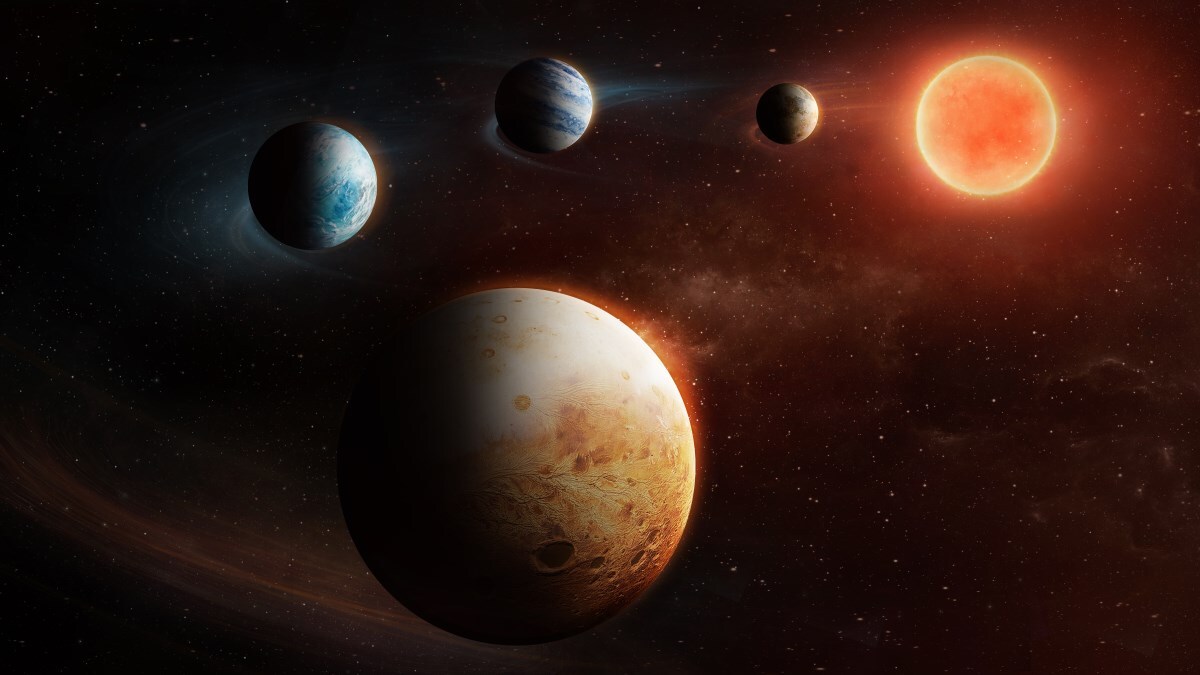
Illustration of LHS 1903, a small red M-dwarf star, and its planets (not to scale). Credit: ESA (CC BY-SA 3.0 IGO)
Astronomers have discovered a planetary system with a distant rocky world that breaks the pattern seen in our solar system and consistently observed elsewhere in the Milky Way.
The solar system’s inner planets – Mercury, Venus, Earth and Mars – are small and rocky (iron- and silicate-rich). The outer planets – Jupiter, Saturn, Uranus and Neptune – are larger and composed of water and gas.
But data collected by the European Space Agency’s CHaracterising ExOPlanet Satellite (CHEOPS) reveals 4 planets orbiting LHS 1903 – a cool faint red dwarf star in the Milky Way – that break this convention.
A rocky planet orbits closest, followed by 2 gas worlds. But the fourth, outermost planet was a surprise – rocky, not gaseous.
“This strange disorder makes it a unique inside-out system” says Thomas Wilso from the UK’s University of Warwick, first author of a study presenting the findings in the journal Science.
“Rocky planets don’t usually form far away from their home star, on the outside of the gaseous worlds.”
Traditional models of planet formation suggest that planets closest to stars are rocky because stellar radiation carries away their gaseous atmospheres but leaves behind their dense, solid cores. Gas giants form farther out in cooler regions where gas can accumulate and remain.
“By the time this final outer planet formed, the system may have already run out of gas, which is considered vital for planet formation,” Wilson suggests.
“Yet here is a small, rocky world, defying expectations. It seems that we have found first evidence for a planet that formed in a gas-depleted environment.”
“Historically, our planet formation theories are based on what we see and know about our Solar System,” adds Isabel Rebollido, a research fellow at ESA who was not involved in the study.
“As we are seeing more and more different exoplanet systems, we are starting to revisit these theories.”
Quelle: CONNECTSCI