
10.02.2026
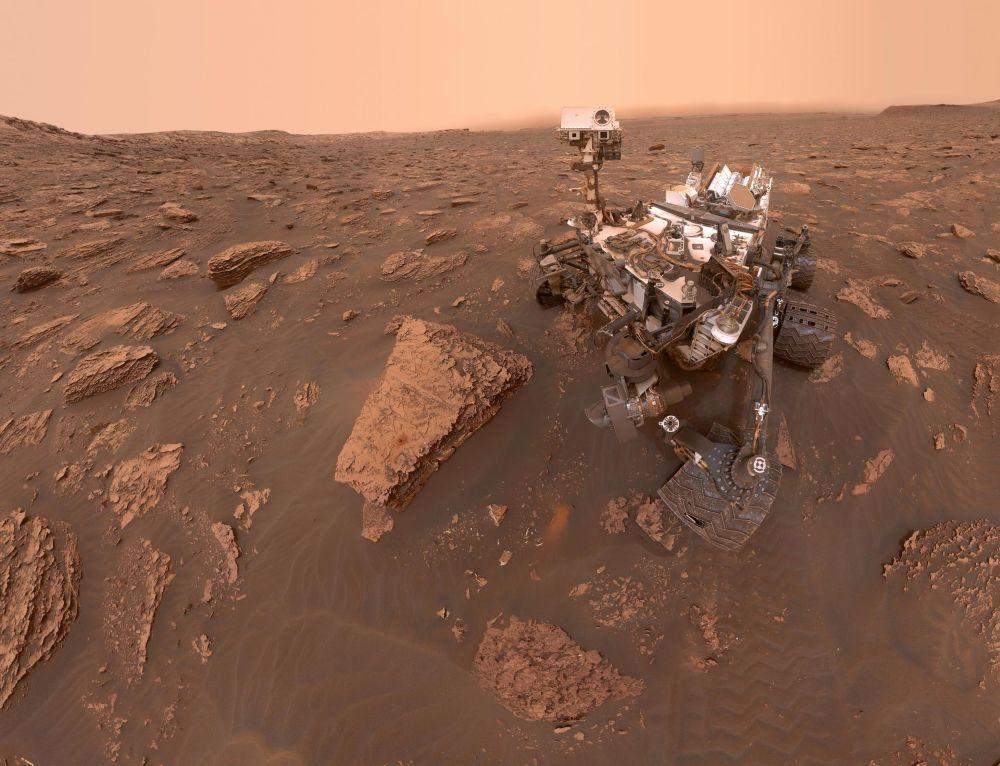
HOUSTON—A new research analysis of a sample of Mars gathered by NASA’s Curiosity rover and initially studied by onboard instrumentation has determined that non-biological sources once considered cannot fully account for the abundance of organic compounds detected, a Feb. 6 NASA Jet Propulsion Laboratory (JPL) mission update says.
Still functional, Curiosity touched down in Gale Crater on Mars in August 2012 to search for evidence of microbial life.
The sample gathered by the rover from the Cumberland rock formation in the crater’s Yellowknife Bay in May 2013 was studied using Curiosity’s onboard mini-lab, which detected the carbon-rich compounds decane, undecane, and dodecane. These are thought to be fragments of fatty acids that, on Earth, are among the organic molecules considered chemical building blocks of life. However, geological processes can also produce them.
A March 2025 study reported that it was not possible to determine from Curiosity’s data alone whether the compounds originated from life forms. This led to another round of research to determine if potential non-biological sources were responsible for the Mars organic molecules. Meteorite impacts emerged as a potential source.
The follow-on study, reported in the journal Astrobiology on Feb. 4, concludes that known non-biological sources do not sufficiently explain the abundance of the Cumberland sample’s organic compounds, meaning they could have been generated by life forms.
The conclusions from the latest research were based on laboratory radiation experiments, mathematical modeling, and Curiosity data. These methods were used to evaluate changes undergone by Cumberland’s presence on the Martian surface for about 80 million years. The effort estimated how much organic material could have been present before being destroyed by long-term exposure to cosmic radiation, which exceeds what typical non-biological processes could generate, the JPL update said.
“The team says more study is needed to better understand how quickly organic molecules break down in Mars-like rock under Mars-like conditions before any conclusions can be reached about the absence or presence of life,” the update concludes.
Curiosity’s NASA Mars rover companion, Perseverance, has been exploring Jezero Crater on Mars, a dry lakebed that was once home to a stream delta, since February 2021. Its onboard and surface-cached rock and soil samples await a costly and technically challenging return to Earth to be analyzed for evidence of possible biological activity.
Quelle: AVIATION WEEK