
6.02.2026
A distant Kreutz comet heading our way may grow a glorious tail in April.
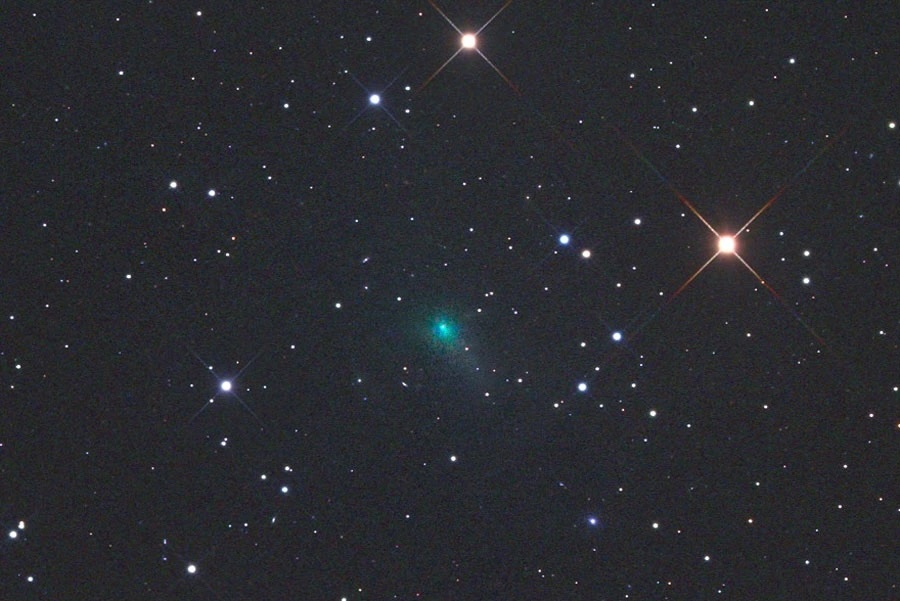
Glowing a striking turquoise from diatomic carbon (C2) emission, Kreutz comet C/2026 A1 (MAPS) was only at magnitude 17 when this photo was taken on Jan. 17th. The comet will remain relatively dim except for a few days centered on its April 4th perihelion, when it may reach negative magnitudes for several hours.
Gerald Rhemann and Michael Jaeger
Want to see a comet watcher's eyes light up? Tell them that a new Kreutz comet has been discovered. Some of the most magnificent "broom stars" in history were members of the Kreutz gang. Examples include the Great Comets of 1843 and 1882, and more recently, Ikeya-Seki (C/1965 S1) and Lovejoy (C/2011 W3). All became stunning objects with spectacular tails around the time of their perihelion passages. The newest discovery, C/2026 A1 (MAPS), is generating lots of excitement.
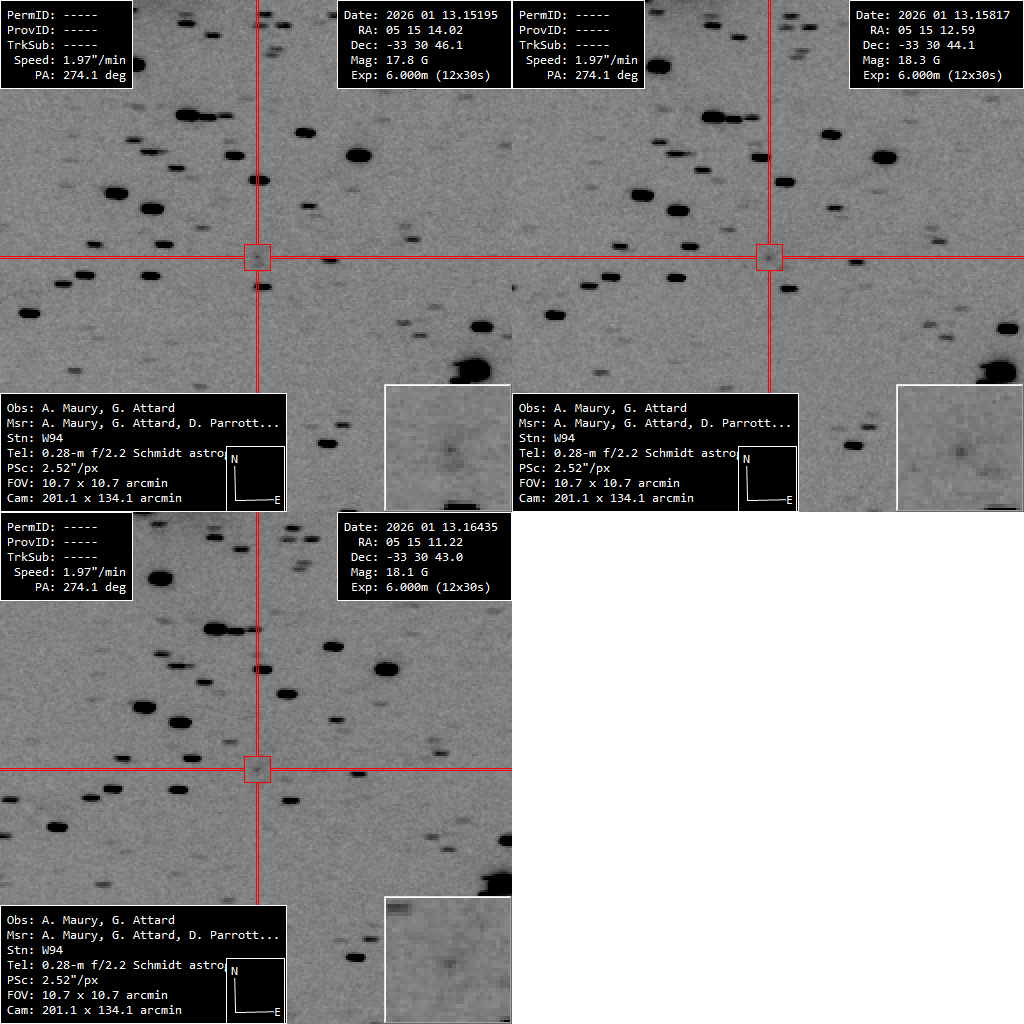
Copyright MAPS 2026
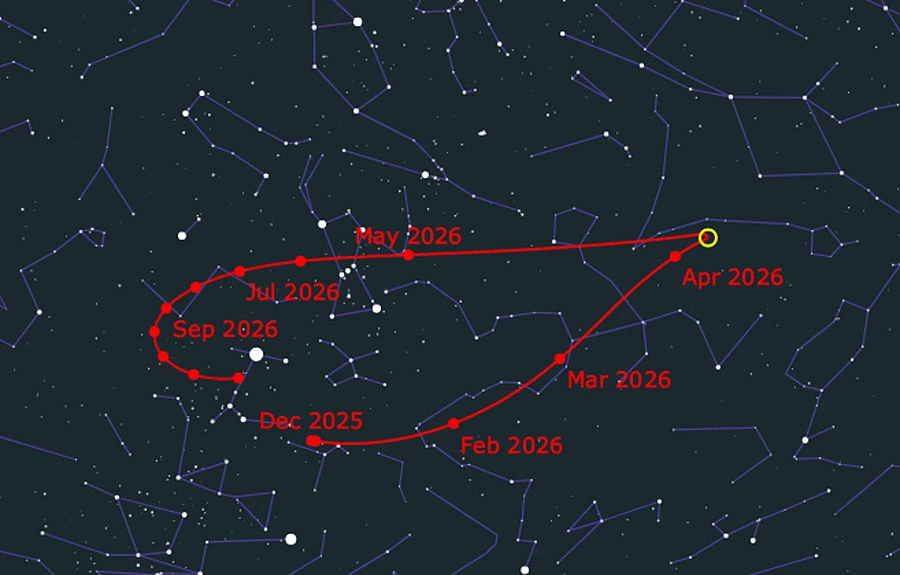
The newcomer was discovered photographically on January 13th at a Chilean observatory by four French astronomers. The group runs a dedicated near-Earth asteroid search program called MAPS, an acronym based on their last names — Alain Maury, Georges Attard, Daniel Parrott, and Florian Signoret. C/2026 A1 was an 18th-magnitude blip in the constellation Columba at the time. It currently hovers around 17th magnitude at the Eridanus-Fornax border and remains well beyond visual range for most amateurs.
Based on a recent ephemeris, the shy comet won't become visible in 8- to 10-inch telescopes until mid-March, when it brightens to around 13th magnitude. It will lie in central Cetus at that time and hover low in the southwestern sky during late evening twilight. Viewers in the Southern Hemisphere will see it climb higher in a darker sky both then and throughout the comet's apparition.
Its April 4th perihelion will be a squeaker, with MAPS soaring just 748,000 km (465,000 miles) above the Sun's searing surface — within range of the highest-recorded solar prominences! Officially, it's a sungrazer, a comet that gets within 1.4 million km of the Sun at its nearest approach. Such close shaves often lead to the comet fragmenting due to a combination of extreme heating and strong gravitational tides. However, if the comet survives its joust with the Sun, it may become a bright, naked-eye object.
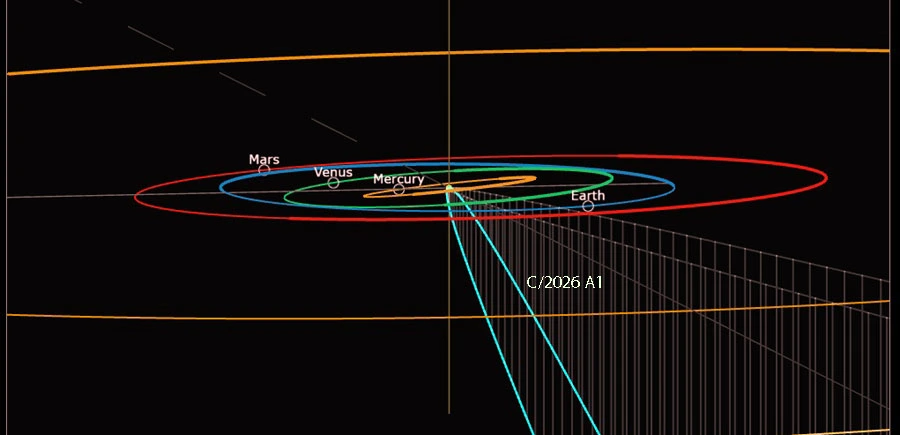
Copyright MAPS 2026
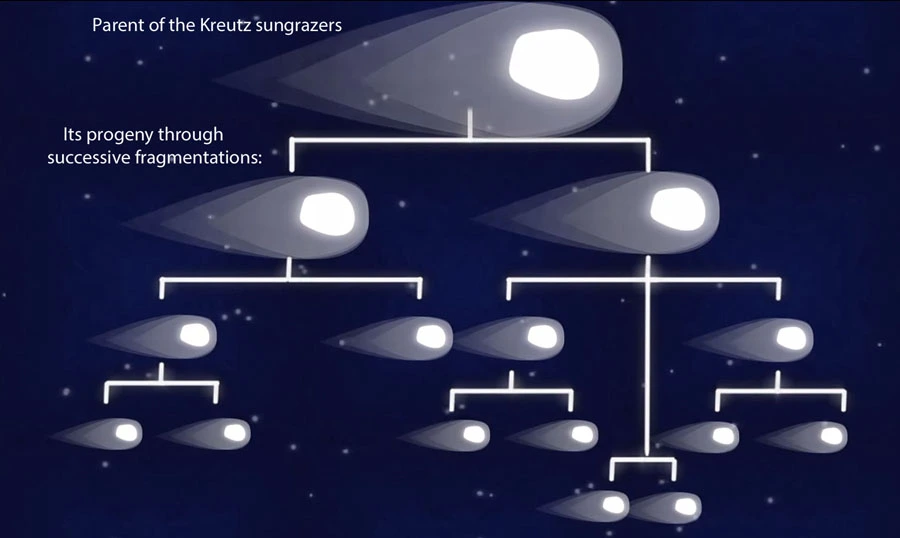
C/2026 A1 is a member of the Kreutz family of comets, which are thought to be the offsprings of a massive parent comet that was disrupted by its close approach to the Sun thousands of years ago. They're characterized by highly eccentric orbits and extremely close perihelia. The Great Comet of 371 BC, observed by Aristotle and said to have been bright enough to cast shadows, is the suspected progenitor.
NASA
Well over 4,500 Kreutz comets have been discovered by the joint NASA-ESA Solar and Heliophysics Observatory (SOHO). Most are tiny — just a few feet across — and disintegrate in the solar sizzle like the beeswax-and-bird-feather wings of the mythical Icarus. The MAPS comet won't be dismissed so easily. With a diameter possibly as large as 2.4 kilometers, it has the potential to "keep it together" and grow bright. It was discovered at more than 2 astronomical units (299 million km) from the Sun, making it the farthest Kreutz sungrazer ever found.
George Frederick Chambers
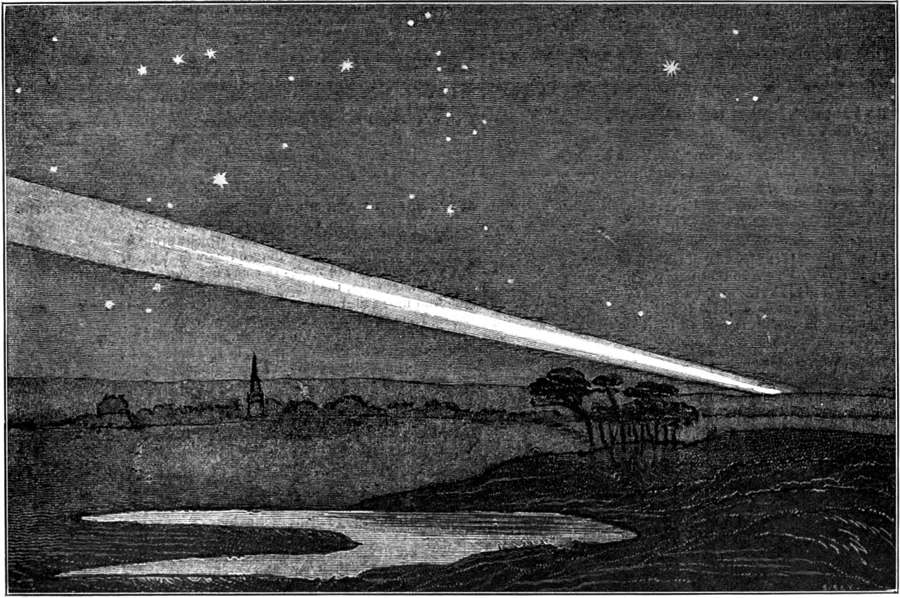
MAPS is related to both the Great Comet of 1843 and Comet Pereya (C/1963 R1), both of which became naked-eye objects around perihelion. The 1843 sungrazer briefly reached magnitude –6 to –8 around perihelion and was visible in daylight not far from the Sun. Comet Pereya achieved a more modest magnitude 2. Both were fragments of the Great Comet of 1106, itself a descendent of Aristotle's 371 BC sungrazer. Like a family that's been in business forever, Comet MAPS is the latest, freshest face pushing the product line.
VIEWING PROSPECTS FOR THE NORTHERN HEMISPHERE
In a word, viewing prospects are poor leading up to perihelion, especially for northern observers. The comet's elongation is small and declination low, while at the same time earlier sunsets chip away at the dark sky. Moreover, the comet only begins to get bright enough for 8- to 10-inch telescopes in late March, just days before perihelion. Even then, it wallows in late evening twilight, at best just a few degrees above the southwestern horizon at nightfall.
Gideon van Buitenen
While it could potentially reach magnitude –4 or brighter at perihelion, it will lie only arcminutesfrom the Sun and perilous to observe from both hemispheres, except with the best solar filtration methods and utmost precaution. Perhaps a short, bright tail will be visible by blocking the Sun with a roof line or power pole. MAPS is expected only to remain brilliant for a day centered on perihelion and then fade rapidly. By the time it's free of the solar glare, it may be as dim as magnitude 13 to 14. Few will see it.
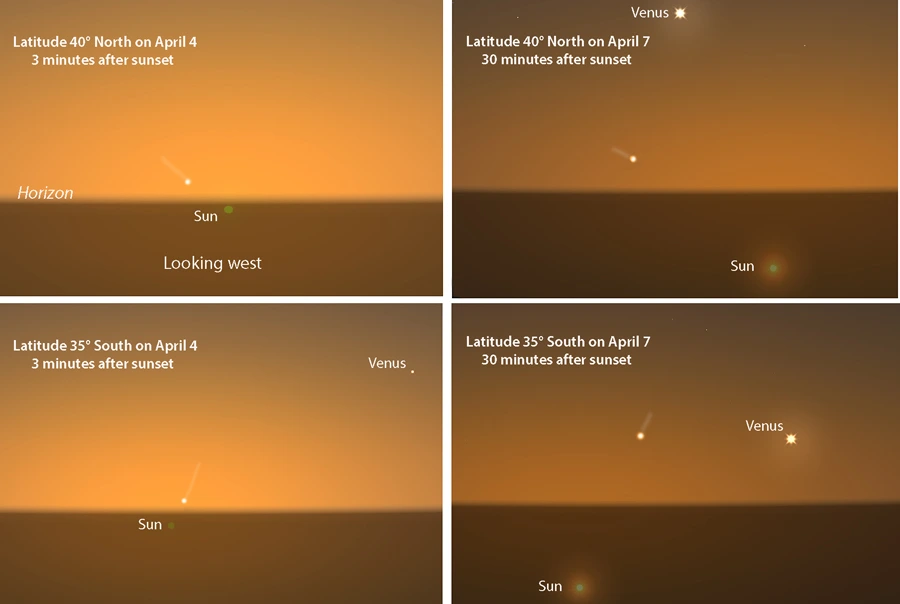
Before you abandon hope, it's very likely the comet will grow a long, striking tail, which Northern Hemisphere observers would see during mid-twilight for several days (or longer) on and after April 4th. Look for a slanting feather extending to the east-southeast low in the darkening western sky.
VIEWING PROSPECTS FOR THE SOUTHERN HEMISPHERE
Stellarium with annotations by Bob King
Although the comet remains faint until close to perihelion, those living at mid-southern latitudes will fare much better than the north because the object's relatively low declination places it more directly above the Sun in the sky. That keeps it observable — albeit with decreasing elevation — even as its elongation shrinks. Comet MAPS should be visible around 13th magnitude in larger amateur telescopes during the third week of March, low in the western sky. After that it's lost in the solar glare.
On the evening of April 4th, it'll only be about 2° from the Sun and sets shortly after it in bright twilight. While the comet's head may have already faded to 4th magnitude by that time, the tail will tip up at a steep angle from the horizon and could be showy. Thereafter, its elongation increases rapidly from 7° on April 5th to 21° by April 10th.
A COMET'S PREROGATIVE
Of course, all of the above predictions are subject to change. If C/2026 A1 breaks up around perihelion, it may become another "headless wonder" like Comet Lovejoy (C/2011 W3). If it survives, we can expect a long tail perhaps similar to Comet Pereyra or even the Great Comet of 1843.
To sum up, Comet MAPS will be faint until shortly before perihelion and then quickly dim right after. If the nucleus crumbles on solar approach, it could turn out to be a flop. Assuming MAPS survives perihelion, it's likely to reach negative magnitudes but may prove challenging to see from the ground, especially for Northern Hemisphere observers. Views from space via the coronagraphs aboard SOHO and other orbiting satellites should be spectacular.
Quelle: Sky&Telescope