
23.01.2026
"The Cosmos Will See You Now" was Rocket Lab's 80th launch to date.
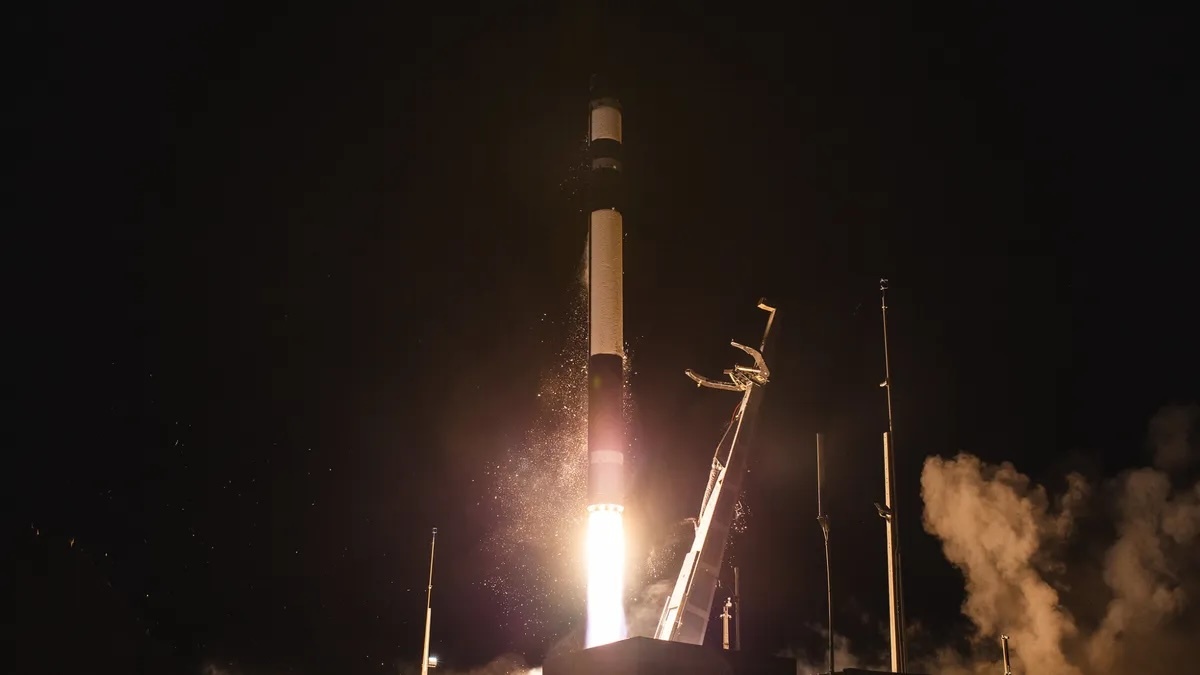
A Rocket Lab Electron rocket launches two satellites for the European company Open Cosmos from New Zealand on Jan. 22, 2026. (Image credit: Rocket Lab)
Rocket Lab just launched its first mission of 2026.
An Electron rocket carrying two satellites for the European company Open Cosmos lifted off from Rocket Lab's New Zealand site today (Jan. 22) at 5:52 a.m. EST (1052 GMT; 11:52 p.m. local time in New Zealand).
Electron's "kick stage" deployed the two spacecraft into a circular orbit 1,050 kilometers (652 miles) above Earth as planned about 70 minutes after liftoff.
Today's launch was Rocket Lab's first dedicated mission for Open Cosmos, a company that designs, builds and operates satellites and also offers data-sharing and data-analysis services.
"Our approach not only dramatically lowers the costs, complexity and timescales of missions, but it also simplifies access to EO [Earth observation] data in a way that removes the barriers for all companies —even non-space customers — to address society’s most urgent challenges," Open Cosmos' website reads.
This morning's mission, which Rocket Lab called "The Cosmos Will See You Now," sent up the first two satellites in Open Cosmos' planned telecom constellation in low Earth orbit.
"This new constellation complements the already-in-orbit satellites that deliver high-resolution imagery and global monitoring capabilities, supporting a wide range of applications and providing valuable metadata for diverse uses," Rocket Lab said in an emailed statement after the launch.
"The Cosmos Will See You Now" was Rocket Lab's 80th overall to date. The vast majority have been conducted by the 59-foot-tall (18-meter-tall) Electron, which gives small satellites dedicated rides to Earth orbit and beyond.
Rocket Lab has also conducted a handful of missions with HASTE, a suborbital version of Electron that allows customers to test hypersonic technologies in the space environment.
Rocket Lab launched 21 missions in 2025, which set a new record for the company. Its previous high, set in 2024, was 16.
Quelle: SC