
22.01.2026
"I don't think anyone's made this connection between the surface fluid pattern and the interior properties of these planets."
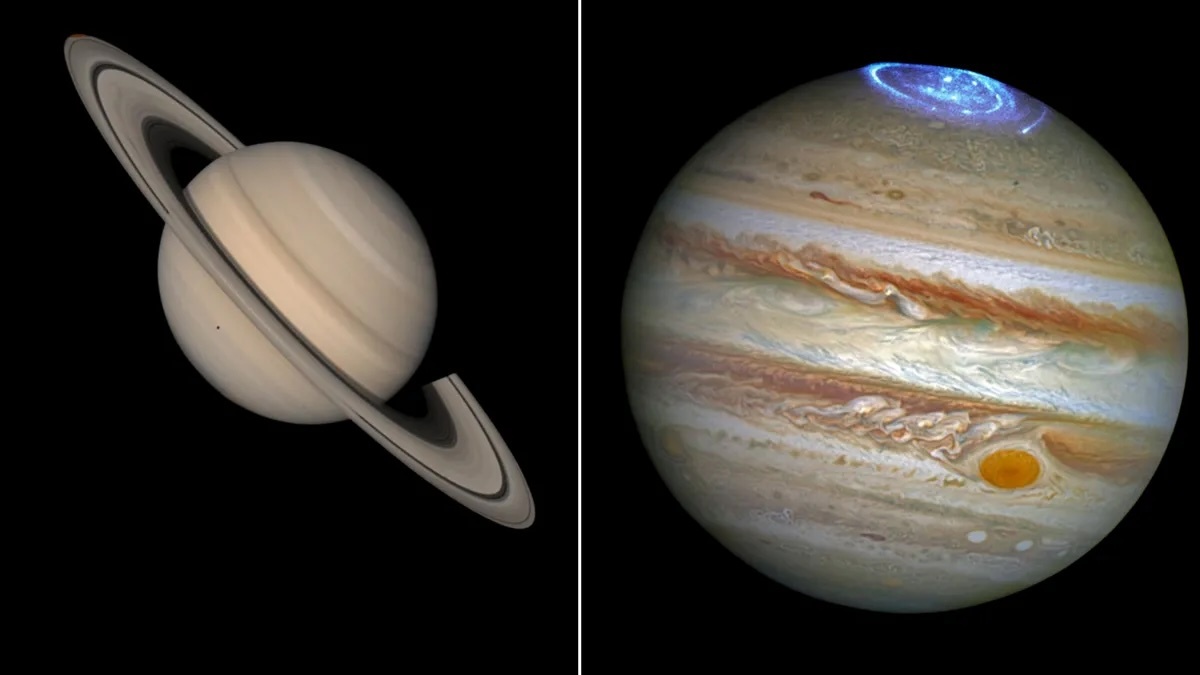
Scientists may finally know why Jupiter and Saturn have very different weather patterns at their poles, despite having similar sizes and compositions. The discovery could help researchers probe deep into the interiors of these giant gaseous planets.
Observations of the two solar system gas giants have revealed that Jupiter's north pole hosts a central polar vortex surrounded by eight smaller vortices, while Saturn has a single, strangely hexagonal, massive atmospheric whirlpool over its north pole.
While performing complex simulations of these types of vortexes of gas giants, the team behind this research found that the difference between a single vortex configuration and a multi-vortex pattern depended on how "hard" the base of the vortex was, meaning how heavy the gas is in this region (the softer the gas, the lighter it is). This "hardness" is in turn related to the interior composition of the gas giant.
"Our study shows that, depending on the interior properties and the softness of the bottom of the vortex, this will influence the kind of fluid pattern you observe at the surface, research team member Wanying Kang, of the Massachusetts Institute of Technology (MIT), said in a statement. "I don't think anyone’s made this connection between the surface fluid pattern and the interior properties of these planets. One possible scenario could be that Saturn has a harder bottom than Jupiter."
Softer than Saturn?
Kang and colleagues were inspired to conduct their simulations after viewing images of Jupiter captured by the Juno spacecraft, which has been orbiting the solar system's largest planet since 2016, and by images of Saturn delivered by Cassini over 13 years of observations before it was deliberately plunged into the ringed planet at the end of its mission in 2017.
The Juno images revealed the immense scale of Jupiter's polar storms, which are around 3,000 miles (4,800 kilometers) wide. For context, that is around half the width of Earth. Cassini's observations of Saturn, meanwhile, showed its single hexagonal vortex is a staggering 18,000 miles (29,000 kilometers) wide.
Astronomers aren't sure why there is such a size discrepancy between the two planets' vortices. "People have spent a lot of time deciphering the differences between Jupiter and Saturn," team leader and MIT scientist Jiaru Shi said. "The planets are about the same size and are both made mostly of hydrogen and helium. It’s unclear why their polar vortices are so different."
Quelle: SC